
New Zealand house prices rise for three consecutive months: is a market recovery now assured? Will residential construction keep shrinking in 2025? Latest data reveals the picture
The latest data and economists’ surveys and analysis paint a complex market outlook. The recovery in house prices is certainly encouraging, but the risks behind the figures warrant closer consideration.

After a period in the doldrums, New Zealand’s housing market appears to be coming back to life. Yet economic uncertainty clouds this recovery. Will the market return to its former heights or maintain cautious growth? The latest data and economists’ surveys and analysis paint a complex market outlook. The recovery in house prices is certainly encouraging, but the risks behind the figures warrant closer consideration.
From rising sales to rebounding house prices, are these positive signals enough to lift the gloom over the market? How will cautious buyers, forthcoming debt-to-income restrictions and global economic volatility affect this delicate recovery? Let us examine the data and expert views to understand where this housing market “battle for recovery” is heading.
Positive signals: sales and house prices recover
CoreLogic’s September data shows house sales increased 8% compared with the same period last year. Independent New Zealand economist Tony Alexander further notes that national house prices have risen by an average of 0.5% a month over the past three months, marking a significant rebound from the downward trend that persisted from the start of the year. Auckland has been particularly strong, with house prices rising 1% a month.
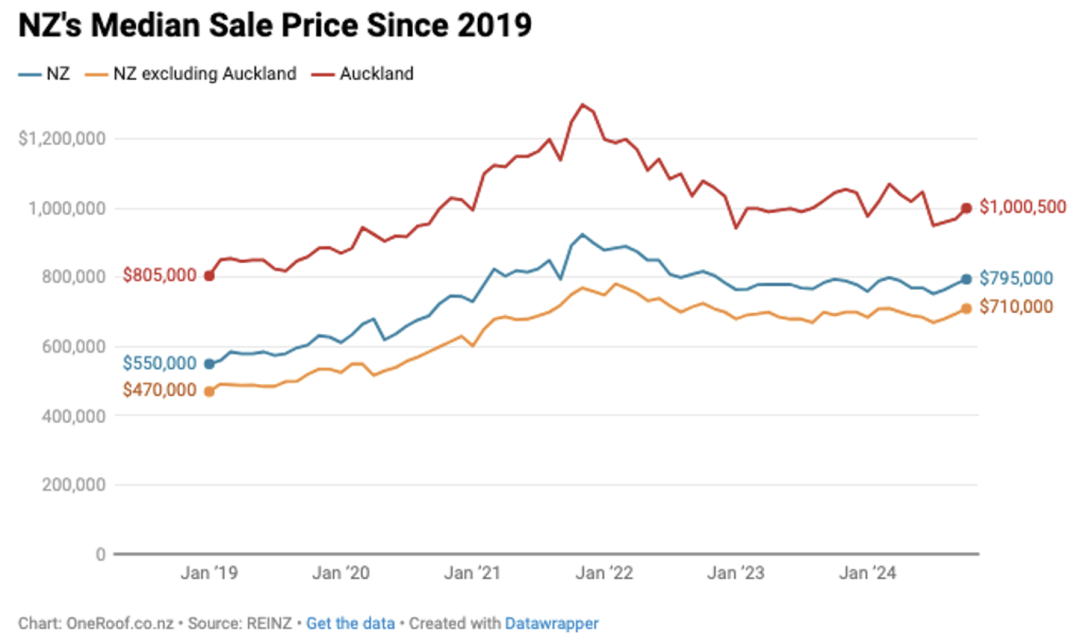
Chart showing median house prices in New Zealand and Auckland from 2019 to the present (Source: REINZ)
Falling interest rates are a key driver behind the recovery in house prices. Alexander forecasts that the Reserve Bank of New Zealand will cut the Official Cash Rate (OCR) by another 0.5 percentage points next week, with further reductions potentially taking it to 3.5% or lower in 2025. This interest rate environment is strengthening buyer confidence and attracting more investors into the market.
Persistent challenges: economic concerns linger
Despite some recovery in the housing market, buyers remain notably cautious. CoreLogic chief property economist Kelvin Davidson emphasises that high house prices remain a major issue for buyers, particularly amid growing employment pressures and plentiful listings. Although falling mortgage rates have eased repayment burdens, forthcoming debt-to-income (DTI) restrictions could make borrowing harder. He notes that these conditions leave buyers facing complex decisions involving multiple trade-offs.

Independent New Zealand economist Tony Alexander
Alexander warns against reading too much into short-term changes in the data. He notes that businesses currently face tight cash flow and squeezed profit margins. An indicator he tracks shows that pressure on business profit margins is at its highest since 1976. Some industries, such as residential construction, will continue to contract throughout 2025. The outlook for China, New Zealand’s largest export market, also warrants consideration: the US presidential election result could lead to tariffs of up to 60% on Chinese goods. Furthermore, with the fiscal position continuing to deteriorate, the net migration surge disappearing and the negative economic effects of climate change intensifying, the government may be forced to cut spending further.
Changes in the buyer mix
As the market gradually recovers, investor participation has increased, particularly among small-scale “mum-and-dad investors”. This shift is largely driven by the relative value available following house price falls and a move towards other assets as deposit interest rates decline. Meanwhile, first-home buyers remain a mainstay of the market, accounting for 26% of all home purchases and demonstrating their resilience in current conditions.
Outlook: a gradual recovery without rapid growth
Both economists believe the property market is improving and investor interest in buying is growing. Davidson expects house prices and sales volumes to increase slowly but steadily over the next 12 to 18 months. Alexander expresses a similar view: although prices will continue to trend upwards, broader economic weakness will keep market growth modest.
YIJU believes New Zealand’s housing market is currently in a transitional phase. Rising sales and house prices are boosting confidence, while the fragile economic environment is a reminder that the road to recovery may be challenging. For buyers and investors, opportunities exist, but careful decisions are also needed to navigate this complex and evolving market.