
BNZ slashes short-term fixed mortgage rates, with its six-month rate hitting a new low—but experts warn of a worrying outlook!
BNZ has also trimmed its one-year fixed rate to 5.95%, although this adjustment does not particularly stand out.
BNZ today announced cuts to two fixed-term mortgage rates, focusing on the shortest terms to meet strong demand from mortgage holders for short-term rates. With interest rates widely expected to fall, many borrowers are choosing short fixed terms to retain flexibility ahead of possible further rate cuts by the central bank.
BNZ has slashed its six-month fixed rate by 50 basis points to 5.99%, making it the only six-month fixed rate currently below 6% among New Zealand banks. It is 40 basis points below the lowest rate offered by other banks, giving BNZ a clear advantage in the short-term mortgage market. BNZ has also trimmed its one-year fixed rate to 5.95%, although this adjustment does not particularly stand out. Kiwibank currently offers a 1-year fixed rate of 5.79%, while Heartland Bank’s advertised rate is even lower, at just 5.65%.
Borrowers favour short fixed terms as competition intensifies
According to BNZ, around 90% of its mortgage customers are fixing for 12 months or less to make the most of falling interest rates. This trend reflects borrowers’ strong focus on short-term flexibility. Although banks’ advertised rates provide a benchmark, negotiated rates are often lower. Competition in the mortgage market is fierce, with major banks attracting customers through unpublished, off-card rates. Borrowers should therefore actively negotiate with banks for better rates based on their financial position.
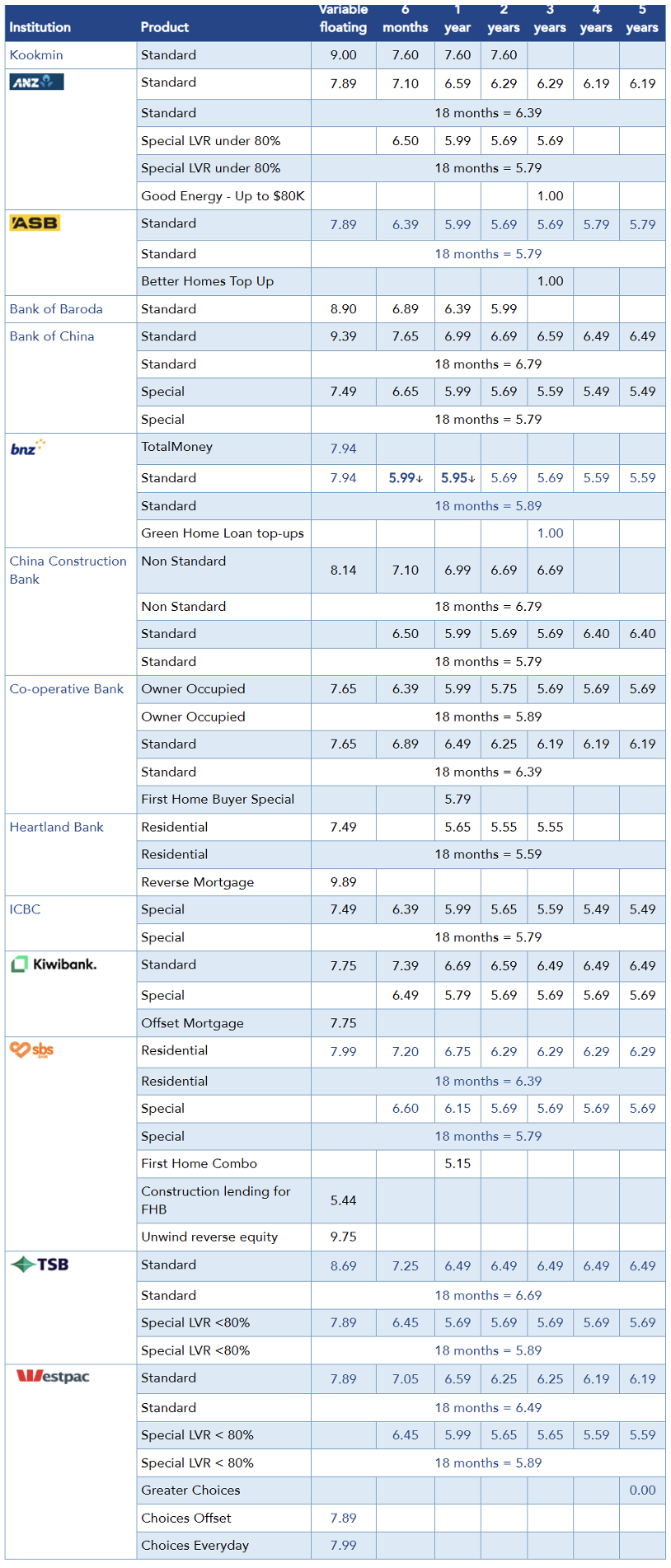
Latest commercial bank interest rates as at 21 November
(Source: interest.co.nz/borrowing)
With the Reserve Bank of New Zealand (RBNZ) due to hold its final monetary policy meeting of the year next week, the Official Cash Rate (OCR) is expected to be cut by a further 50 basis points to 4.25%. However, this raises a question: Will banks’ lending rates fall further as a result? Experts warn that despite an OCR cut, mortgage rates may not decline significantly in the short term.
Banks have already priced in the expected rate cut
Although an expected 50-basis-point OCR cut to 4.25% next week appears to offer good news for borrowers, Kiwibank chief economist Jarrod Kerr points out that banks have already anticipated this reduction when setting mortgage rates. In other words, current mortgage rates already partly reflect the impact of an OCR cut. “Mortgage rates will certainly fall, but much of the movement is already reflected in current wholesale rates,” Kerr says. He adds that mortgage rates have fallen by around 1 percentage point since August, exceeding the central bank’s 0.75-percentage-point cut over the same period.
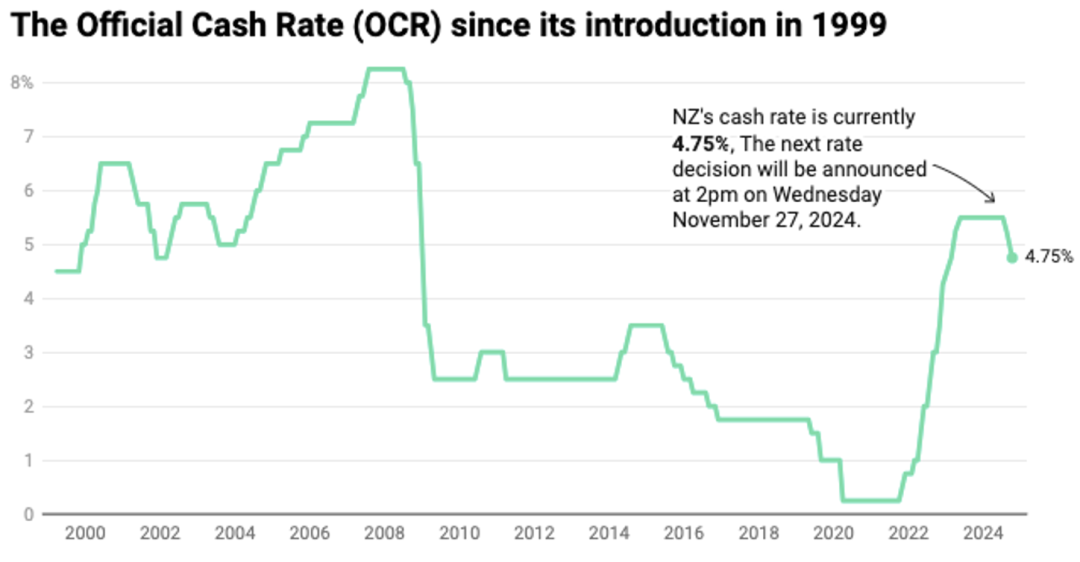
Chart showing the Reserve Bank of New Zealand’s OCR from 1999 to the present (Source: RBNZ)
Modest housing recovery constrained by the labour market
Looking ahead, Kerr expects the central bank to take a more cautious approach at its first monetary policy meeting in early 2025, possibly cutting the OCR by just 0.3 percentage points rather than making a larger adjustment. He says plainly: “We need to get the cash rate below 4% as soon as possible.” He considers an OCR of around 3% to be “neutral”, a level that would help support economic recovery.
Meanwhile, CoreLogic chief economist Kelvin Davidson believes that although short-term mortgage rates may fall further, longer-term rates, such as those fixed for three or five years, may already be close to their floor. He also notes that while lower mortgage rates help lift the housing market, other factors, such as rising unemployment, could offset some of their impact.
Housing market outlook: a modest recovery
Economists generally forecast modest house price growth of around 5% next year. This growth is expected to be moderate and steady rather than “explosive”. Meanwhile, limited scope for further mortgage rate cuts, combined with rising unemployment, could constrain the strength of the recovery. They advise borrowers to temper expectations of further mortgage rate falls and adapt their financial plans to current market conditions.
Infometrics chief forecaster Gareth Kiernan expects fixed mortgage rates could bottom out above 4% but below 5.4%. He notes: “Financial market expectations of further rate cuts will influence the actual path of interest rates.” With the central bank’s next meeting not until February next year, he also believes a larger cut this time is intended to “bridge the gap”.
Kiernan also expects the OCR could fall to 3.5% by the middle of 2025, a level widely regarded as the “neutral interest rate”. If the economic recovery needs more support, the central bank may introduce additional stimulus measures.