
How far will rates fall in the year’s final OCR decision? A full analysis of the Reserve Bank’s rate strategy and this week’s key events for property investors
As lending rates fall, more people will benefit from lower borrowing costs. However, this monetary easing “sweet spot” may not last long.

1
Focus on the Reserve Bank’s latest monetary policy decision
This week’s most closely watched economic and property event is undoubtedly the Reserve Bank of New Zealand’s latest Monetary Policy Statement, due at 2 pm on Wednesday. Markets broadly see almost no chance of the OCR remaining unchanged, with the realistic options being cuts of 25, 50 or 75 basis points. Current market pricing favours a 50-basis-point cut, which would bring the OCR down to 4.25%.
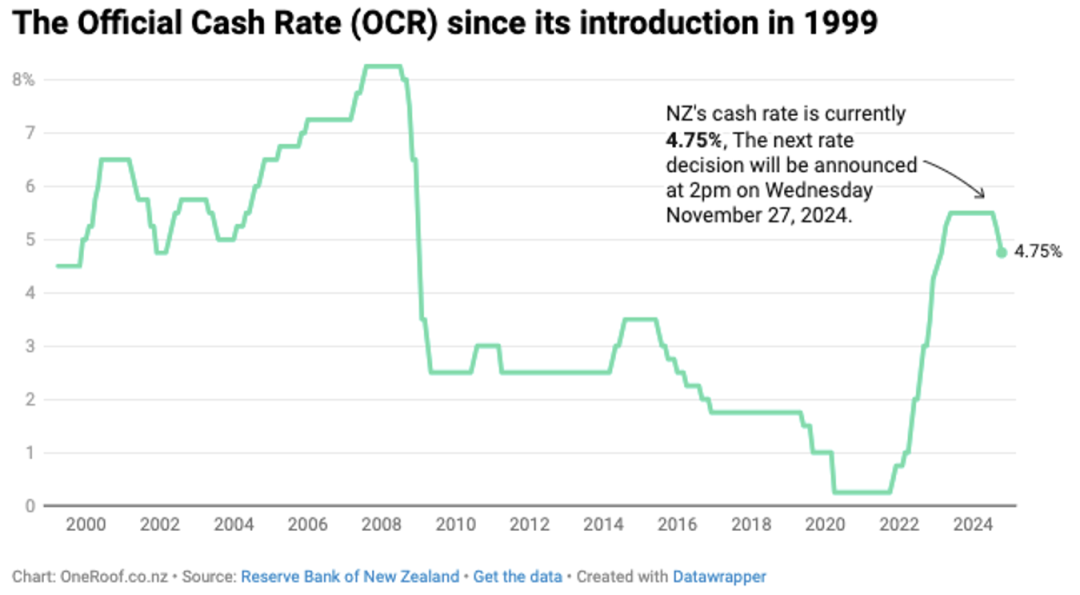
OCR changes from 1999 to the present (source: RBNZ)
Although a 50-basis-point cut is substantial, the new round of economic forecasts accompanying the announcement matters even more. These forecasts will provide a crucial window into the Reserve Bank’s views on inflation, economic activity and the direction of interest rates. In particular, the size and pace of cuts in 2025 may be more moderate, although further easing remains possible.
For existing homeowners and prospective buyers, the current rate cuts are undoubtedly good news. As lending rates fall, more people will benefit from lower borrowing costs. However, this monetary easing “sweet spot” may not last long. From next year, every move by the Reserve Bank will become more cautious.
The views of Kiwibank chief economist Jarrod Kerr and economist Sabrina Delgado merit consideration: “There is a full quarter until the Reserve Bank’s next decision. During that time, fresh data on economic activity, inflation and the labour market will emerge, potentially alongside major events such as Trump’s inauguration. If the data unfolds as we expect, another 50-basis-point cut in February would be logical.”
2
Signs of economic weakness persist
The Reserve Bank’s current easing reflects the broad weakness of New Zealand’s economy. Alongside consumer price index (CPI) inflation returning to the 1%–3% target range, several economic activity indicators also show weakness. For example, the BNZ–BusinessNZ Performance of Services Index remained in negative territory for the eighth consecutive month in October, while Stats NZ’s New Zealand Activity Index also continued to hover at low levels.
This weakness is expected to keep putting downward pressure on inflation over the coming quarters. Although negative inflation—falling prices—may sound beneficial, it can create problems just as serious as rapidly rising prices: if people expect prices to fall, they delay spending, potentially pushing the economy into a deeper recession.
3
Keep watching lending data
Alongside its OCR decision on Wednesday afternoon, the Reserve Bank will release extensive mortgage lending data for October. Analysts will pay particular attention to whether the proportions of lending at high loan-to-value ratios (LVRs) and high debt-to-income ratios (DTIs) have increased. These figures may reflect a gradual recovery in market confidence as mortgage rates fall. Another focus will be whether refinancing activity between banks remains high.
4
The labour market remains weak
On Thursday, Stats NZ will release jobs data for October. Although recent months’ figures have been more resilient than expected, the labour market remains subdued overall. Job numbers for October could fall further, which is one reason the property market outlook for the next 6 to 12 months remains unpromising.
5
What are businesses’ hiring intentions?
On Thursday, ANZ will release its November business confidence survey, with the employment intentions indicator particularly worth watching. A recovery in this indicator would be an important sign that the labour market is emerging from its weak patch. With the OCR decision and related data due, this is a crucial week for economic observers and property market participants.