
Is a major turning point ahead for New Zealand’s property market? Auckland home construction declines steadily, Trump is re-elected, the Reserve Bank cuts rates…
This year, 1683 CCCs were issued in May, falling to 1322 in June, rising again to 1614 in July, then dropping to 1186 in August…

The latest Auckland Council data shows that new home completions in Auckland are declining gradually rather than plunging. Completions peaked between September and November last year, when a total of 5801 code compliance certificates (CCCs) were issued for homes, equivalent to more than 1900 a month.
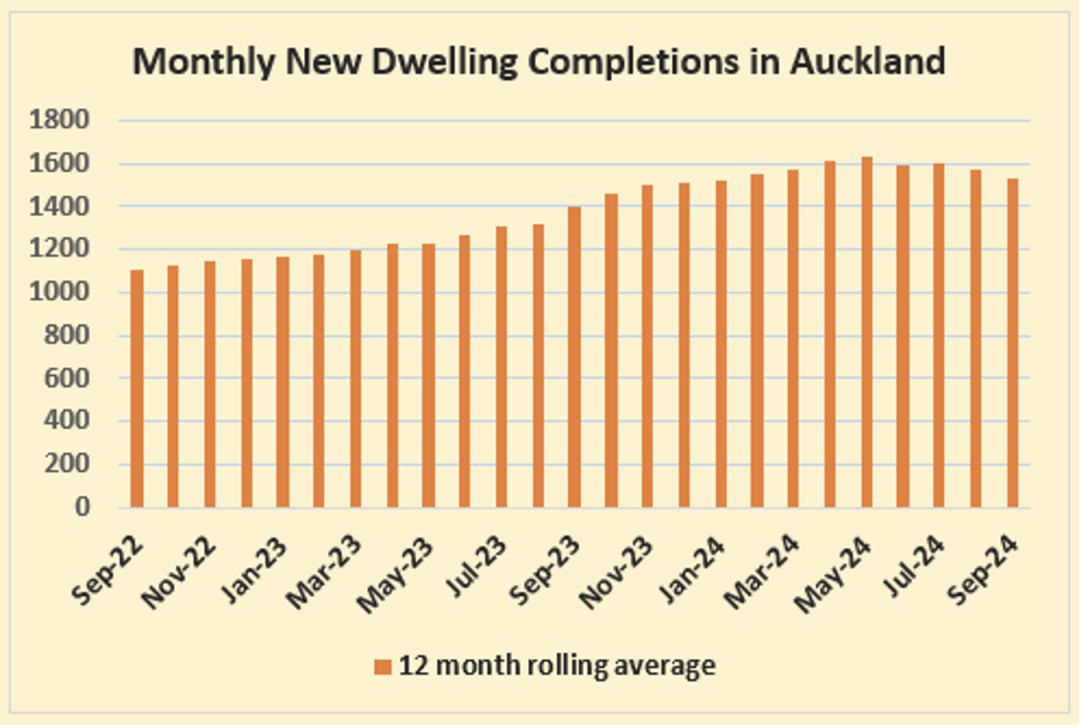
However, the figures have trended down since the start of this year. For example, 1683 CCCs were issued in May, falling to 1322 in June, rising again to 1614 in July, then dropping to 1186 in August. A 12-month rolling average provides a clearer view of the long-term trend: average monthly home completions peaked at 1630 in May this year, before falling to 1534 in September, a decline of 5.9% over four months. Completion activity in September was around 9.8% lower than in September last year, but remained 38.5% above the same period in 2022.
Another indicator worth watching is the proportion of residential projects completed within two years of receiving building consent. This completion rate has fallen from more than 80% in mid-2021 to 65% in September this year. The change may reflect a backlog caused by capacity constraints during the construction industry’s busy period. As the market cools, this backlog is gradually being cleared, with delayed projects providing ongoing work for developers and builders.
Global economic turbulence and Reserve Bank of New Zealand rate cuts:
How will the housing market’s direction change?
Tomorrow afternoon, the Reserve Bank of New Zealand will announce whether it will cut the Official Cash Rate (OCR) again, with markets widely expecting a 50-basis-point reduction. Countless mortgage holders and home buyers will undoubtedly be waiting with bated breath—will lower rates make mortgages easier to manage? Or will banks’ high profits continue to limit the benefits? Meanwhile, what ripple effects will Trump’s re-election have on the global economy and New Zealand’s housing market?

Reserve Bank of New Zealand Governor Adrian Orr
According to Infometrics chief forecaster Gareth Kiernan, financial markets have fully anticipated a 50-basis-point cut, so the direct impact on fixed mortgage rates may be limited. He expects fixed rates to fall by only around 10 basis points, while floating rates, which usually follow OCR changes closely, are expected to fall by 50 basis points.
Bayleys real estate group chief executive Mark Macky believes further cuts will strengthen market confidence and signal that the bottom of the property cycle has passed. He noted that listings are currently at historically high levels, and lower rates will help lift sales volumes by giving buyers greater confidence to make decisions as borrowing costs fall. However, he does not expect the property market to recover rapidly simply because of a lower OCR.
Although the OCR adjustment is expected to boost market confidence in the short term, Tella mortgage company CEO Andrew Chambers reminds consumers that the OCR is only one factor affecting mortgage rates. Long-term wholesale market rates and banks’ internal asset and liability management are also crucial. New Zealand’s wholesale swap rate curve is currently flattening, making significant declines in long-term rates difficult and weakening the effect of rate cuts on long-term mortgage rates to some extent.
The Reserve Bank of New Zealand also has several tools for controlling inflation. Alongside OCR adjustments, it reduces market liquidity by restricting bank lending through measures such as loan-to-value ratio (LVR) and debt-to-income ratio (DTI) limits. In the longer term, increasing compulsory KiwiSaver saving rates or influencing consumer spending through tax policy are alternative approaches worth exploring.

US President Trump, who is about to take office again
Global conditions are making the outlook increasingly unclear, and Trump’s re-election has added uncertainty to global capital markets. His policies tend to stimulate US economic growth but could cause volatility in global capital markets, affecting New Zealand’s wholesale funding costs and lending rates. As an export-led economy, New Zealand also depends on a stable global trading and capital environment, so the Trump administration’s economic policies could indirectly affect domestic monetary policy and the direction of interest rates.
For consumers preparing to buy a home, making decisions that build confidence is particularly important in the current market. Whatever the outcome of this Wednesday’s OCR adjustment, buyers need to assess their financial capacity and the market outlook carefully to prepare for potential changes.