
Breaking: ASB cuts fixed mortgage rates in a final push for the peak property selling season! This week’s key developments for property investors
Stats NZ will release October new dwelling consent figures and third-quarter data on actual building activity this week, putting residential construction back in the spotlight.

ASB’s website today shows cuts to both its fixed mortgage rates and term deposit rates, bringing them more closely into line with its main competitors. The move follows fixed-rate cuts by ANZ, Westpac and Co-operative Bank last week, and is being seen as a final push by banks to win customers buying property before the end of the year.
With the property selling season drawing to a close, market activity is expected to cool rapidly after next week. The resale market was subdued in November, with high stock levels and cautious offers from buyers. Most properties currently selling are those whose owners are willing to accept prices that reflect a buyer’s market. Stable median house prices largely reflect increased sales in higher-priced areas rather than a broad market recovery.
Although banks’ advertised rates provide a useful guide, actual agreed rates are usually lower, and the discounts offered vary between customers. Borrowers should negotiate actively for better terms when discussing their mortgage rates. As property transactions slow towards year-end, banks hope to attract the final wave of customers with more competitive rates. Borrowers should seize this opportunity to negotiate a better mortgage package with their bank.
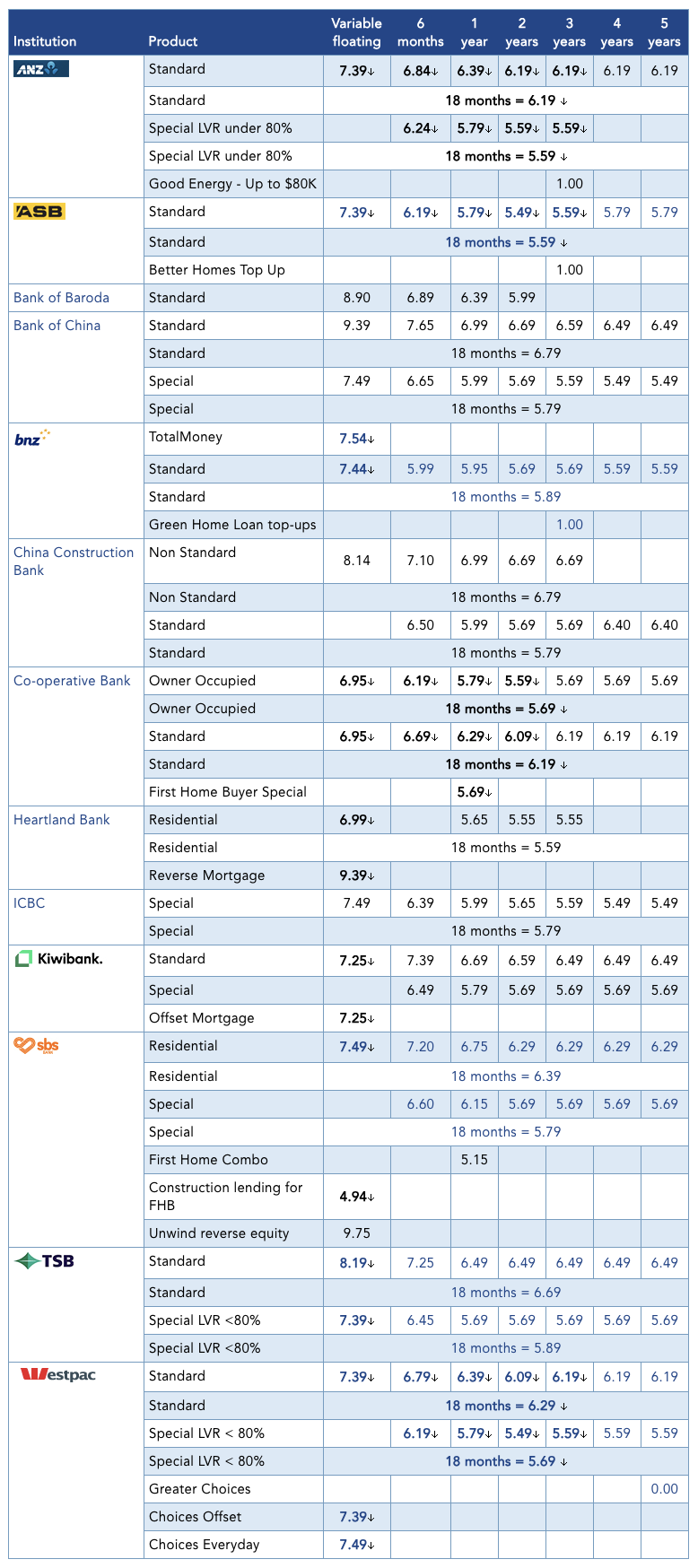
An overview of banks’ latest mortgage rates as at 2 December
Source: interest.co.nz/borrowing
|
The Official Cash Rate continues to fall: Multiple factors influence the housing market |
Last week, the Reserve Bank of New Zealand announced a cut in the Official Cash Rate (OCR) to 4.25%, its lowest level in almost two years. The move undoubtedly has significant implications for the economy and property market. More strikingly, however, the Reserve Bank of New Zealand signalled that it might further “front-load” OCR adjustments at its next meeting in February next year. Markets expect another substantial cut of 0.5%, followed by smaller reductions.
Whether the cut is 0.25% or 0.5%, its potential impact on the property market deserves attention. Short-term rates may fall further, but longer-term rates for 3 to 5 years may not decline by the same amount. Although falling interest rates generally stimulate property sales and push up house prices, a weak labour market, an oversupply of homes and banks’ strict debt-to-income (DTI) limits could all restrain strong housing market growth. The Reserve Bank of New Zealand forecasts house prices could rise by around 7% in 2025: a moderate but steady increase rather than a rapid surge.
Last week, the Reserve Bank of New Zealand announced a cut in the Official Cash Rate (OCR) to 4.25%, its lowest level in almost two years. The move undoubtedly has significant implications for the economy and property market. More strikingly, however, the Reserve Bank of New Zealand signalled that it might further “front-load” OCR adjustments at its next meeting in February next year. Markets expect another substantial cut of 0.5%, followed by smaller reductions.
Whether the cut is 0.25% or 0.5%, its potential impact on the property market deserves attention. Short-term rates may fall further, but longer-term rates for 3 to 5 years may not decline by the same amount. Although falling interest rates generally stimulate property sales and push up house prices, a weak labour market, an oversupply of homes and banks’ strict debt-to-income (DTI) limits could all restrain strong housing market growth. The Reserve Bank of New Zealand forecasts house prices could rise by around 7% in 2025: a moderate but steady increase rather than a rapid surge.
| Economic data supports the case for interest rate cuts |
Last week, the Reserve Bank of New Zealand announced a cut in the Official Cash Rate (OCR) to 4.25%, its lowest level in almost two years. The move undoubtedly has significant implications for the economy and property market. More strikingly, however, the Reserve Bank of New Zealand signalled that it might further “front-load” OCR adjustments at its next meeting in February next year. Markets expect another substantial cut of 0.5%, followed by smaller reductions.
Whether the cut is 0.25% or 0.5%, its potential impact on the property market deserves attention. Short-term rates may fall further, but longer-term rates for 3 to 5 years may not decline by the same amount. Although falling interest rates generally stimulate property sales and push up house prices, a weak labour market, an oversupply of homes and banks’ strict debt-to-income (DTI) limits could all restrain strong housing market growth. The Reserve Bank of New Zealand forecasts house prices could rise by around 7% in 2025: a moderate but steady increase rather than a rapid surge.
Economic data released last week shows that many households and businesses are still facing difficult times. For example, retail sales fell slightly again in the third quarter, although the decline was smaller than in previous quarters. Employment also fell for the seventh consecutive month in October. These figures suggest that further interest rate cuts are a reasonable and necessary step to help ease economic pressure.
| Early signs of recovery in the investor market |
Last week, the Reserve Bank of New Zealand announced a cut in the Official Cash Rate (OCR) to 4.25%, its lowest level in almost two years. The move undoubtedly has significant implications for the economy and property market. More strikingly, however, the Reserve Bank of New Zealand signalled that it might further “front-load” OCR adjustments at its next meeting in February next year. Markets expect another substantial cut of 0.5%, followed by smaller reductions.
Whether the cut is 0.25% or 0.5%, its potential impact on the property market deserves attention. Short-term rates may fall further, but longer-term rates for 3 to 5 years may not decline by the same amount. Although falling interest rates generally stimulate property sales and push up house prices, a weak labour market, an oversupply of homes and banks’ strict debt-to-income (DTI) limits could all restrain strong housing market growth. The Reserve Bank of New Zealand forecasts house prices could rise by around 7% in 2025: a moderate but steady increase rather than a rapid surge.
As mortgage rates fall, overall lending activity is gaining momentum, particularly among investors. Although signs of recovery are still at an early stage, they are gradually emerging. According to CoreLogic’s buyer classification data, the share of investor lending with a debt-to-income ratio (DTI) above 7 rose from 3.0% in September to 4.0% in October. Although modest, this change could mark the beginning of renewed investor activity, a trend that warrants further observation in the coming months.
| A clear preference for shorter mortgage terms |
Last week, the Reserve Bank of New Zealand announced a cut in the Official Cash Rate (OCR) to 4.25%, its lowest level in almost two years. The move undoubtedly has significant implications for the economy and property market. More strikingly, however, the Reserve Bank of New Zealand signalled that it might further “front-load” OCR adjustments at its next meeting in February next year. Markets expect another substantial cut of 0.5%, followed by smaller reductions.
Whether the cut is 0.25% or 0.5%, its potential impact on the property market deserves attention. Short-term rates may fall further, but longer-term rates for 3 to 5 years may not decline by the same amount. Although falling interest rates generally stimulate property sales and push up house prices, a weak labour market, an oversupply of homes and banks’ strict debt-to-income (DTI) limits could all restrain strong housing market growth. The Reserve Bank of New Zealand forecasts house prices could rise by around 7% in 2025: a moderate but steady increase rather than a rapid surge.
A new set of lending data will be released this week, including analysis of the mortgage terms and rates borrowers have chosen. In recent months, borrowers have generally preferred short-term fixed rates, or even floating rates, despite these typically being higher than longer-term rates. This reflects a desire to benefit from falling short-term rates during the easing cycle. This preference is expected to remain evident in the October data and could continue as the Reserve Bank provides greater clarity on its plans for rate cuts.
| Construction returns to the spotlight |
Last week, the Reserve Bank of New Zealand announced a cut in the Official Cash Rate (OCR) to 4.25%, its lowest level in almost two years. The move undoubtedly has significant implications for the economy and property market. More strikingly, however, the Reserve Bank of New Zealand signalled that it might further “front-load” OCR adjustments at its next meeting in February next year. Markets expect another substantial cut of 0.5%, followed by smaller reductions.
Whether the cut is 0.25% or 0.5%, its potential impact on the property market deserves attention. Short-term rates may fall further, but longer-term rates for 3 to 5 years may not decline by the same amount. Although falling interest rates generally stimulate property sales and push up house prices, a weak labour market, an oversupply of homes and banks’ strict debt-to-income (DTI) limits could all restrain strong housing market growth. The Reserve Bank of New Zealand forecasts house prices could rise by around 7% in 2025: a moderate but steady increase rather than a rapid surge.
Stats NZ will release October new dwelling consent figures and third-quarter data on actual building activity this week, putting residential construction back in the spotlight. Although the construction downturn is not yet over, consent figures in recent months suggest the sector may have bottomed out, at a level significantly above the low following the global financial crisis. This is undeniably an important first step towards a housing market recovery.