
The investment strategy behind Prime Minister Luxon's 770,000 gain on three investment properties: how can everyday buyers plan their investment journey?
These transactions have drawn public attention to how high-net-worth individuals navigate the housing market, while also sparking debate about property market performance across different regions

In 2024, Prime Minister Christopher Luxon sold three investment properties, with potential capital gains of nearly NZ$770,000. These transactions have drawn public attention to how high-net-worth individuals navigate the housing market, while also sparking debate about property market performance across different regions: are expensive areas such as Auckland still the best choice? Do lower-priced areas such as West Coast offer better opportunities for everyday homebuyers?
Luxon's property transactions appear highly profitable on the surface, but also involve substantial investment and risk. Meanwhile, steady growth on the West Coast suggests lower-priced regions may offer a more attractive investment path for everyday investors and first-home buyers. Luxon's example allows us to explore pre-pandemic housing opportunities and the differences and similarities between property investment in Auckland and on the West Coast.
The Prime Minister's investment transactions: behind the high returns
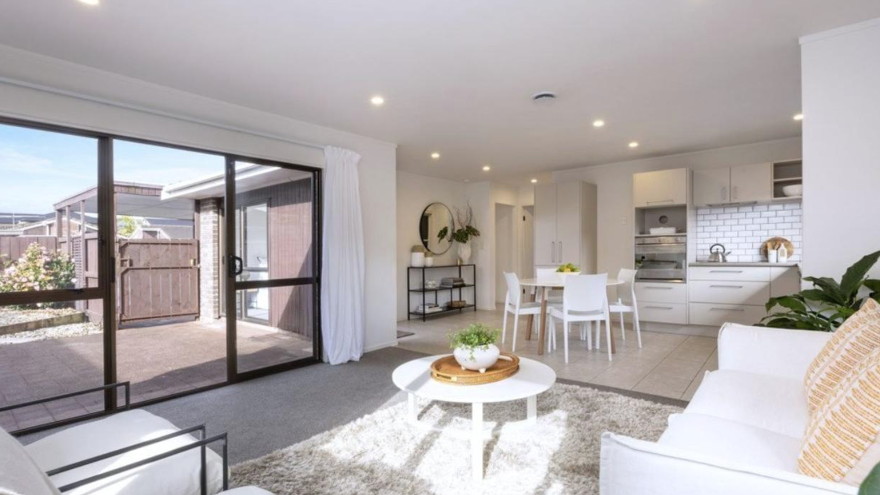
A property Luxon sold in Onehunga, Auckland
Luxon's three investment properties were in Onehunga, Auckland, and Wellington's Kate Sheppard Complex. Data shows that his two Onehunga properties gained approximately NZ$280,000 and NZ$309,500 respectively, while the Wellington apartment had a potential gain of NZ$180,000, bringing total capital gains to nearly NZ$770,000. However, these gains cannot simply be calculated as the difference between purchase and sale prices; holding costs such as mortgage interest, maintenance and tax expenses must also be considered.
Luxon's successful transactions reflect his ability to time the market, but also depend on substantial capital investment. For example, the Onehunga properties he bought in 2015 cost NZ$620,500 and NZ$650,000 respectively, while properties of this type were priced at around NZ$930,000 in 2024. Such a large investment may be beyond the reach of everyday homebuyers.
The potential of lower-priced regions: steady growth on the West Coast
The West Coast's housing market performance stands in stark contrast to Luxon's high-priced investments. Data shows that its average house price rose by NZ$192,000 over the past five years, close to Auckland's NZ$211,000 increase over the same period, but with a much lower investment outlay. In 2019, West Coast buyers needed a deposit of just NZ$56,000, compared with as much as NZ$215,000 in Auckland.
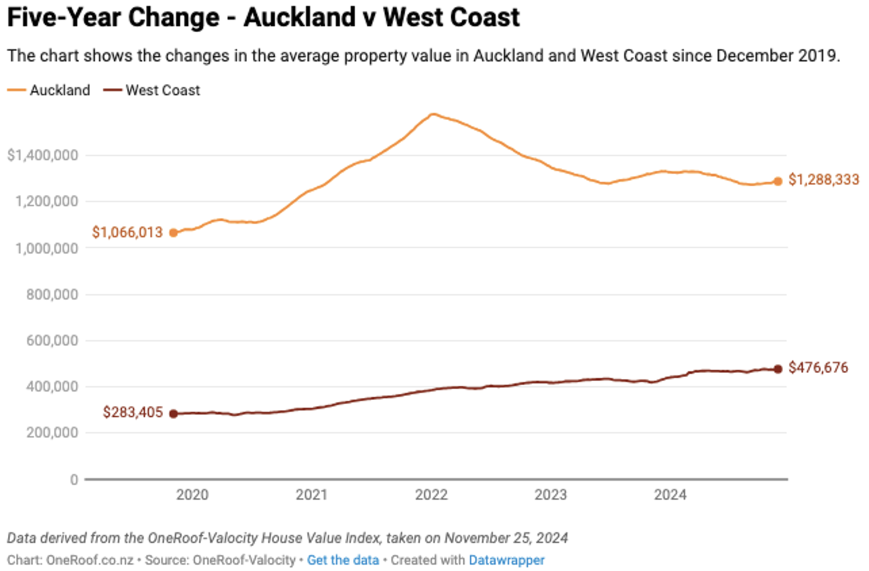
Graph showing house price changes in Auckland and on the West Coast over the past five years
(Source: OneRoof)
West Coast house price growth has also been steadier, avoiding Auckland's sharp post-pandemic fluctuations. For example, a Greymouth property that sold for NZ$200,000 five years ago now sells for nearly NZ$500,000. This stability has attracted many first-home buyers and investors from other regions. By contrast, Auckland's housing market reached a peak before falling rapidly, dropping more than 18% within three years.
Housing policy and market trends: key factors affecting investment
Luxon's property transactions benefited from changes in government policy. For example, changes to the bright-line rules meant the sale of his Wellington apartment did not attract capital gains tax. On the West Coast, lower house prices and a relatively simple tax structure provide a more favourable environment for investors. This shows that the influence of the policy environment on investment decisions cannot be overlooked.
Market trends show that more investors are leaving expensive areas such as Auckland for lower-priced markets such as the West Coast. Harcourts agent Harsh Kathuria said “lower risk and greater growth potential” were the main reasons investors chose cheaper areas. This trend also reflects buyers' search for more cost-effective investment options.
Auckland and the West Coast: the investment logic behind different paths
Luxon's Auckland investments demonstrate the appeal of expensive markets: substantial capital gains, prime property locations and a relatively mature market structure. However, these also involve significant outlays and exposure to market volatility. By contrast, the West Coast's lower entry costs, greater stability and lighter tax burden offer another possibility for everyday homebuyers and small to medium-sized investors.
For buyers hoping to seize opportunities before the pandemic, choosing Auckland may have involved greater risk and pressure, while the West Coast offered good returns through lower costs and steady appreciation. This divergence illustrates the diversity of New Zealand's housing market and provides more options for different types of investors.
Investment lessons for everyday buyers
From Luxon's investment transactions to the West Coast's house price performance, these two very different investment paths reveal the underlying logic of New Zealand's housing market: expensive markets rely on strong financial backing and market opportunities, while lower-priced regions attract more investors through stability and affordability.
Policy changes, economic developments and market trends will continue to shape the housing market. For homebuyers and investors, whether choosing Auckland or the West Coast, the key is balancing outlay and returns, and risk and stability. Which of these two very different investment approaches appeals to you more? Share your views in the comments.