
Early recovery as the summer peak season begins: a buyer’s market takes hold! But stock pressure remains the market’s biggest concern
However, in stark contrast to these positive signals, the backlog of properties for sale is becoming the market’s central challenge.

Early signs of recovery in sales and prices
After a prolonged downturn, New Zealand’s property market is finally showing some signs of recovery. In November, Auckland’s largest real estate agency, Barfoot & Thompson, delivered one of its stronger performances of 2024 (see the second article published by YIJU today). It sold 1002 residential properties during the month, up 4.8% year on year and 3.4% from the previous month. This was the first time monthly sales had exceeded 1000 since March, signalling a positive start to the traditional summer selling season.
On prices, the company’s average sale price rose slightly for the second consecutive month, reaching NZ$1,132,795 in November, up 0.3% from the previous month. The median sale price also increased significantly, rising 5.9% month on month to NZ$1,011,000. These figures suggest that some buyers are entering the market in response to lower prices and a wider choice of properties, offering sellers some hope.
However, in stark contrast to these positive signals, the backlog of properties for sale is becoming the market’s central challenge.
The stock backlog continues to grow
High stock levels nationwide are slowing the market’s recovery. Realestate.co.nz data shows that 33,984 properties were listed for sale nationwide at the end of November, up 21.3% from a year earlier and the highest level since 2015. Barfoot & Thompson’s stock situation is also concerning. At the end of November, it had 5711 properties for sale, a substantial 18% increase year on year and a jump of 42% from the market peak in 2020.
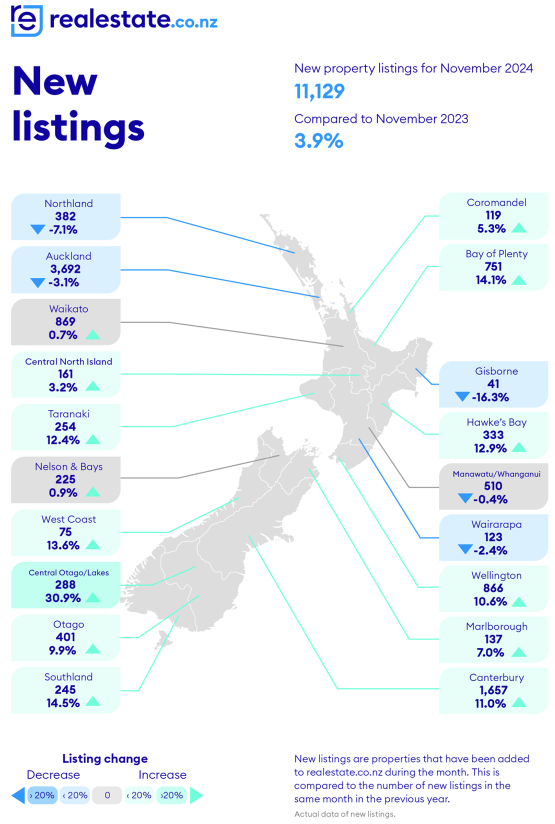
Chart showing changes in new property listings in November 2024
(Source: realestate.co.nz)
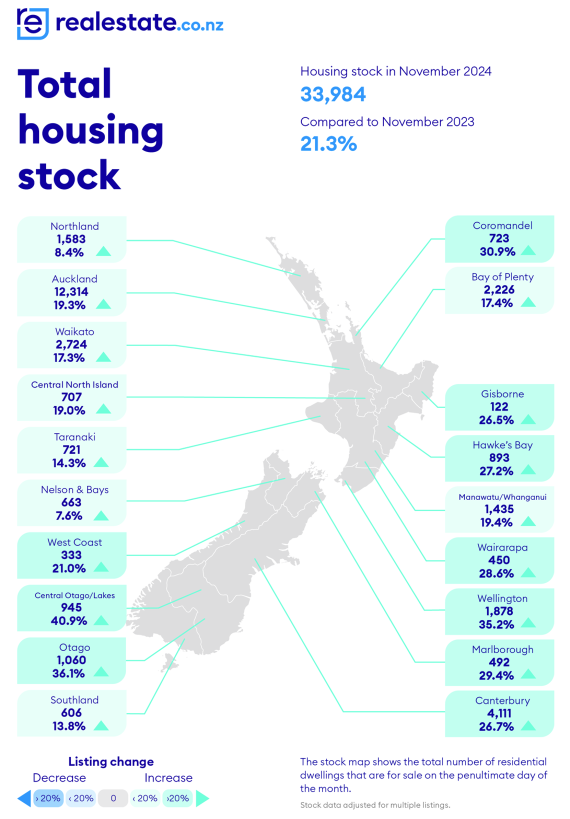
Chart showing changes in the total number of properties listed for sale in November 2024
Independent economist Tony Alexander’s analysis suggests that this is more than ordinary market fluctuation: it reflects the combined impact of several factors. He noted in particular: “Property listings in New Zealand have reached their highest level since 2015. In Auckland, the oversupply of townhouses is especially pronounced, a legacy of the construction boom following the introduction of the Unitary Plan in 2016.” This oversupply is making it extremely difficult for developers to secure presales and finance, and poses a potential obstacle to the future economic recovery.
Meanwhile, there is no sign of stock pressures easing in the short term. Alexander noted that requests for property appraisals received by real estate agents had increased sharply, with a net reading of 51%, well above the historical average of 21%. “This means supply will remain high, and the balance between supply and demand will continue to favour buyers,” he said.
A buyer’s market: caution and a willingness to wait
High stock levels and ample choice have given buyers more bargaining power, but caution remains dominant. In his latest property survey, Tony Alexander found that the proportion of buyers showing a “fear of missing out” (FOMO) had fallen from 23% at the start of the year to 14% now. He explained: “Although buyers can see the market gradually recovering, they are in no hurry to enter it, believing that time is on their side.”
Another important reason for buyer caution is uncertainty about the economy and employment. Alexander noted that 44% of agents now reported a significant increase in buyers’ concerns about employment, compared with just 14% at the start of the year. With unemployment expected to rise from 4.8% to 5.5%, this caution could persist throughout 2025.
Changes in migration patterns are also directly affecting market demand. Tony Alexander said: “Annual net migration has fallen sharply from a peak of 136,000 people to 45,000. This is putting pressure on the rental market and further weakening buyer confidence.”

Independent economist Tony Alexander
A slow recovery as supply and demand interact
The market currently appears to be experiencing simultaneous growth in supply and demand. Tony Alexander believes this trend will continue into 2025. Although falling mortgage rates and gradually improving economic data may generate some demand, high stock levels will restrain price growth over the longer term. He concluded: “Oversupply, cautious buyers and uncertainty in the global economy are the three main features of the current property market.”
Meanwhile, changes in the international environment are also casting a shadow over the market’s recovery. Alexander noted in particular: “With Trump re-elected as US president, the outlook for global trade has become more pessimistic and inflationary pressures have intensified, while the potential for slower economic growth in China also poses challenges for New Zealand’s exports and overall economic recovery.”
Market opportunities and challenges
Overall, although some indicators for New Zealand’s housing market are showing positive signals, the stock backlog and economic uncertainty remain major obstacles. For buyers, this is a rare window of opportunity to seek an attractive deal from an ample supply of properties. For sellers, adjusting pricing strategies to attract limited demand will be crucial to competing in the market ahead. As Tony Alexander put it: “The property market is recovering, but buyers and sellers both need to navigate the current complex balance of supply and demand carefully. This will determine the market’s true direction.”