
Short-term or long-term fixed rates: what is the best borrowing choice for 2025?
Drawing on analysis from two economists, this article examines the far-reaching effects of interest rate cuts on the housing market and borrowing strategies.

The Reserve Bank of New Zealand’s latest interest rate policy is sparking fresh debate about the housing market. Could mortgage rates reach new lows? Will house price growth match the strong gains of the past? These questions are weighing on homebuyers and attracting close attention from investors. Drawing on analysis from two economists, this article examines the far-reaching effects of interest rate cuts on the housing market and borrowing strategies.
Limited scope for further interest rate cuts
but a clear direction
The Reserve Bank of New Zealand has already lowered the OCR from 5.5% to 4.25% in 2024, and the market widely expects a further fall to 3.5% by the middle of 2025. Independent economist Tony Alexander notes that although continued OCR cuts will lower wholesale funding costs and push mortgage rates down further, the extent of those falls may be very limited.
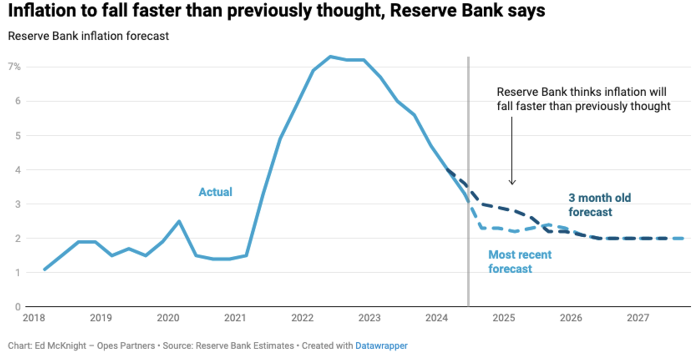
Chart showing the Reserve Bank of New Zealand’s inflation forecast
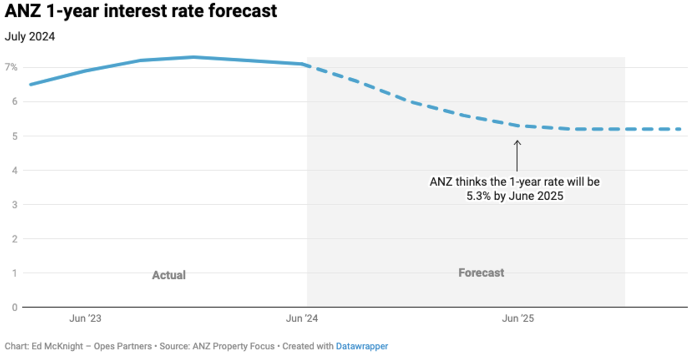
Forecast trend for one-year mortgage rates (source: ANZ)
“Even if the 1-year fixed rate falls to around 5% by the middle of 2025, it will still be above the 4.4% average seen in 2017–2018. The market should not expect a return to the exceptionally low rates seen during the pandemic, when they fell below 4%.” ——Tony Alexander
Similarly, Opes Partners economist Ed McKnight forecasts that the 1-year rate could fall to 5.5% by June 2025, and approach 5% in 2026. ANZ is more optimistic, forecasting that the 1-year rate will fall to 5.3% by the middle of 2025, potentially giving homebuyers and investors greater borrowing capacity.
“A 1.5% fall in interest rates could allow first-home buyers to borrow an extra $75,000, while increasing investors’ borrowing capacity by around $132,000.” ——Ed McKnight
A housing market recovery
but limited price growth
The boost that falling interest rates give the housing market is clear, but their impact may be much more moderate than in the past. Tony Alexander notes that several factors are constraining the mortgage market recovery:
1
Tighter lending policies: Debt-to-income (DTI) restrictions introduced by the Reserve Bank of New Zealand have made loan approvals more stringent.
2
Growing housing supply: Despite the economic downturn over the past two years, the number of new homes consented remains close to the 2004 peak of 34,000 homes.
3
Changes to planning rules: New rules create more scope for land development and higher-density housing, further easing pressure between supply and demand.
Taking these factors together, Tony Alexander forecasts annual house price growth of 5%–10% over the next three to four years, below the rates above 10% commonly seen in the past.
“Price gains in this property cycle will be significantly lower than those seen over the past thirty to forty years.” ——Tony Alexander
Borrowing strategies
Short-term fixed rates are the preferred option
On borrowing strategies, Ed McKnight and Tony Alexander broadly agree: fixing for a shorter term is better suited to the current market.
“The 1-year rate is currently slightly higher than longer-term rates, but as interest rates fall, fixing for a shorter term will put borrowers in a better position to capture future lows.” ——Ed McKnight
According to a survey by Tony Alexander, 90% of mortgage advisers recommend that clients choose fixed terms of 1 year or less, while only 10% favour fixing for longer. Although longer-term rates offer stability, that stability may come at an extra cost during a period of falling rates.
Uncertainty remains
Careful planning is key
Although both economists are positive about falling interest rates, they also remind the market that the direction of policy and changes in the external economic environment remain uncertain.
“The pace at which inflation falls will determine the scope for interest rate adjustments. Although inflation has now fallen to 2.2%, the Reserve Bank of New Zealand’s long-term target is to keep it within 1%–3%. Low inflation is a prerequisite for interest rates to keep falling.” ——Tony Alexander
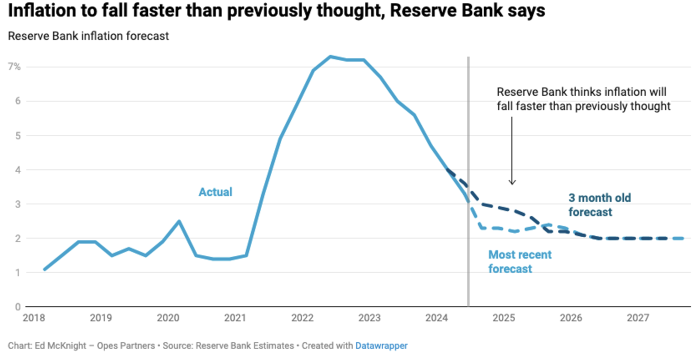
Chart showing the Reserve Bank of New Zealand’s inflation forecast
Faced with uncertainty, borrowers should adopt flexible strategies:
1. Stress testing: model investments using higher interest rates to ensure financial resilience.
2. Watch the short-term market: choose shorter fixed terms to remain responsive to market changes.
3. Diversify your approach: where finances allow, consider fixing part of the loan for a longer term to protect against unexpected risks.
Overall, falling interest rates will ease borrowing costs and provide some support for the property market. However, house price growth in 2025 may be more moderate than in previous cycles. Borrowers and investors need realistic expectations about the scale of rate cuts and should choose strategies that suit their financial circumstances. Flexibility and adaptability will be crucial in a complex and changing market.
*Cover: Opes Partners economist Ed McKnight