
Do soaring CVs mean house prices are recovering? Buyers fear overpaying, sellers refuse to concede, and the market keeps waiting!
Auckland’s latest council valuations (CVs) have triggered a chain reaction across the market: CVs in luxury coastal locations such as Waiheke Island and Great Barrier Island have surged by as much as 34%, while traditional luxury suburbs such as Ponsonby and Herne Bay have seen valuations fall by more than NZ$400,000.
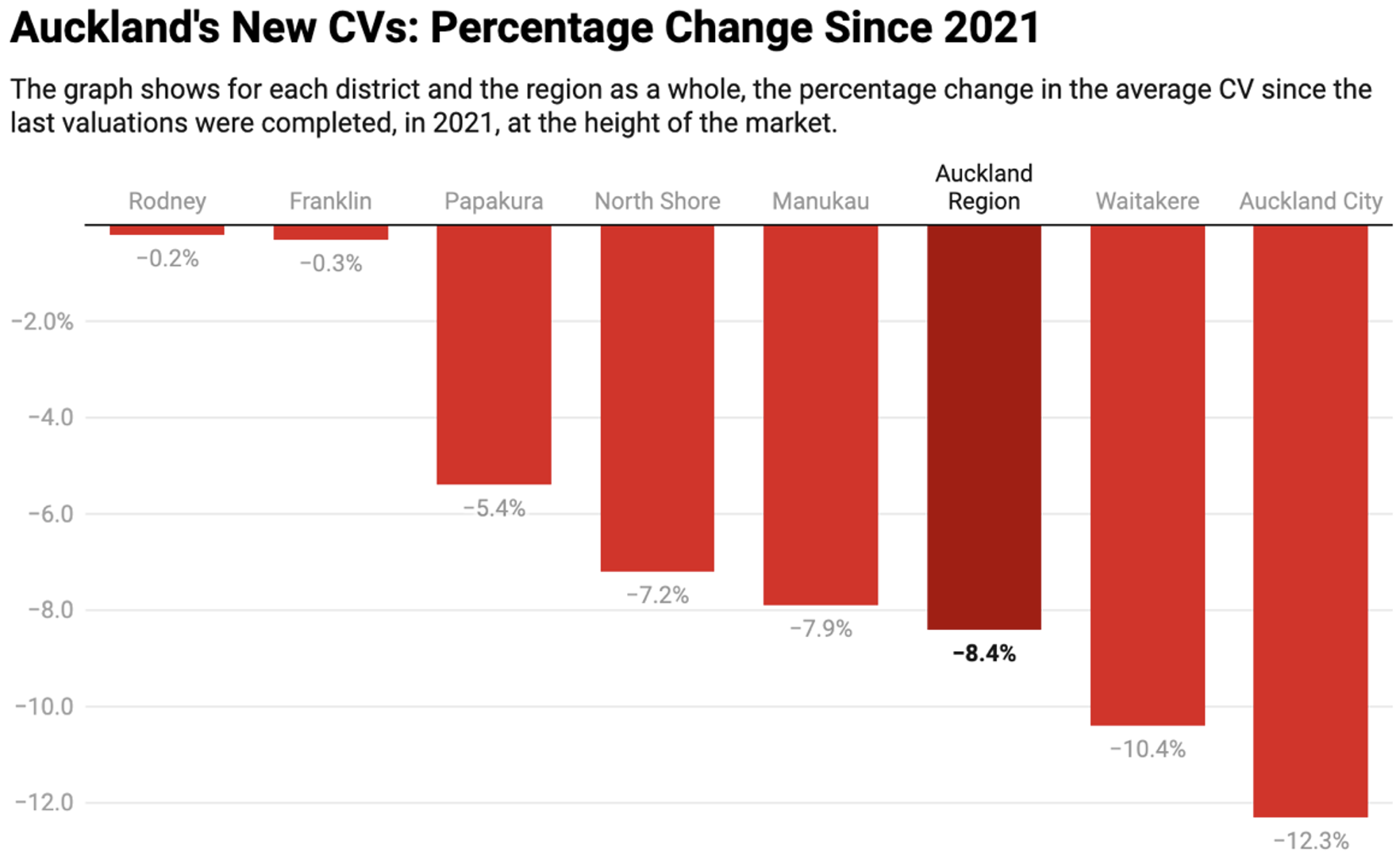
Auckland’s latest council valuations (CVs) have triggered a chain reaction across the market: CVs in luxury coastal locations such as Waiheke Island and Great Barrier Island have surged by as much as 34%, while traditional luxury suburbs such as Ponsonby and Herne Bay have seen valuations fall by more than NZ$400,000. Meanwhile, house price growth across New Zealand has virtually stalled. Independent economist Tony Alexander’s latest survey notes: “Sellers are still clinging to hopes of 2021 highs, while buyers are waiting for reality to return.”
This apparent prosperity generated by council valuations masks a deeper problem: the housing market is being squeezed by both misaligned valuations and weak confidence.
One: ‘Overvalued’ islands and heavily discounted urban suburbs
Among the biggest surprises in this CV update were increases against the trend in some premium locations. Waiheke Island’s average CV rose 7.8% to a remarkable NZ$3,900,000, even surpassing Herne Bay to become the city’s most expensive location. Okura Bush recorded a CV increase of NZ$618,000 despite a small sales sample. These figures look exciting at first glance, but their relationship to actual transactions is contentious.
CVs for luxury holiday homes on Waiheke Island rose 7.8%
For example, Muriwai was badly hit by extreme weather in 2023, yet its CVs still rose 8.1%. The council responded: “With a limited sample size, the valuation system struggles to reflect the full impact of natural disasters.” That response undoubtedly raises questions about the ‘objectivity’ of CVs.
By contrast, urban neighbourhoods such as Kingsland (-21.5%), Point England (-20%) and Newmarket (-18.3%) saw sharp valuation falls, with Ponsonby down 15%. These areas face sales pressure from a mix of housing types, while also revealing a key trend: falling land values are rapidly eroding market confidence in established urban suburbs.
Ponsonby’s latest CVs fell by as much as 15%
Two: Transactions freeze as willing buyers lose their nerve
Independent economist Tony Alexander’s June market report noted that, despite mortgage rates falling below 5%, buyers remain firmly on the sidelines. ‘FOOP’ — fear of overpaying — is spreading rapidly among homebuyers, with 39% of agents reporting that their clients’ main concern is buying an ‘overvalued home’. Meanwhile, another of Tony’s indicators shows that 51% of agents say their clients lack confidence in their incomes, compared with just 14% at the start of the year.
With expectations like these, even areas with rising CVs may not see brisk sales. ‘CVs have risen, but buyers are even more afraid of overpaying’, leaving the market more subdued instead.
Three: Who gives way first — sellers, buyers or the valuation system?
While transactions stall, more properties are coming onto the market. According to Tony Alexander’s analysis, nationwide inventory now exceeds 33,000 homes, the highest level since 2015. More worryingly, many developers are putting unsold new apartments into the rental market, making it harder to find tenants. This also means that even where CVs are ‘holding up’, the market’s underlying supply and demand have already quietly changed.
Faced with sluggish sales, Tony poses a central question: “Who’ll blink first?” Sellers who do not proactively adjust their prices risk becoming trapped in a prolonged wait, while buyers who place too much faith in CV increases could end up left holding the property.
Four: Can CVs still be trusted? Yes, but not completely.
Auckland Council chief financial officer Ross Tucker emphasised in an RNZ interview: “CVs are an auditable valuation system used to set fair council rates.” While that is true, for buyers and sellers CVs are, at best, an administrative tool rather than a guide to the market.
Especially in highly fragmented markets with sparse transactions, such as Great Barrier Island and Okura Bush, CV increases look more like an illusion created by the data than a reflection of actual sales.
Five: Seeing the subdued market beneath the CV frenzy
Behind the rises and falls in CVs, the housing market is moving from sentiment-driven pricing back towards pricing based on fundamentals. CVs can provide the basis for calculating council rates, but should not become a psychological anchor for homebuying. New Zealand’s housing market is entering a phase of ‘value recalibration’ in 2025 — one in which buyers vote with their feet, sellers make successive concessions, and the valuation system needs to keep pace with market realities.
Over the coming months, if the labour market does not improve significantly, actual sale prices in areas with rising CVs may soften further. Areas with lower CVs, meanwhile, could attract rational buyers through realistic pricing. In this quiet contest, the real winners will be property buyers and sellers who understand market conditions and make considered decisions about when to act, rather than the overvalued or undervalued figures themselves.