
New Zealand’s best homebuying opportunity in four years? Competition intensifies as mortgage rates approach the 3% range! Fix long term or wait on a shorter term?
New Zealand’s housing market is experiencing an ‘affordability window’ rarely seen over the past four years. According to tracking data from Interest.co.nz, stabilising house prices, falling interest rates and steadily rising incomes have combined to significantly ease the pressure on typical first-home buyers.

New Zealand’s housing market is experiencing an ‘affordability window’ rarely seen over the past four years. According to tracking data from Interest.co.nz, stabilising house prices, falling interest rates and steadily rising incomes have combined to significantly ease the pressure on typical first-home buyers.
Affordability at its best in four years
The latest figures show that New Zealand’s national lower-quartile house price was NZ$590,000 in September 2025, down NZ$80,000 from its peak of NZ$670,000 in November 2021. Meanwhile, prices have fluctuated within a narrow range of NZ$580,000 to NZ$599,000 over the past six months, broadly halting their decline and stabilising.
More importantly, mortgage costs have eased substantially. The average two-year fixed mortgage rate has fallen to 4.72%, well below its 7.04% peak in November 2023. For a typical young homebuying household with two earners aged 25–29, this has reduced weekly mortgage repayments after a 10% deposit to NZ$728. That represents just a third of their after-tax income, the most favourable level since June 2021.
Although saving a deposit remains a major challenge, the amount needed for a 10% deposit has fallen from NZ$67,000 in 2021 to NZ$59,000 this year. Saving 20% of income would build the required sum in an estimated 2.6 years, a full year less than four years ago.
Rates could fall below 4%
Market attention is shifting from ‘improving conditions now’ to ‘what comes next’. Squirrel Group chief executive David Cunningham predicts that if the Reserve Bank of New Zealand cuts the Official Cash Rate (OCR) further to 2.25% in November, New Zealand is very likely to see a one-year fixed mortgage rate of 3.99% by early 2026.
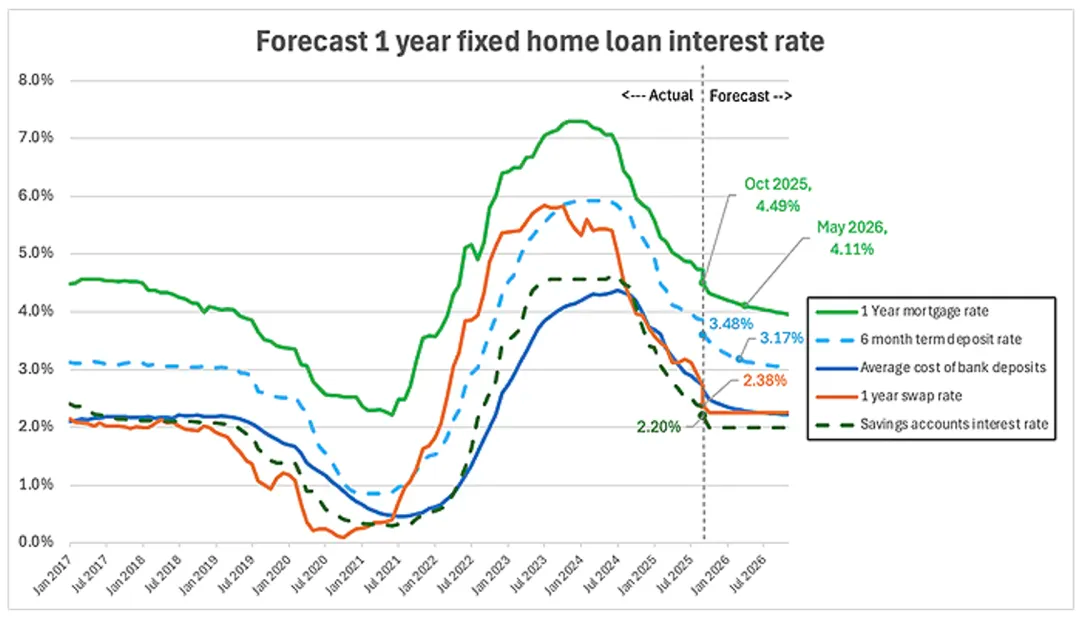
Chart of New Zealand’s one-year fixed mortgage rate trend and forecast
(Source: interest website)
Using a model based on the relationship between wholesale and retail rates over the past eight years, Squirrel expects banks to gradually reduce their overall funding costs after cutting term deposit rates, leading to further mortgage rate declines. Cunningham emphasises that 3.99% pricing is both a psychological tactic (the ‘.99 effect’) and a signal of banks competing for market share.
His view also carries an important conclusion: even if rates fall to around 4%, that would not be enough to reignite inflation. Instead, it would give New Zealand’s weak economic recovery some ‘breathing space’.
{ad}
Banks launch a rate-cutting battle
Driven by market expectations, several major banks have already begun competing on rates.
-
Kiwibank moved first, cutting its six-month fixed rate to 4.75% and adjusting its two-year rate to 4.49%, in line with the other major banks.
-
Westpac followed, cutting its two-year rate to 4.45% and its three-year rate to 4.75%, both currently the lowest among its peers.
-
The Co-operative Bank also cut its lending and deposit rates.
Notably, challenger banks have led with lower rates this time, unlike in the past when they struggled to undercut the major banks. Rates were last this low in mid-2022, when they were gradually rising out of the 3% range.
Should you fix long term or keep waiting?
Although short-term rates continue to fall, industry views differ sharply on whether borrowers should take the opportunity to lock in longer-term rates.
Independent economist Tony Alexander suggests cautious borrowers consider fixing for five years at 4.99%. He says that if he were borrowing, he would favour ‘fixing for five years for peace of mind’, particularly amid heightened global uncertainty. He recalls advising borrowers in 2021 to fix for five years at 2.99%, a choice that subsequently helped many avoid the surge in interest rates.
Some mortgage advisers take the opposite view, however. They believe one-year rates could fall to 3.99%, meaning a hasty decision to fix for five years could add 1% to interest costs. Advisers generally suggest that households with smaller mortgages, below NZ$350,000, can choose shorter terms. Those with larger mortgages, above NZ$500,000, should adopt a ‘hedging strategy’, fixing part for a longer term and part for a shorter term to reduce risk.
Closing thoughts and commentary
From stabilising house prices and rising incomes to competition among banks and the prospect of mortgage rates in the ‘3% range’, New Zealand’s first-home buyers are seeing their best opportunity to enter the market in four years. Whether they choose to wait on a shorter term or lock in a long-term rate, this period offers unprecedented flexibility for different types of borrowers.
An improving housing market does not mean the challenges have disappeared. Deposits remain difficult to save, regional differences are still substantial, and the global economic outlook is uncertain. In precisely these circumstances, buyers need calm judgement and considered planning.
The current state of New Zealand’s housing market reflects the combined effects of policy, market and economic factors, as well as a shift in buyers’ attitudes. Falling interest rates will not immediately ignite another frenzy, but they could mark an important turning point in restoring confidence and rebuilding balance.