
Entries for the 2026 NZCBIA Excellence Awards are officially open. Give your project the stage it deserves.
Entries for the 2026 NZCBIA Excellence Awards are officially open. Give your project the stage it deserves.
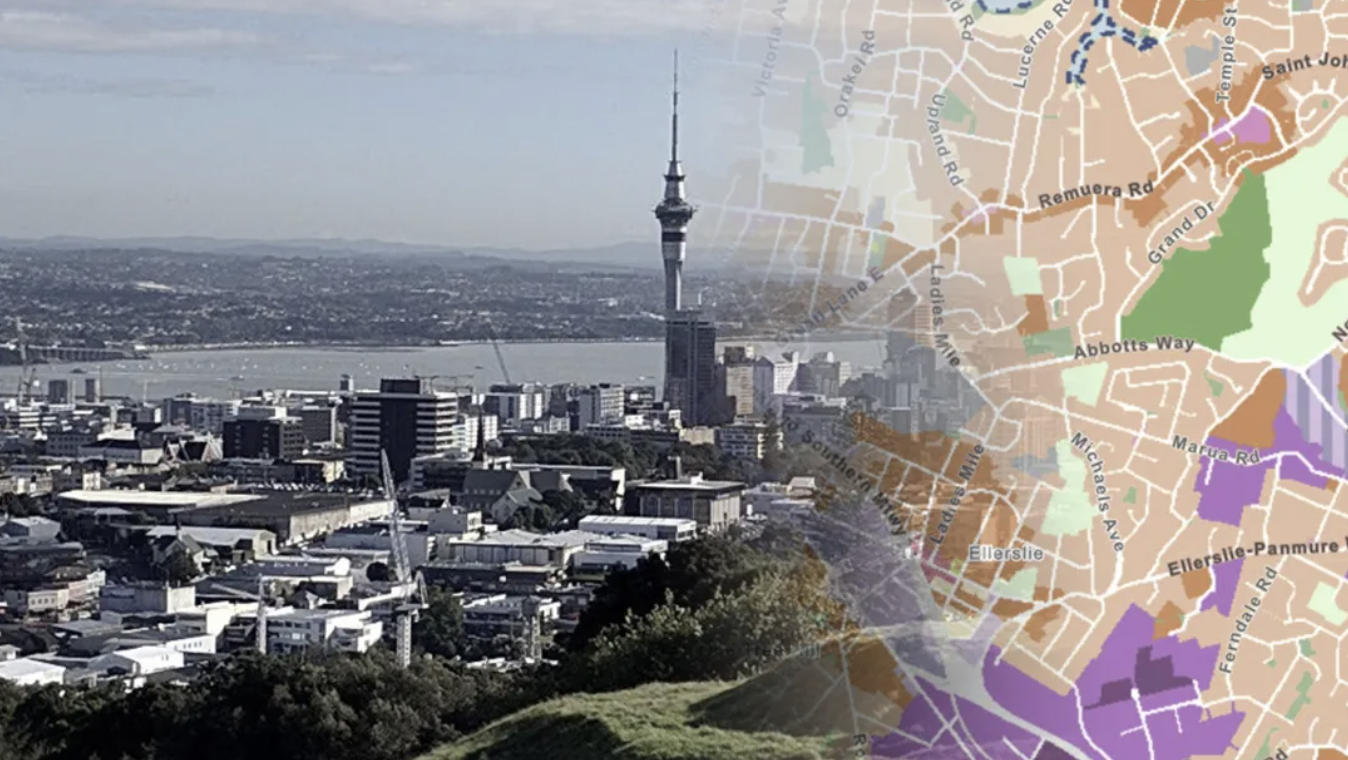
When a city’s future is expressed as “2,000,000 homes”, it becomes more than just a planning figure.
In Auckland, this theoretical ceiling on planning capacity ultimately became a political symbol: of anxiety about high-density development encroaching on backyards, of lingering concerns while memories of flooding remain fresh, and of forceful central government intervention in local planning.
Now, as election day approaches, that figure is being revised down from a theoretical capacity of 2,000,000 homes to around 1,600,000. The shift from widespread intensification towards a greater focus on the CBD and transport corridors represents a rebalancing of the approach to urban development.
One: from technical capacity to political flashpoint
In 2021, National and Labour reached a rare consensus to introduce the Medium Density Residential Standards (MDRS), allowing three homes of up to three storeys as of right on most residential sites. Known as the “3 × 3 rule”, its original purpose was to increase housing supply.
Auckland Council subsequently implemented the policy through Plan Change 78. But the Anniversary floods in 2023 changed the course of the city’s debate. Density was no longer simply an issue of efficiency; it became an issue of risk.
In 2025, central government allowed Auckland to opt out of the MDRS framework, on the condition that the new Plan Change 120 still provided comparable housing capacity: potential capacity for around 2,000,000 homes.
The “2,000,000” here refers only to theoretical capacity, not the number of homes about to be built. But that distinction has been difficult to convey in public debate. Once a figure becomes a label, it is hard for it to be understood rationally.
The policy’s evolution can be traced as follows: Auckland introduced its Unitary Plan in 2016, establishing the city’s planning framework; the “3 × 3” rule followed in 2021; Plan Change 78 was implemented in 2022; flooding brought risks to the fore in 2023; Plan Change 120 replaced the previous approach in 2025; and in 2026, the capacity target is being revised again against the backdrop of an election year.
Three changes of direction within five years tell their own story.
Two: after the floods, infrastructure becomes an invisible boundary
The sudden Auckland Anniversary floods in 2023 changed the tone of the debate.
Inner-city communities such as Sandringham are not opposed to density itself. Many residents have publicly acknowledged that the city needs to grow. What they question is this:
Should high-density development continue while stormwater systems remain inadequate?
The Central Interceptor project addresses wastewater, not stormwater drainage. Some areas still use combined wastewater and stormwater systems. During extreme weather, connections to the wastewater network have to be closed, leaving stormwater with nowhere to go but onto the streets.
Plan Change 120 has already restricted development on around 12,000 sites at risk of flooding or landslides. Yet public unease remains: is density policy truly keeping pace with infrastructure upgrades?
When growth outpaces capacity, the city uses extreme weather to deliver a reminder.
An election year and a policy adjustment
As 2026 begins, political factors are coming into play.
Several National MPs representing Auckland electorates have felt pressure at meetings with constituents. The figure of 2,000,000 has become a focal point at community meetings. Former National Cabinet minister and current Auckland councillor Maurice Williamson has been outspoken, calling the target “unsustainable”.
Prime Minister Christopher Luxon has said he is willing to “listen to feedback”. Chris Bishop has confirmed that the Government is reassessing the capacity target.
The latest reports suggest the target could be reduced to around 1,600,000 homes, with a greater focus on the CBD, areas around City Rail Link stations and major transport corridors, and less coverage of traditional “leafy suburbs”: neighbourhoods known for detached homes and tree-lined streets.
Observers have interpreted this as a political retreat. The Government’s explanation, however, is that this is democracy.
Whatever the motivation, intervening before the formal consultation process has ended certainly adds complexity to planning.
Four: the cost of changing rules — uncertainty
Auckland Council has already spent around NZ$13,000,000 during the consultation process for Plan Change 120, with a further NZ$3,000,000 spent on public consultation.
The development industry is increasingly speaking with one voice, with widespread concern about repeated changes to the rules.
The property association points out that successive policy revisions waste upfront planning costs while increasing project uncertainty and risk. Infrastructure organisations warn that excessive political intervention will ultimately raise the overall cost of infrastructure construction.
What the market fears most is not strict rules, but uncertain ones.
For developers, land acquisition, financing arrangements and design approvals often span three to five years. If policy changes direction three times, risk premiums naturally rise and projects progress more slowly. This could unintentionally delay housing supply.
Five: grow upwards or spread outwards?
At its heart, this debate over density has never been just about a number. It is about choosing a direction:
Should Auckland grow upwards or spread outwards?
Auckland Mayor Wayne Brown has repeatedly spoken out against uncontrolled greenfield sprawl, arguing that excessive expansion into rural fringes will bring higher infrastructure costs and longer-term fiscal pressure.
The message from the infrastructure sector is also relatively clear: increasing density in core areas with existing transport networks and council services is often more cost-effective than continually building new roads, pipe networks and electricity systems.
The Government’s signals of a policy adjustment suggest high-density development will be more concentrated in the CBD, around City Rail Link stations and along major transport corridors, with reduced coverage of traditional leafy, low-density neighbourhoods.
If the final policy focuses on development around transport hubs, restricts construction on high-risk sites and gives traditional suburbs some breathing room, it may be more of a pragmatic adjustment than a straightforward retreat. The question is whether that balance can remain stable over the long term.
Six: what does this mean for investors?
For long-term investors, this shift sends three signals:
First, the strategic importance of the CBD and areas around the CRL is increasing. As the scope of density policy narrows, development potential in core areas becomes more certain.
Second, dramatic changes in traditional low-density neighbourhoods become less likely. But this also implies a more moderate outlook for suburban land value growth.
Third, policy risk becomes a new pricing factor. Over the coming years, urban growth will be less linear and more influenced by political cycles.
Comment and reflection
Whether the figure is 2,000,000 or 1,600,000, what really deserves attention is whether the rules will keep changing.
Urban planning is not a matter of a year or two. Development cycles, infrastructure investment and population movements all operate on timescales of a decade or more.
If policy is recalibrated every few years, confidence will gradually erode.
Auckland needs to grow. Infrastructure is under pressure. Political cycles influence decisions. All are facts.
The question is whether we can find a more enduring consensus among these realities.
Do you favour concentrating development around transport corridors, or do you think the city should expand outwards to a moderate extent? Is this adjustment a necessary correction, or will it weaken housing supply?
Share your views in the comments.