
More than 45 Auckland projects enter the fast track: city transformation accelerates, but opportunities demand a clear view of the risks
From the city centre waterfront to Ōrewa in the north, and from Drury in the south to the Northwestern Motorway corridor, a wave of major projects is advancing across Auckland. Port expansion, a new metropolitan centre, a 55-storey skyscraper, a rapid bus corridor and an Eden Park upgrade… These seemingly separate projects are together shaping Auckland’s urban landscape for the next decade.
From the city centre waterfront to Ōrewa in the north, and from Drury in the south to the Northwestern Motorway corridor, a wave of major projects is advancing across Auckland. Port expansion, a new metropolitan centre, a 55-storey skyscraper, a rapid bus corridor and an Eden Park upgrade… These seemingly separate projects are together shaping Auckland’s urban landscape for the next decade.
According to information published on the New Zealand Government’s official fast-track projects website, more than 45 Auckland projects are now at various stages of the fast-track process, including being listed, referred, under assessment or approved. Auckland is increasingly becoming New Zealand’s ‘fast-track city’. This undoubtedly sends a positive signal to a construction industry that has endured a prolonged downturn. But for Chinese builders, subcontractors and building materials businesses preparing to participate, major projects bring financing, payment terms, scheduling and contract performance risks alongside orders.
Fast-track approvals are changing the pace of development
The New Zealand Government introduced its fast-track approvals system in 2024, seeking to provide a more coordinated and efficient approval pathway for housing, infrastructure and commercial projects of significant regional or national importance. Previously, a major project often needed resource consent and multiple statutory approvals separately, requiring repeated coordination between agencies. Fast-track approvals aim to consolidate these procedures, shorten approval times and reduce uncertainty during project development. However, entering the fast-track process does not mean automatic approval. Projects must still undergo expert panel assessment to determine whether they should be approved and what conditions should apply. Nevertheless, the system has already noticeably changed the pace of major development in Auckland, with some long-discussed plans moving into substantive stages.
Port upgrades address a long-standing infrastructure backlog
The expansion of Bledisloe North Wharf and Fergusson North Berth at the Port of Auckland is the first major infrastructure project approved through the fast-track process. Work includes constructing a new reinforced-concrete piled wharf, extending Fergusson North Berth, building a cruise passenger terminal and upgrading associated facilities. Auckland has discussed building a new cruise terminal for more than a decade. Cruise ships currently berth mainly at Princes Wharf and Queens Wharf, but as a new generation of larger cruise ships enters service, existing berths are becoming inadequate in length and handling capacity.
The new terminal will affect Auckland’s ability to keep attracting international cruise ships and other large vessels. Construction began in September 2025 and is expected to finish in early 2027. For a city whose harbour is central to its identity, the project provides more than an additional berth: it addresses an infrastructure shortfall left unresolved for years.
Drury’s growth accelerates as a new southern urban centre takes shape
Drury embodies ambitions for a new southern urban centre, and Kiwi Property Holdings’ planned Drury metropolitan centre has now received fast-track approval. The project covers around 53 hectares, including future residential land and an integrated centre combining business, retail and community activities. With the opening of new railway stations at Drury and Paerātā, the area is expected to gradually develop into a self-contained urban centre with homes, jobs, commerce and public transport. Infrastructure Minister Chris Bishop says the project is expected to inject more than NZ$1,450,000,000 into Auckland’s economy over the next 11 years and create around 3420 direct full-time jobs in construction and related industries. Over the next 30 years, the Drury area could accommodate 22,000 new homes. But whether roads, rail connections, schools, healthcare, water supply and wastewater infrastructure arrive on time will determine whether Drury becomes a fully functioning new urban centre.
CBD car park building to become a twin-tower landmark
The multibillion-dollar redevelopment of Auckland’s Downtown Carpark has also received fast-track approval. The existing seven-storey car park will be demolished and replaced by a 55-storey commercial office building and a 45-storey mixed-use residential and hotel tower. The project will also provide around 3450 square metres of public space, with new pedestrian laneways connecting Customs Street West and Lower Hobson Street.
Work is expected to begin in early 2027, with completion targeted for 2031. Once finished, the project could reshape both Auckland’s skyline and the gateway from the city centre to the waterfront. However, timely delivery of the offices, hotel and apartments still depends on financing conditions, commercial leasing, tourism performance and property market demand over the coming years. There is still a long way to go from architectural renderings to completion.
Transport, historic neighbourhoods and a stadium also join the fast track
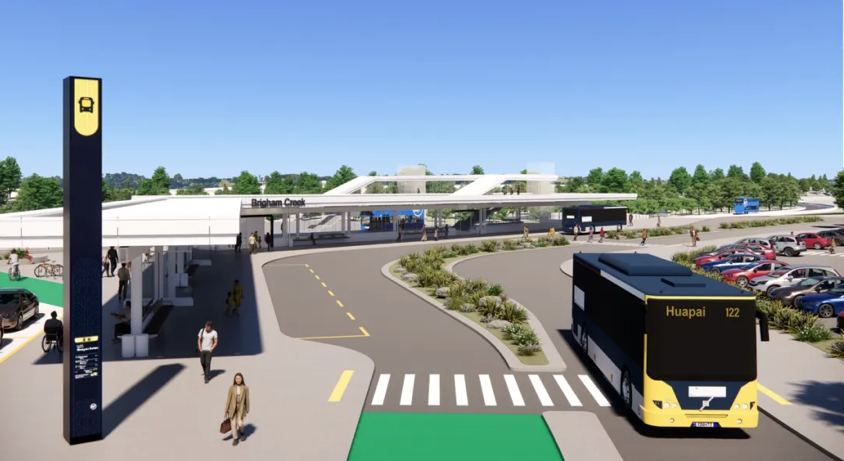
The Northwest Busway plan draws on the North Shore’s Northern Busway model, proposing a rapid bus system along the Northwestern Motorway and parts of SH16 to connect the city centre with the Brigham Creek area. The northwest’s population has grown rapidly in recent years, but public transport has long lagged behind. If the project proceeds smoothly, it could improve commuting and influence future residential and commercial development in Westgate, Hobsonville and surrounding areas. Meanwhile, the major mixed-use Devonport Lanes development has been referred into the fast-track process. Supporters argue that its proximity to the ferry terminal makes it suitable for additional housing and commercial space. Opponents worry that large buildings would worsen traffic pressure and damage the historic character of the century-old seaside town.
Eden Park also hopes to advance an upgrade through fast-track approvals, including redeveloping the north and south stands, building a hotel and student accommodation, and adding a retractable roof. However, construction costs, government support, transport and effects on nearby residents could still spark debate. These projects show that entering the fast-track process does not make community concerns disappear. Approval times can be shortened, but long-term effects on urban character, residents’ lives and public finances still require careful consideration.
Approval does not guarantee construction, let alone profit
After falling demand, rising costs and company liquidations, this wave of projects does offer the construction industry new orders and job opportunities. But fast-track approvals primarily address approval efficiency; they do not automatically resolve financing, bank lending, presales, development costs or market demand. Entering the fast-track process does not mean funding is secured. Approval does not mean construction will begin immediately. Even after a smooth start, rising costs, design changes, weak sales or changing financing conditions can cause delays. Success therefore cannot be measured solely by the number of projects approved. It also depends on how many actually begin construction, whether they finish on time, and who ultimately pays for supporting infrastructure.
Chinese builders need to look beyond orders and establish who will pay
More than 45 projects entering the fast-track process will create substantial potential demand for civil works, roads, drainage, structural construction, building materials, mechanical and electrical installation, and interior fit-outs. Chinese main contractors, subcontractors and building materials businesses also have opportunities to participate. But larger projects do not necessarily carry lower risks.
Chinese businesses preparing to participate must look beyond renderings and approval progress to check developers’ funding sources, financing terms, ability to pay and construction staging. They should be cautious about excessively long payment terms, arrangements dependent on future sales proceeds, and contracts without secured funding. Businesses also need to assess their own cash flow, staffing, material price commitments and ability to fulfil contracts. If they accept excessively low prices to win a major project, or commit substantial labour and materials upfront without adequate payment safeguards, financial problems at the developer or main contractor can quickly transmit risk down the supply chain. Subcontractors and suppliers with weaker bargaining power are often hit first.
Fast-track approvals are indeed creating a wave of opportunities worth watching, but an approval document is no notice to proceed, and certainly no guarantee of profit. For Chinese builders, the most important skill ahead may be assessing the financial backing, payment safeguards and realistic delivery prospects behind a project, alongside winning the work. With more than 45 projects advancing, will Chinese builders participate in the potential orders and accompanying risks? Share your thoughts.