
What will New Zealand’s buildings look like when security guards no longer keep watch?
“There isn’t a single security guard in this building?”
“There isn’t a single security guard in this building?”
Many people might find that question astonishing at first. Yet in New Zealand, a growing number of new residential communities, commercial complexes and business park developments are indeed moving in this direction.
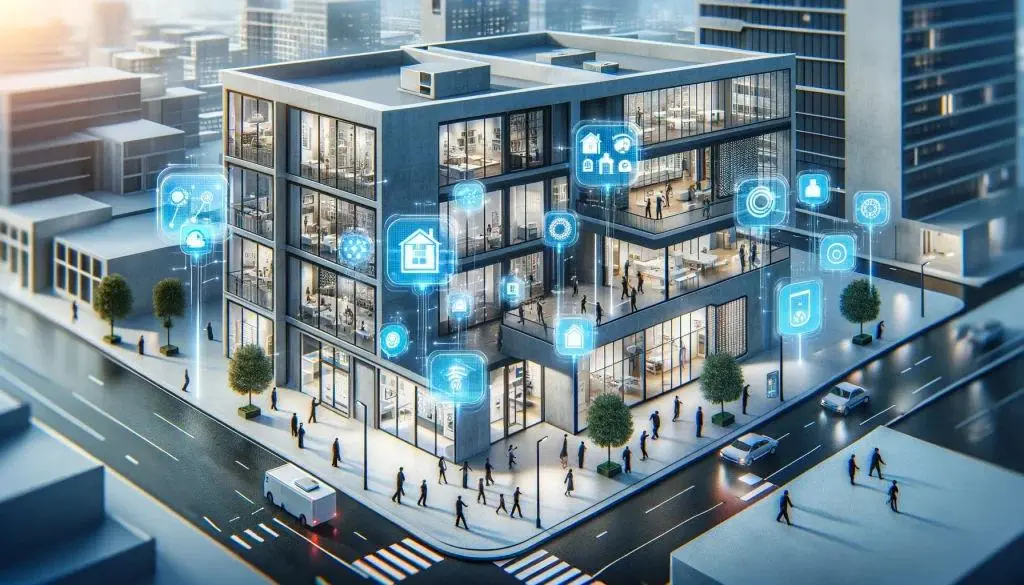
Of course, this does not mean buildings need no human management. Rather, many tasks that once required constant human attention are gradually being handed over to systems. Night patrols, identifying unfamiliar vehicles, alerts about unusual activity in shared areas, managing car park traffic and recording visitor access, for example, can all be assessed and addressed more efficiently through smart platforms.
In other words, buildings are gradually moving from management that relies on people towards operations supported by systems.
Rising labour costs are forcing changes in building management
A large residential community or commercial development once typically needed security patrols, staff to monitor CCTV, receptionists to register visitors, property managers to resolve access control issues and people on site to coordinate parking. These tasks are not complicated, but they require substantial staffing.
In New Zealand in particular, labour costs have long been a practical challenge for property managers and developers. Overnight security is expensive, suitable technical staff are difficult to recruit and property management teams have limited resources. Yet residents and tenants increasingly expect efficient service, a sense of safety and a better user experience.
This has prompted many developers and property management companies to reconsider:
Which tasks must people perform, and which can be handled by systems?
The next generation of buildings is starting to “think for itself”
These changes are accelerating the arrival of AI and smart platforms in the building sector.
Today’s smart systems do far more than record and replay video. A mature smart building system can automatically recognise number plates, detect unusual pedestrian activity, analyse behaviour using AI, issue perimeter intrusion alerts, provide centralised remote management and automatically coordinate responses across different events.
For a simple example, if an unfamiliar vehicle repeatedly circles a car park, the system can automatically identify unusual behaviour and alert the control centre. If someone enters a restricted area late at night, the platform can send an immediate notification. If a vehicle blocks a fire access route, cameras can also detect it automatically and generate an alert.
Previously, these situations often came to light only through security patrols, complaints to property managers or repeated manual checks of CCTV footage. Now, systems can make an initial assessment earlier and flag the issues that require human intervention.
The real change lies in how buildings operate
Many people first encountered Dahua through its video surveillance products. Today, however, its involvement in New Zealand projects extends beyond supplying security equipment in the traditional sense.
From smart communities, commercial complexes, car park management, AI perimeter protection, building intercoms, EV charging, commercial displays and unified operating platforms to data integration and remote management across entire buildings, Dahua is providing more comprehensive smart space solutions.
The real value of these solutions lies in helping buildings make their smart systems clearer, more stable and easier to control during ongoing operations, with customer satisfaction improving as a result, rather than simply adding more equipment.
For many buildings, the problem is insufficient intelligence rather than age
In day-to-day operations, many property managers encounter a similar issue: operating costs often spiral because systems function independently of one another, rather than because the building is old.
Surveillance runs on one system, access control on another and parking on yet another, while the property management platform may need to be operated separately too. Every system is running, but data cannot be shared and responses cannot be coordinated. Ultimately, considerable staff time is still needed to switch between interfaces, cross-check information and resolve issues.
This is the fragmentation commonly found in traditional building operations.
That is why more projects are focusing on unified platforms. The buildings that are truly competitive in future will not necessarily have the most equipment; they will be the easiest to manage, the most reliable to operate and the best at reducing ongoing costs.
Operating with fewer staff will become a new trend for New Zealand buildings
As labour costs, property management pressures and expectations of the tenant experience continue to rise, operating with fewer staff will become a trend in New Zealand’s building sector.
This is not about impersonally cutting services. It means using technology to handle repetitive, inefficient and frequent management tasks, enabling property teams to identify problems faster and allocate resources more accurately, while giving users a more consistent experience.
A building of the future may increasingly resemble a system that can run automatically. It will know where something unusual is happening, where maintenance is needed and when to alert property managers. It may even use data to help reduce energy waste.
In this process, what matters extends beyond the hardware itself to the combination of AI, platform functionality, system integration, local service and long-term operation and maintenance capabilities.
Competition in the next generation of the building industry may extend beyond who can construct the most attractive building to who can keep it operating more intelligently, more efficiently and for longer.