
Explained: Are prefabricated homes the answer to New Zealand’s housing crisis?
A wall, a bathroom or even an entire room can be built in a factory before being transported to a building site for assembly. While foundations are being laid on site, factory production is already under way; tasks that once had to be completed in sequence can now potentially happen at the same time.
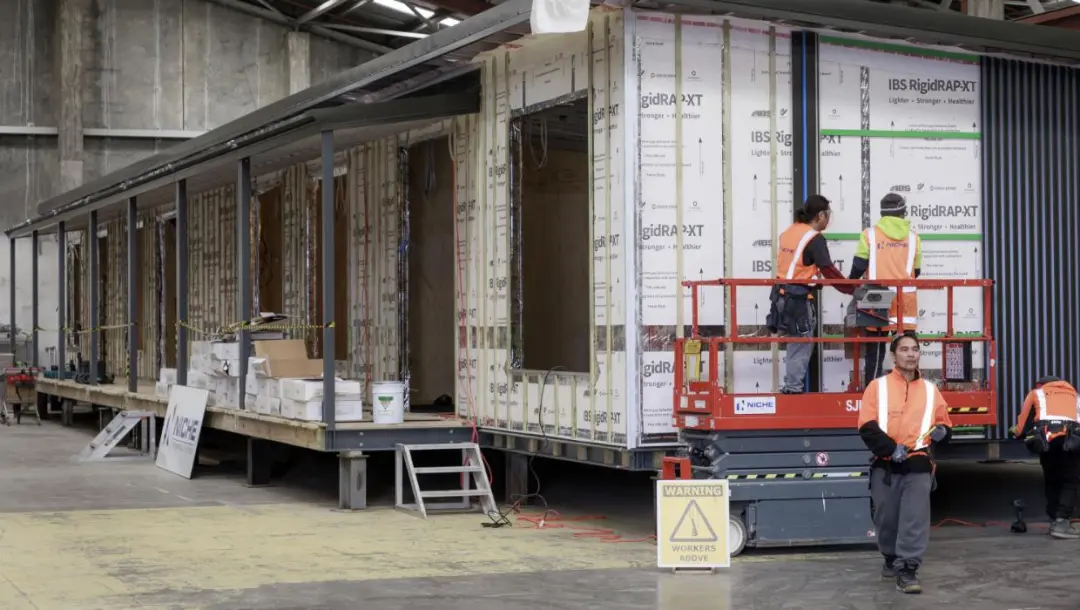
A wall, a bathroom or even an entire room can be built in a factory before being transported to a building site for assembly. While foundations are being laid on site, factory production is already under way; tasks that once had to be completed in sequence can now potentially happen at the same time.
Prefabricated homes sound like just the answer New Zealand needs: faster to build, less affected by the weather and perhaps cheaper too. But building a home quickly in a factory does not mean it can be delivered to its occupants sooner or at a lower cost.
Janine van Leeuwen, a director of New Zealand’s offsite construction industry organisation Offsite NZ, recently pointed out that the industry focuses too heavily on manufacturing technology and can overlook how projects are delivered. In her view, prefabrication alone will not automatically speed up projects or save money; its advantages can only be realised by coordinating design, approvals, procurement, factory production, transport and on-site construction.
Faster — but where are the time savings?
In conventional construction, one task often has to finish before the next can begin. Prefabrication changes that sequence: while building components are being manufactured in a factory, foundation work and other preparations can proceed on site. Shorter on-site installation times may also reduce the risk of weather delays.
Van Leeuwen told The Post that an Australian study estimated factory prefabrication could reduce construction costs by up to 20% and construction time by up to 50%, provided conditions such as sufficient scale were met. But she also stressed that New Zealand has no equivalent local research yet. These figures illustrate the potential; they should not be treated as outcomes that New Zealand projects can generally achieve.
A report by Australia’s SBS Chinese explained that prefabrication involves more than simply transporting an entire house from a factory. Some projects manufacture panels such as walls, roofs and floors for assembly on site; others prefabricate three-dimensional modules, such as integrated bathrooms, completing some plumbing, electrical work and interior fit-out in the factory.
For homebuyers, the most appealing promise is simple: less time waiting and less uncertainty during construction. Yet there is a long chain of steps between faster manufacturing and moving in sooner.
The home is built, but is the site ready?
If the modules are complete but the foundations are not ready, if transport vehicles cannot access the site, or if lifting arrangements have not been made in advance, even the fastest factory production cannot bring forward final delivery. Finished components may even need to be stored, adding costs.
This is precisely why Van Leeuwen emphasises delivery planning. Prefabrication allows factory and site work to proceed in parallel, but also requires them to align precisely at critical points. Once the design is finalised, subsequent changes may affect manufacturing, transport and installation; a delay at any stage could cancel out the time saved by producing components in advance.
Finance can also become an obstacle. In a company-produced advertorial, New Zealand prefabricated home business Advance Build noted that some projects encounter issues with on-site installation, module transport and lending arrangements. These are practical risks worth considering, but the article is promotional material and cannot establish how widespread these problems are across the industry, or which company’s solutions are more effective.
Consumers therefore need to compare more than the number of days it takes to build a home in a factory. They also need to consider the total time and cost involved, from design to obtaining consent, from factory dispatch to on-site installation, and through to final handover.
A home can be prefabricated, but a supply chain cannot survive on a single order
Even when an individual project succeeds, prefabricated homes face another challenge if they are to become an effective response to the housing shortage: manufacturers need a steady flow of projects to give them the confidence to invest in equipment, staff and capacity.
Van Leeuwen believes it will be difficult to achieve scale if the industry continues to treat prefabrication as a series of standalone projects. She suggests the government could draw on demand for education facilities, defence buildings and social housing to plan a continuing pipeline of projects across agencies and by region, giving manufacturers visibility of future orders.
She cited Fletcher Building’s closure of its prefabrication business Clever Core in 2025 as an example of the difficulties facing the industry. However, a business closure has its own particular operating context, and this case alone cannot establish that unstable orders were the cause.
New Zealand has now developed an offsite construction roadmap and presented a draft to Building Minister Simon Watts and the industry. Whether the roadmap proves effective will depend on whether it leads to concrete projects, and whether those projects can form a stable, deliverable construction programme.
Lessons from Australia are useful, but its figures cannot simply be applied here
Australia also faces pressures on housing supply, construction costs and labour, which has drawn attention to prefabrication. SBS Chinese reported that factory production helps bring materials, production processes and finished-product testing into more standardised procedures; however, issues such as approvals, insurance and liability still give some developers pause.
These experiences suggest avenues for New Zealand to investigate, but they cannot directly provide local answers. The countries differ in their approval systems, transport conditions, construction markets and project sizes. Australian project timelines or costs cannot simply be translated into how much New Zealand homebuyers could save or how much sooner they could move in.
Answering whether prefabricated homes can ease New Zealand’s housing pressures requires more data from local projects: how long did it actually take from signing the contract to handover? What was the final cost once foundations, transport, crane lifting, finance and approvals were all included? How did quality and subsequent maintenance measure up? These questions matter more than comparing factory production speeds alone.
Observations and reflections: Homes can be built faster, but who can get them delivered?
The appeal of prefabricated homes lies in moving part of construction into a factory, allowing production and on-site work to proceed simultaneously. But shorter construction times alone cannot solve the housing crisis. If land, infrastructure, approvals or finance continue to hold projects up, the time saved in the factory may be lost elsewhere.
There is another question here that deserves closer scrutiny: even if prefabricated homes reduce construction costs, who ultimately receives the savings? Developers may reduce their risks and improve project viability, while homebuyers hope for improvements in both prices and delivery times. But with land prices, financing costs and market pricing all playing a part, cheaper to build does not necessarily mean cheaper to buy. Assessing whether prefabrication can improve housing affordability requires looking at actual costs across the entire project and the final sale price, alongside factory production efficiency.
Scale is equally critical. Factories need stable orders to expand capacity; without enough projects, economies of scale are difficult to achieve. And if concerns about demand, approvals or delivery risks make developers unwilling to place orders consistently, manufacturers will struggle to invest. This is a challenge that government, developers, financial institutions and manufacturers need to resolve together. Whether public housing and other public building projects can provide steady demand deserves continued attention; public contracts themselves must also be assessed against cost, quality and delivery outcomes.
Perhaps the greatest promise of prefabricated homes, then, is the opportunity to reorganise the homebuilding process, rather than a technological miracle that builds homes overnight. New Zealand needs local projects to answer some specific questions: how much time was actually saved from project inception to moving in? Once foundations, transport, crane lifting, approvals and finance were included, how much money was ultimately saved? What was the quality like? Were these benefits passed on to the people who truly need housing?
So, would you consider buying a prefabricated home? What matters most to you: price, construction speed, quality, or lending and ongoing maintenance assurances? If you have lived in, bought or helped build a prefabricated home, you are also welcome to share your experience in the comments. What do you think about the potential for prefabricated homes to ease New Zealand’s housing pressures?