
Auckland home sells for NZ$2,150,000, Sydney home reportedly bought for A$5,300,000: what does Ardern’s trans-Tasman move reveal about the two housing markets?
How much did Jacinda Ardern’s former Auckland home actually sell for? The answer has finally emerged: NZ$2,150,000.
How much did Jacinda Ardern’s former Auckland home actually sell for? The answer has finally emerged: NZ$2,150,000.
According to Stuff’s report on 29 September, property records show that Ardern and her husband Clarke Gayford’s home in Sandringham, Auckland, sold for NZ$2,150,000. A week earlier, Australian media reported that the couple had bought a house in Dee Why on Sydney’s Northern Beaches for around A$5,300,000. News of the Sydney purchase comes from media reports; the new home’s exact location has not been publicly confirmed.
A sale and a purchase, spanning the Tasman Sea. New Zealand and Australian dollar amounts cannot be compared directly, and the two properties differ in location, type and price bracket. The Ardern family’s move does, however, offer an opportunity to examine the two housing markets: when sales slow, what kinds of homes can still persuade buyers to commit?
The former Auckland home: sold after eight years, with a nominal price gain of NZ$410,000
Ardern and Gayford bought the Sandringham home in 2018. According to property website OneRoof, they paid NZ$1,740,000. Based on the newly disclosed sale price of NZ$2,150,000, the nominal price gain over eight years was NZ$410,000, or around 23.6%.
That does not mean they ultimately made a profit of NZ$410,000. Renovations, mortgage interest, insurance, council rates, maintenance and selling costs over their ownership all need to be taken into account when calculating the actual return; those expenses have not been fully disclosed. Inflation over the eight years also means that a nominal price rise is not the same as an increase in real purchasing power.
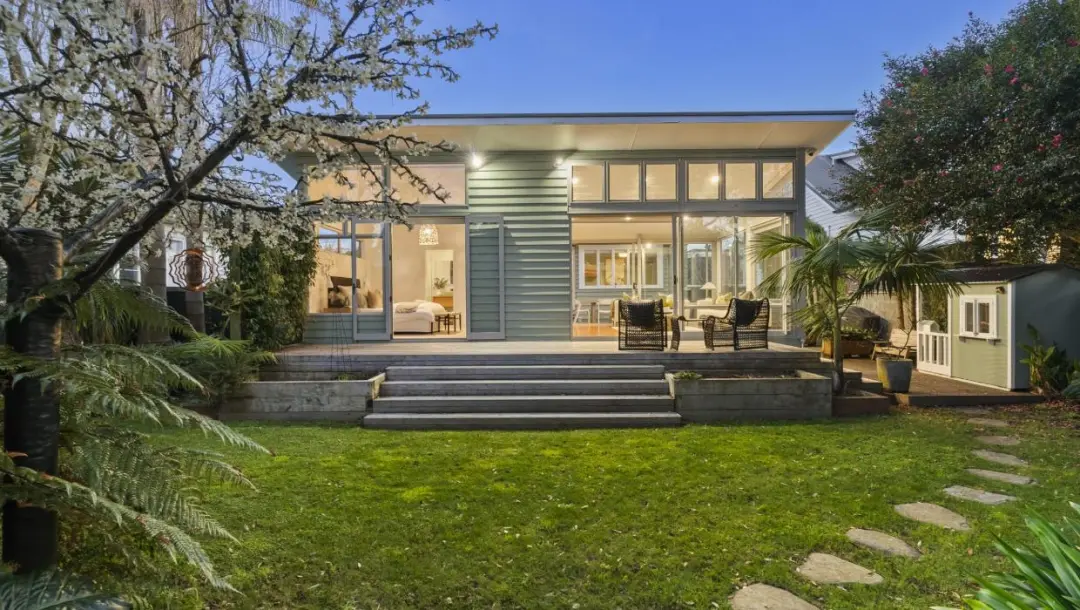
The four-bedroom, two-bathroom home sits on approximately 643 square metres of flat land, with a floor area of around 155 square metres. Its weatherboard exterior and front veranda retain the character of an older home, while the extended interior connects to the garden and deck.
The house also bears many personal touches. Gayford built the deck himself while caring for their young daughter Neve, and the home appears in family footage used in the documentary Prime Minister. For buyers, however, it ultimately comes back to the property itself: it offers the land, indoor space and outdoor areas for family life that come with a standalone home.
The home was listed in June this year and sold on 8 July after negotiations moved to a private sale during the auction. Its capital value in May 2024 was NZ$2,300,000, putting the final sale price NZ$150,000 below that figure. A capital valuation reflects a particular assessment date. A sale below that valuation cannot automatically be equated with a loss for the owner, nor can this single property establish whether prices across Sandringham are rising or falling.
The new Sydney home: what is seaside living in Dee Why worth?
According to media reports, the Ardern family bought a home in Dee Why on Sydney’s Northern Beaches for around A$5,300,000. It was reported as one of the area’s high-priced sales so far this year. Local agents have speculated about which property it might be, but its exact location has not been publicly confirmed.
Dee Why has more than one type of home, and no single price represents all its properties. The area includes apartments as well as standalone homes near the beach with views. Proximity to the sea, whether a property has sea views, and the condition of the house and land can all create price differences within the same suburb.
The area offers a beach, surfing, waterfront restaurants and cafés, and residential streets quieter than those in the popular tourist destination of Manly. There is no train line, but residents can take buses into central Sydney. For families wanting to make seaside living part of everyday life, Dee Why offers a distinctive way of living.
However, a sale at A$5,300,000 does not mean Sydney’s housing market is rising across the board. Property data firm Cotality noted that Sydney dwelling values fell 1.4% in August this year, leaving them 7.1% below their previous peak. Another report from the firm in September showed that values for Sydney’s top quarter of houses by price had fallen 10.7% from their peak.
Even in a declining market, eye-catching high-priced sales can still occur. Whether a home meets a particular buyer’s needs and how house prices are moving across an entire city are separate questions.
The two housing markets: Auckland sales slow, Sydney prices retreat
Auckland’s situation cannot be summed up by a single celebrity home either.
Data from the Real Estate Institute of New Zealand (REINZ) for August showed that the Auckland region’s median residential sale price was unchanged from a year earlier, but the median time taken to sell reached its highest level for any August on record. That month, Auckland recorded 3278 new listings, broadly in line with the same period last year. REINZ also noted that Auckland’s stock of properties for sale had exceeded year-earlier levels for 31 consecutive months.
These figures depict a market with more homes available and more time for buyers to choose. Nationwide, the median residential sale price in August was NZ$750,000, down 1.3% year on year, while sales volumes fell 13%. Sales are slowing nationally, but analysis of Auckland house prices should still be based on Auckland data.
Sydney’s adjustment is showing up more in prices. Cotality’s data showed that Sydney dwelling values continued to fall in August. The firm attributed pressure on the market to weaker demand and an increase in properties for sale.
Both markets are changing, but in different ways; the sale of an individual home cannot replace an investment analysis of an entire city.
Observations and reflections: the former prime minister’s choice—what can ordinary buyers learn from it?
Celebrity property transactions always spark discussion, with striking prices and compelling stories. But a family’s decision about where to live is not necessarily based on predictions about house prices. Public reports have not stated that the Ardern family bought the Dee Why home as an investment. Work arrangements, family life, ease of travel to and from New Zealand, and neighbourhood preferences can all influence the choice of a home to live in. Outsiders cannot determine how much weight the family gave each factor.
For ordinary buyers, there is likewise no standard answer to ‘where is it more worthwhile to buy?’ that can be separated from personal circumstances. The former Sandringham home and the reportedly purchased Dee Why home offer different living conditions. Some people are willing to pay for land and a garden; others place more value on being near the beach. Some can afford higher ownership costs, while others need to leave more room in the household budget.
If the discussion is about investment, a different calculation is needed: purchase and selling costs, mortgage interest rates, insurance and maintenance expenses, potential rental income, and exchange-rate movements when owning property across countries. Two sale prices alone can neither establish the actual return nor predict future trends.
Perhaps the most noteworthy aspect of the Ardern family’s trans-Tasman move is that both markets are posing a similar question to buyers: when people are no longer rushing to bid prices higher, what is it about a home that persuades them to buy?
If it were you, would you rather pay for land and family space, or for seaside living?