
Warm in winter and cool in summer, these homes are widely promoted in Europe. But in New Zealand, it is a tale of woe!
It is the depths of winter, yet the workers inside are all working in T-shirts and shorts without feeling cold at all.
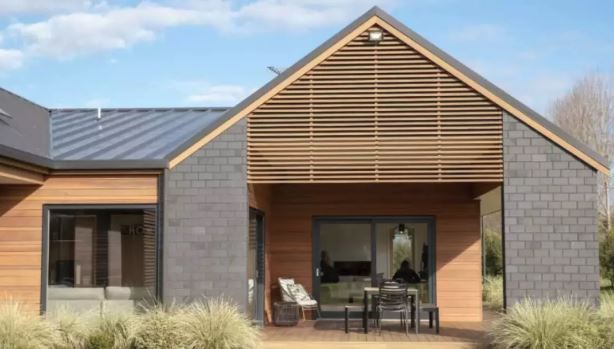
It is the depths of winter, yet the workers inside are all working in T-shirts and shorts without feeling cold at all.
This is not because the house has air conditioning, but because it is a passive house!
Passive houses originated in Germany in the 90s of the 20th century. They use exceptionally thick insulation and sophisticated windows and doors, so virtually no heat escapes and no cold draughts get in. These energy-efficient homes are called passive houses because they need little or no actively supplied energy.
Passive houses can be heated by sunlight and can even retain heat released by appliances or their occupants’ bodies.
New Zealand has now started building passive houses too! But progress seems to be an uphill struggle!
Ross Brown and Julie Brown founded building company Brown Construction in 1997.
Ross Brown said his team realised passive houses were the right choice when he saw workers comfortably working in T-shirts and shorts inside one, while feeling cold in another new house built to standard requirements.
Ross said passive houses were already the building standard in many European countries.
“But uptake is relatively low in New Zealand. New Zealanders tend to think that if they are cold, they should put on another jersey or light the fire.”
Ross Brown and Julie Brown founded Brown Construction in 1997.
Ross pointed out that if houses were well built, we would not need to fend off the cold as we do now. A passive house works like a thermos flask, using an airtight seal to maintain a constant indoor temperature.
{Ad}
Ross’s cousin helped establish eHaus, a nationwide passive house design and construction company. Ross took a keen interest at the time. 5 years ago, his company, Brown Construction, became an authorised eHaus builder for Waikato and the Bay of Plenty.
Recently, Brown Construction stopped building conventional homes to focus exclusively on passive houses.
Ross said that, put simply, a passive house is like a thermos flask: its airtight structure keeps the indoor temperature constant with little intervention. It also combines careful design, more than 2 times the standard amount of insulation, a heat-recovery ventilation system, and airtight European windows and doors.
The heat-transfer ventilation system draws in fresh air at room temperature without losing heat from inside.
At the passive house show home in Taupiri, Waikato, the temperature difference is obvious as soon as you step inside. Ross said that on the coldest morning, it was minus 3 degrees outside, while the indoor temperature was 19 degrees without any heating switched on.
Passive houses are warm in the depths of winter and pleasantly cool in summer.
Julie Brown said these homes could also save a substantial amount on electricity bills. For the Taupiri passive house, with 4 bedrooms and 2 bathrooms, monthly electricity bills range from around NZ$20 at the lowest to NZ$56 at the highest.
The home’s hot water is solar-heated, and filtered air means residents do not have to worry about pollen, dust or insects. “The house is also free from cold and damp, with nowhere for mould to grow.”
Passive houses have no damp or mouldy areas.
Why have passive houses not become widespread in New Zealand?
These passive houses cost 15% to 20% more to build than ordinary homes.
Take the Taupiri show home as an example. This lifestyle property has 6300 square metres of land and a floor area of 252 square metres, with an expected price of NZ$1,500,000. It is one of just 3 certified passive houses in Waikato.
Julie Brown believes there are few passive houses in New Zealand partly because land may be scarce, and partly because people want homes built quickly or face financial constraints. The short-sighted approach of building a house, living in it briefly after completion and then selling it on also makes it difficult for passive houses to become widespread in New Zealand.
Julie Brown demonstrates a European window.
Most of Brown Construction’s clients are young people and those with strong environmental awareness. Some older clients want a warm, healthy home. Others have lived overseas and have a deeper appreciation of quality housing from having experienced it themselves.
When it comes down to it, New Zealanders simply do not have the money!
Finally, a reminder that a series of new policies takes effect today.
1. From 1 July, all rental properties must have ceiling and underfloor insulation installed to the legally required standard, meaning a thickness of at least 100 mm. All rental property owners must attach a statement to tenancy agreements confirming that they comply with the new healthy homes standards;
2. From today, nationwide fuel tax rises by 3.5 NZ cents per litre (4 NZ cents including GST). The increase is expected to add about NZ$1 to the average vehicle’s weekly fuel bill. Road user charges also rise by 5.5%, with the charge for a diesel car increasing from NZ$59.13 to NZ$62.61 per 1000 kilometres.
3. From 1 July, the plastic bag ban takes full effect. All plastic bags with handles that are less than 70 microns thick, including degradable plastic shopping bags, are banned. Retailers found breaching the ban face fines of up to NZ$100,000.