
Prefabricated construction in New Zealand: limitless potential, an untapped goldmine
Prefabricated construction (prefab), also known as offsite manufacturing, is a revolutionary change in the history of building.
Before prefabricated construction emerged, housebuilding was fundamentally no different from 100 years earlier. People mixed concrete, laid bricks and tiled bathrooms on site… The cranes were simply more powerful and the tower cranes taller.
Prefabricated construction is different. Major building components are highly modular: external walls, bathrooms and structural frames are produced on factory production lines, then transported to the site for assembly. For low-rise buildings such as standalone houses, the entire home can be manufactured in a factory, transported to the site and made ready to live in simply by connecting water and electricity.
Liu Gang, an expert committee member of China’s national prefabricated construction industry technology innovation alliance and director of the CSP research, development and promotion centre at China Architecture Design & Research Group, says traditional construction is a civil engineering concept, while prefabricated construction is a product concept. ‘The biggest difference is that one is built, while the other is manufactured.’
The distinction between building and manufacturing brings an enormous difference in construction costs. New Zealand’s high residential construction costs have many causes: labour shortages, expensive labour and weather-related delays, among others. Industrially manufactured prefabricated homes can resolve all these problems perfectly.
Put simply, prefabricated construction has three main advantages:
Lower labour costs: Major building modules are produced in factories, leaving workers on site only to assemble them, saving substantial labour. Greater efficiency and shorter construction periods: Assembling modules on site is much faster than traditional housebuilding.
Weather-independent production and reliable schedules: New Zealand’s wet winters often prevent work on site, causing delays. The main modules of prefabricated buildings, however, are produced in factories, allowing uninterrupted production.
In 2018, the high-rise apartment project at 111 Dixon Street in Wellington used 228 prefabricated bathrooms manufactured in China, shortening construction by 6 months and substantially reducing costs.
New Zealand’s Minister for Building and Construction, Jenny Salesa, says the country’s unprecedented construction boom will continue until at least 2023. Without swift action, the shortage of skilled construction workers will rise from 30,000 to 50,000.
With fewer than 5 years remaining until 2023, New Zealand simply cannot train 50,000 construction workers domestically. That leaves only two solutions: either bring in large numbers of overseas workers,
or rely on industrially manufactured prefabricated homes to address the labour shortage. Given that New Zealand’s immigration policy is unlikely to be substantially relaxed in the foreseeable future, prefabricated homes have become the only option!
{Ad}
As products of factory production lines, prefabricated homes have a uniform appearance. Some worry that their wider adoption could diminish New Zealand’s architectural diversity. Liu Gang says this concern is entirely unnecessary.
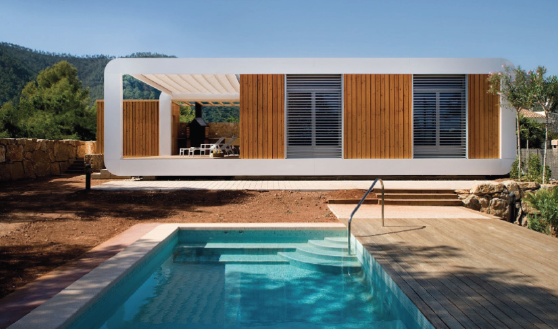
‘Prefabricated buildings can be very beautiful too. The key is stronger planning at the broader level and better design when projects are implemented. Industrial production and standardisation do not necessarily mean everything looks the same. Prefabricated homes can be found in upmarket residential areas and beautiful scenic locations in Western countries alike.’
Several major hurdles to wider adoption in New Zealand
Australia’s residential construction costs are lower than New Zealand’s, and highly standardised housing is one important reason.
Huang Haixin, head of Archiland Architecture in Auckland, says this is particularly disheartening.
‘Prefabricated construction started later in Australia than in New Zealand, yet Australia has long since moved ahead. Homes with a 10-year Master Builder guarantee are already considered relatively good in New Zealand, but leading Japanese prefab companies aim to offer lifetime guarantees.’
Prefabricated construction is already a global trend. New Zealand’s expensive housing and shortage of construction workers make it an ideal place for prefabricated homes to flourish. What is preventing their widespread adoption here? Huang Haixin, who has studied prefabricated housing for many years, identifies 5 main reasons.
- A complex building approval system
Under New Zealand’s current building approval system and its level of efficiency, every major stage on site, such as foundations, framing and external walls, must pass inspection by council officials before work can proceed to the next stage.
Prefabricated housing, however, relies on industrial production, replacing manual construction on site with manufactured products. Factory production lines cannot stop to wait for inspections. This is a major bottleneck.
- A cumbersome building material certification system
New Zealand certifies building materials from Commonwealth countries relatively quickly, but has yet to establish a mature system for recognising certification from non-Commonwealth countries. Asking a small country to understand the certification systems of so many countries around the world is indeed beyond its capacity.
New Zealand also has very distinctive building standards. Given its small market, manufacturers in China and elsewhere are reluctant to produce materials to special standards solely for such a limited market.
- Production capacity and prices
New Zealand’s factories have limited production capacity. Without higher volumes, prices cannot come down.
When materials are imported, local interest groups use every means to defend their interests. Germany’s Knauf plasterboard, for example, offered good quality at a low price and saved the New Zealand Government 6% in costs during the Christchurch rebuild. Ultimately, however, even a powerful international company could not overcome entrenched local interests: local players drove the world-renowned Knauf out by controlling building standards.
- An incomplete supply chain, particularly persistently high logistics costs
Prefabricated housing components need cranes to lift them into place on site. New Zealand’s shortage of cranes means hire is expensive and bookings involve waiting. This increases both time and financial costs, eroding the advantages of prefabricated housing.
- New Zealand housing is characterised by its many standalone homes. Owning a home with a 1/4-acre section is also known as the Kiwi Dream.
Almost every house on a street looks different. Prefabricated homes, however, are industrial products, and large-scale production is needed to realise their cost advantage. Producing a particular standalone home for a single customer offers little cost advantage over traditional construction.
Prefabricated housing is an untapped goldmine
Although prefabricated housing has struggled to adapt to New Zealand, Huang Haixin believes this is temporary. With large numbers of higher-density homes being built in Auckland, prefabricated housing represents an enormous untapped goldmine.
Auckland’s housing crisis results from a combination of expensive land, costly building materials, high labour costs and low efficiency. Prefabricated housing resolves these problems perfectly. It is also naturally suited to higher-density housing such as apartments and high-rise commercial developments, offering a targeted remedy for reducing costs and shortening construction times.
Both Pākehā and Chinese builders are seeking ways to overcome the 5 challenges described above.
There is good news to share: Chinese businesses in New Zealand have already found a way forward by drawing on the advantages of ‘Made in China’. At the forthcoming 2019 New Zealand International Building Expo & Summit, ‘OFF SITE, OFF SHORE’ (prefabricated construction and offshore prefabrication) will be a seminar theme.
How can prefabricated housing break through? How can you share in the opportunity offered by higher-density housing construction, the kind that comes along only once in decades? Several experts will discuss these questions and share their insights with you!