
Financial institutions’ obligations under New Zealand’s anti-money laundering regime
Since New Zealand’s Anti-Money Laundering and Countering Financing of Terrorism Act (the AML Act) came fully into effect in 2013, two Chinese-owned financial companies in Auckland have been the first to face proceedings and severe penalties from their regulator, the Department of Internal Affairs (DIA), for breaching their obligations. The AML Act has raised barriers to market entry, increased operating costs and challenged customers’ privacy rights. Under the current regime, businesses face a difficult balancing act: meeting compliance requirements, developing productivity and protecting customer privacy.

Established in 1989, the Financial Action Task Force, FATF, is currently the world’s most authoritative and influential intergovernmental anti-money laundering organisation, setting international standards for combating money laundering and terrorist financing.
FATF’s 40 Recommendations (The 40 Recommendations), first published in 1990 and most recently updated in 2012, are the best-known international guidance on combating money laundering. They have played an important role in guiding national legislation and the development of international anti-money laundering legal frameworks.
FATF currently has 39 members, comprising 37 countries and 2 regional organisations. China and New Zealand are both members. From 1 July 2019, Liu Xiangmin, Director-General of the Legal Department at the People’s Bank of China, will succeed the United States’ Marshall Billingslea as the next rotating president.
Cooperation between New Zealand and China on combating money laundering is therefore expected to become closer.
FATF’s 40 Recommendations not only urge governments to take appropriate and effective anti-money laundering measures, but also call for civil, criminal and administrative sanctions against individuals, companies and other legal entities that breach anti-money laundering obligations.
FATF also requires these sanctions to apply not only to financial institutions and designated non-financial businesses and professions, but also to the directors and senior managers responsible for those companies.
New Zealand enacted the Anti-Money Laundering and Countering Financing of Terrorism Act in 2009, and it came fully into effect on 30 June 2013. Its first phase primarily covered banks, casinos and financial services. In July 2018, the second phase began, bringing lawyers providing specified legal services, conveyancers, trust and company service providers, accountants, real estate agents, high-value dealers, and sports and racing betting operators within its scope.
On 16 July 2019, the Department of Internal Affairs (DIA), one of New Zealand’s regulators, publicly warned the major multinational serviced-office provider Regus. DIA said that, when providing trust and company services, Regus had failed to conduct customer due diligence, retain transaction records, or implement and maintain an anti-money laundering compliance programme appropriate to its business risk assessment.
Meanwhile, New Zealand’s anti-money laundering case law has also developed. The defendants in the two cases so far were both Chinese-owned financial companies in Auckland, and both received substantial financial penalties.
Judgment in New Zealand’s first anti-money laundering case was delivered on 28 September 2017, imposing a penalty of NZ$5,290,000. The company’s breaches included failing to conduct customer due diligence, retain transaction records and report suspicious transactions;
{Ad}
The director’s misleading statements during DIA’s investigation increased the penalty and also resulted in the director being banned from financial business activities. Subsequently, in August 2018, the court convicted the director of money laundering and imposed 6 months’ community detention and 200 hours of community work.
New Zealand has three parallel supervisory agencies.
The first is the Reserve Bank of New Zealand (RBNZ), which supervises banks, insurers and non-bank deposit takers. The second is the Financial Markets Authority (FMA), which supervises derivatives issuers, custodians, crowdfunding platforms, financial advisers, managers of managed investment schemes, peer-to-peer lending, discretionary investment management services, licensed fund supervisors and securities issuers. The third is the Department of Internal Affairs (DIA), which supervises casinos and other financial institutions and sectors outside RBNZ and FMA supervision.
DIA is therefore the supervisor for the vast majority of companies. These three agencies have jointly published a series of anti-money laundering guidance documents.
Most FATF member countries have adapted FATF’s international anti-money laundering standards to suit their own national circumstances.
Broadly speaking, reporting entities in different countries have the following legal obligations in relation to anti-money laundering:
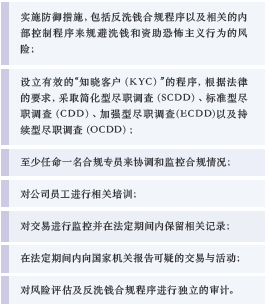
In addition to the obligations described above, New Zealand’s anti-money laundering regime requires reporting entities to:
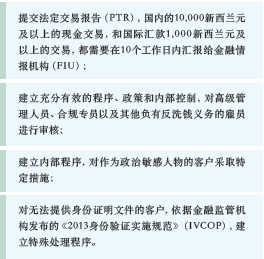
In the current environment, meeting compliance requirements while maintaining productivity is no easy task.
However, the businesses publicly warned by DIA and these two anti-money laundering cases remind us that overlooking compliance may benefit a company’s market position in the short term, but cause greater harm over time.
The AML Act requires every reporting entity to establish internal customer due diligence procedures and conduct due diligence appropriate to a customer’s risk level before establishing a business relationship.
Simplified due diligence generally requires only basic verification of the customer representative’s name, date of birth and relationship with the customer. However, it applies only in a very limited range of circumstances expressly specified in legislation, such as where the customer is a listed company or government department.
The circumstances requiring enhanced due diligence are also expressly prescribed by legislation. Examples include customers that are trust funds or politically exposed persons, or customers conducting very large transactions who cannot readily explain a reasonable and lawful use for the funds.
In these circumstances, customers must also provide evidence of the source of their funds or wealth. Most customers, however, are subject to standard due diligence. Ongoing due diligence applies to all customers.
At the heart of due diligence under New Zealand’s anti-money laundering regime is identifying and verifying beneficial owners. Reporting entities must verify the identities of their customers, their customers’ beneficial owners and their customers’ representatives.
New Zealand’s anti-money laundering legal regime is currently less than 10 years old and is developing rapidly. Reporting entities must comply with the statutory obligations outlined above, or risk warnings or even legal proceedings.
Customers, meanwhile, need to comply with the AML Act’s requirements and cooperate by providing relevant information and documents. Otherwise, reporting entities may be unable to provide services to them.
About the author
Christina Wang
LLM, CAMS-Audit, CCRP
Chief Compliance Officer
She has worked in compliance in New Zealand’s financial markets since 2012. She is a Certified Anti-Money Laundering Specialist (CAMS), a Certified Anti-Money Laundering Audit Specialist (CAMS-Audit) and a GRC Institute Certified Compliance and Risk Professional (CCRP), and her white paper has been published by the Association of Certified Anti-Money Laundering Specialists (ACAMS). She holds a Master of Laws from the University of Auckland and is qualified to practise law in both New Zealand and China.