
← Back to articles
The story behind Park Hyatt Auckland
Park Hyatt Auckland has attracted considerable attention since the project was first proposed.
This five-star luxury waterfront hotel occupies a landmark site in Wynyard Quarter in central Auckland. Developed by Fu Wah International Group, the completed hotel has 7 storeys, 195 rooms and associated facilities, with a total floor area of 29,000 square metres.
Yet despite strong support from both governments, the well-funded and experienced developer encountered numerous unexpected challenges in New Zealand, including cost overruns, construction delays and obstacles to recruiting skilled workers overseas. These repeatedly pushed back the opening, prompting a steady stream of news reports and public speculation.
Even formidable difficulties can be overcome through painstaking dedication.
Four years later, in March 2020, Park Hyatt Auckland is poised to set sail and ride the waves.
Last year, the 4.5-star Waldorf Stadium Hotel was sold to Australia's Mulpha Group for NZ$57,250,000. It is now being expanded.
Beyond five-star luxury arrives! Could Auckland become the next Dubai?
The maturity of a central business district anchored by high-end hotels is arguably becoming an important measure of a city's international standing.
After repeated delays to its opening, Park Hyatt Auckland is finally about to remove the hoardings, roll out the red carpet and welcome guests from near and far!
The hotel's official website is now accepting room bookings for dates after 1 March 2020, with rates ranging from NZ$615 to NZ$755, depending on room type.
Auckland's much-anticipated hotel promising luxury beyond five stars has finally arrived.
The story behind Park Hyatt Auckland
Park Hyatt Auckland has attracted considerable attention since the project was first proposed.
This five-star luxury waterfront hotel occupies a landmark site in Wynyard Quarter in central Auckland. Developed by Fu Wah International Group, the completed hotel has 7 storeys, 195 rooms and associated facilities, with a total floor area of 29,000 square metres.
Its standout feature is that guests can arrive directly at the wharf by yacht, highlighting its distinctive waterfront advantage.
Notably, with total investment exceeding RMB 3,000,000,000, this is the largest public infrastructure investment by a Chinese company in New Zealand and one of the country's largest infrastructure projects funded by overseas investment.
John Hong, who brought the project to Auckland while serving as Waterfront Auckland's head of investment and international relations, told YIJU New Zealand in an exclusive interview: “To build this hotel, we had to engage with the local community, the local business community, iwi, Viaduct Holdings, Waterfront Auckland, the local board, ward councillors and Auckland Council;
alongside tackling these ‘eight formidable mountains’ head-on, we also had to coordinate with central government. The entire process was fraught with difficulties and demanded painstaking effort before we could finally bring the project to fruition and make it one of Auckland's new landmarks.”
Formidable difficulties and painstaking effort also characterised the development and construction of Park Hyatt Auckland.
On 9 March 2016, Fu Wah International Group chairwoman Chen Lihua and then Prime Minister and Minister of Tourism John Key turned the first sod on Auckland's waterfront, formally launching construction, with the opening scheduled for 2018.
At the groundbreaking ceremony, then Chinese Consul-General in New Zealand Xu Erwen said the project's significance lay in its alignment with the direction of trade and commercial relations between China and New Zealand.
At the groundbreaking ceremony, then Chinese Consul-General in New Zealand Xu Erwen said the project's significance lay in its alignment with the direction of trade and commercial relations between China and New Zealand.
On the one hand, tourism is a pillar of New Zealand's economy. Chinese visitor numbers rose by 35% in 2016, but New Zealand's tourism industry faces a bottleneck: it needs more hotels, particularly high-quality five-star hotels;
on the other hand, the project aligns with China's Belt and Road strategy.
Then Auckland Mayor Len Brown said a hotel offering luxury beyond five stars, built by major brands Fu Wah and Hyatt at a landmark Auckland location, would both boost local employment and encourage more Chinese investors to come to Auckland. He hoped more projects would involve collaboration with Chinese investors.
Then Auckland Mayor Len Brown said a hotel offering luxury beyond five stars, built by major brands Fu Wah and Hyatt at a landmark Auckland location, would both boost local employment and encourage more Chinese investors to come to Auckland. He hoped more projects would involve collaboration with Chinese investors.
In his address, Fu Wah International Group's general manager of overseas investment, Wang Lian, concluded: “Any business investing overseas will inevitably encounter many unexpected difficulties. But having chosen to come to New Zealand, we have above all found encouragement and gained confidence.
China–New Zealand relations are entering a new era of comprehensive cooperation. We have experienced first-hand the strong support both governments give to business development, and believe this will also inspire greater confidence and have a positive influence on more Chinese entrepreneurs.”
Yet despite strong support from both governments, the well-funded and experienced developer encountered numerous unexpected challenges in New Zealand, including cost overruns, construction delays and obstacles to recruiting skilled workers overseas. These repeatedly pushed back the opening, prompting a steady stream of news reports and public speculation.
Even formidable difficulties can be overcome through painstaking dedication.
Four years later, in March 2020, Park Hyatt Auckland is poised to set sail and ride the waves.
{Ad}
A cluster of high-end hotels takes luxury to new heights
Dubai may have more luxury hotels than any other city in the world. Alongside the famous seven-star Burj Al Arab are the world's only Armani Hotel, the fantastical Atlantis hotel on Palm Jumeirah and the desert palace hotel overlooking spectacular desert scenery. Naturally, Auckland is far behind immensely wealthy Dubai in both the number of luxury hotels and their opulence. Yet the groundbreaking for Park Hyatt, promising luxury beyond five stars, was like a stone cast into a lake, sending ever-widening ripples through Auckland's luxury hotel development market.
Auckland Airport and Tainui Group Holdings are building a new 311-room luxury hotel near the airport terminal. Construction of the five-star Te Arikinui Pullman Auckland Airport Hotel began in August this year as part of the airport's multibillion-dollar redevelopment programme.
Construction will cost more than NZ$150,000,000. The partners hope to complete the hotel before the first quarter of 2022, and it will be operated by Accor Hotels under Pullman.
Construction of the New Zealand International Convention Centre and Auckland's Horizon Hotel is still under way. The 300-room, five-star hotel is an oval glass building beside TVNZ on the seaward side. It will have a basement gym available to hotel guests and other visitors.
Construction of the New Zealand International Convention Centre and Auckland's Horizon Hotel is still under way. The 300-room, five-star hotel is an oval glass building beside TVNZ on the seaward side. It will have a basement gym available to hotel guests and other visitors.
SkyCity considered selling the hotel before completion but subsequently changed its mind.
As a result, when the hotel opens in 2020, SkyCity will have nearly 1000 beds across its three hotels in Auckland's central business district.
Last year, the 4.5-star Waldorf Stadium Hotel was sold to Australia's Mulpha Group for NZ$57,250,000. It is now being expanded.
Dean Humphries, national director of hotels at Colliers New Zealand, said this was the first major hotel transaction in Auckland's CBD since the Hilton was sold in 2012;
it was also Auckland's largest hotel transaction in 12 years, since the Carlton hotel on Mayoral Drive sold for NZ$113,000,000 in 2006.
Built in 2008, the 10-storey hotel near Spark Arena occupies a 2450-square-metre site and has a total internal floor area of 10630 square metres. It stands on land held under a long-term lease from Ngāti Whātua.
Following the sale, the hotel was renamed Nesuto Stadium Apartment Hotel Auckland. A planned NZ$12,500,000 expansion will increase its room capacity from 178 to 244, allowing it to accommodate more guests.
Mulpha chief executive Greg Shaw said New Zealand's tourism and hotel sectors had limitless potential, which was also why the company acquired the hotel.
Nick Thompson, director of hotels and tourism at Bayleys Real Estate, also said New Zealand appeared to hold strong appeal for visitors, particularly Queenstown.
According to STR research, Queenstown was the best-performing hotel market in the Australasia region in 2018, with revenue per available room (RevPAR) of US$143.32.
The city's tourism industry continued to thrive in 2019, with average occupancy in Queenstown reaching 81.3% over the first 4 months of the year.
Hotel occupancy rates in many other New Zealand cities were similar, including Auckland (82.6%), Wellington (79.9%) and Christchurch (77.3%). These figures reflect continued strong growth in New Zealand tourism.
In the first quarter of 2019, ending in March, New Zealand welcomed 3,870,000 international visitor arrivals, up 1.3% year on year and marking the sixth consecutive year of growth.
Echoing these figures, luxury hotel development in Queenstown has entered the ‘fast lane’: Radisson Hotel Group recently signed its largest hotel management deal in Australasia for 2019, preparing the way for its entry into the New Zealand market.
Echoing these figures, luxury hotel development in Queenstown has entered the ‘fast lane’: Radisson Hotel Group recently signed its largest hotel management deal in Australasia for 2019, preparing the way for its entry into the New Zealand market.
The deal covers four new hotels with a total of 777 rooms across three well-known industry brands: Radisson, Radisson RED and Park Inn by Radisson.
The four agreements were signed with subsidiaries of NZ Horizons Limited and Remarkables Hotel Limited, private businesses specialising in hotel development in New Zealand's South Island.
They will build Radisson and Radisson RED hotels in Queenstown, and Radisson and Park Inn by Radisson hotels at Lake Tekapo.
Hotel investment brings both opportunities and risks
Benefiting from a falling New Zealand dollar in recent years and soaring Asian visitor numbers, the booming tourism industry has become a source of rapid growth for New Zealand's economy. This will inevitably drive the next wave of investment in hotels and related tourism services.
Developers' push into the hotel market can be seen as an adjustment to market demand, with tourism demand the biggest catalyst.
According to a recent Bayleys report, international visitor arrivals are forecast to rise from the current 2,600,000 to between 3,400,000 and 4,000,000 by 2024.
According to a recent Bayleys report, international visitor arrivals are forecast to rise from the current 2,600,000 to between 3,400,000 and 4,000,000 by 2024.
As the main gateway for most international visitors, Auckland stands to benefit considerably. Booming tourism, combined with a longstanding shortage of hotels, has made the Auckland CBD hotel market the tightest.
Its strong market performance is expected to continue: over the coming years, the city centre will host a series of major international events, including the America's Cup and APEC summit, both in 2021.
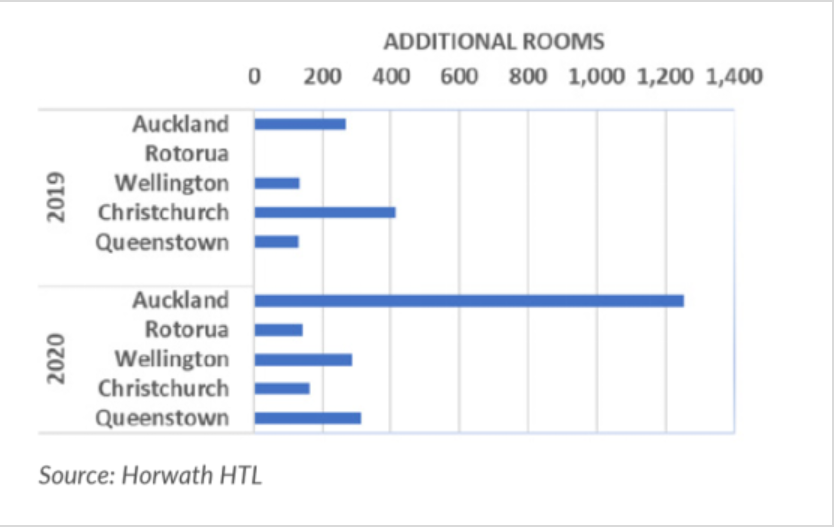
A New Zealand market report released by Horwath HTL in June noted that Auckland would add 13 new hotels with a total of 1522 rooms, scheduled to open over the following two years.
A New Zealand market report released by Horwath HTL in June noted that Auckland would add 13 new hotels with a total of 1522 rooms, scheduled to open over the following two years.
This represents a 16% increase in supply, of which 53% will be five-star accommodation.
By the end of 2019, 9 hotels with a total of 947 rooms will open in New Zealand's popular travel destinations. A further 17 hotels with 2158 rooms are expected to open by 2020.
By the end of 2019, 9 hotels with a total of 947 rooms will open in New Zealand's popular travel destinations. A further 17 hotels with 2158 rooms are expected to open by 2020.
Hotel rooms expected to open in 2019–2020
Despite this, New Zealand still faces a hotel shortage.
Available information indicates that Auckland will need 4000 beds by 2025, yet 72% of planned hotel construction has not begun.
Meanwhile, Taupō will need at least 100 new rooms by 2025, while nearby Rotorua needs more than 500 hotel beds.
Booming Queenstown needs an additional 1170 rooms and is expected to face a shortfall of 251 by 2025. Dunedin, meanwhile, has no new hotels but needs an additional 261 beds.
This gap in supply has prompted domestic and overseas investors to rush into the hotel market. Yet many businesses have focused on market share without carefully considering the risks.
Reports indicate that Auckland hotel performance is weakening.
Horwath HTL's New Zealand market report, released in June, said the hotel industry had experienced significant growth in revenue and profitability, but prospects for further improvement in 2019 and beyond were uncertain. Average occupancy rates (AOR) at TIA member hotels, which comprise New Zealand's major hotels, stood at 80%, down from 81% the previous year.
In the year to April 2019, the average daily rate (ADR) was NZ$193, down from NZ$195 the previous year;
in the year to April 2019, revenue per occupied room fell by nearly 3%, mainly because of declining performance at Auckland hotels.
In Auckland, the accommodation provider targeted rate (APTR) remains in place and has been extended to Airbnb providers.
An increasing number of local authorities are calling on central government to allow a bed tax on commercial accommodation providers. Queenstown Lakes District Council held a referendum on a 5% ‘visitor levy’ on accommodation providers.
Unsurprisingly, the referendum showed strong support among ratepayers for such a levy.
TIA is lobbying central government to allocate 20% of the GST paid by international visitors to funding local government visitor infrastructure.
TIA sees this as a more effective, efficient and equitable way to fund essential tourism infrastructure across the country.
However, accommodation owners strongly oppose targeted rates, bed taxes and visitor levies, particularly when they apply only to accommodation providers.
Bell Gully commercial property specialist Andrew Petersen also said investment approvals and local regulations posed substantial barriers to anyone looking to invest.
Bell Gully commercial property specialist Andrew Petersen also said investment approvals and local regulations posed substantial barriers to anyone looking to invest.
Investors must obtain overseas investment approval while also navigating the local regulatory environment.
“So the easier we can make it for people to invest in these things, the better, while recognising that we need rules to provide safeguards and ensure the right investors are coming into the country,” he said.
“So the easier we can make it for people to invest in these things, the better, while recognising that we need rules to provide safeguards and ensure the right investors are coming into the country,” he said.
These market factors, together with banks tightening lending criteria and rising land prices and construction costs across New Zealand, are expected to present serious challenges for hotel projects over the next 10 years.