
← Back to articles
1. The influence of harmful road energy
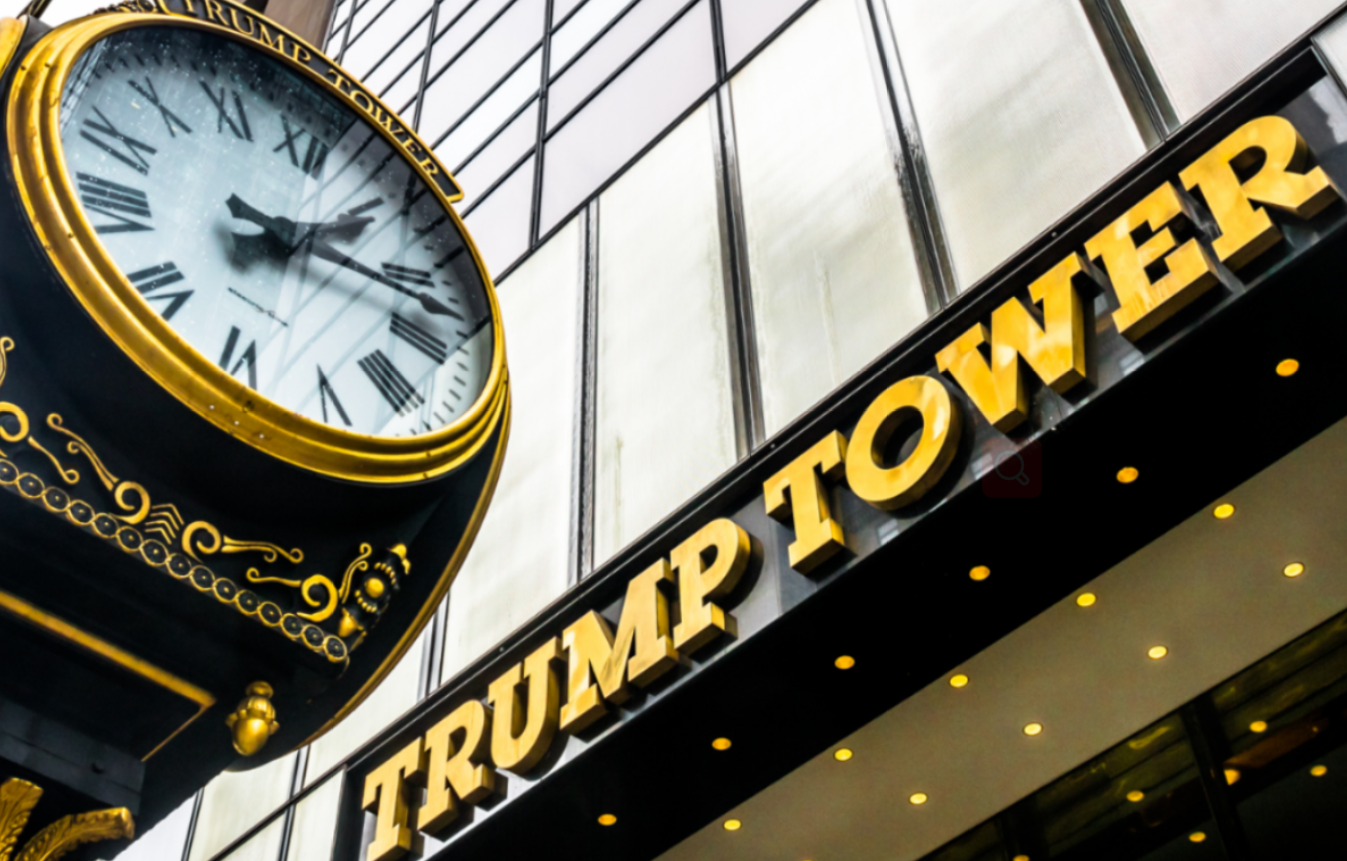
Trump Tower stands at the intersection of Columbus Circle and Broadway in Manhattan, New York, facing Central Park.
1. Choosing a location
- Whether the roads around the building are appropriately planned。
- Whether the shapes of surrounding buildings create harmful configurations.
3. Arranging the internal layout
4. The importance of choosing an auspicious date
JOJO holds a bachelor’s degree in clinical psychology from Victoria University of Wellington and a master’s degree in clinical psychology from Massey University in New Zealand. Trained in the Southern schools of Zi Wei Dou Shu and Xuan Kong, JOJO is a life planner and environmental consultant specialising in Zi Wei Dou Shu psychology, design feng shui and environmental energy.
JOJO has extensive experience in commercial property consulting and feng shui services. The research team to which JOJO belongs has provided feng shui consultancy for more than 50 major commercial property projects, including those for MSN in the United States, American Express, Malaysia’s THE CARAT international jewellery group, Bank of China and China’s Trends Media Group. JOJO is an experienced commercial property feng shui analyst.
The power of feng shui: natural qi safeguards luxury hotel investment
When feng shui and luxury hotels are mentioned together, the first things that spring to mind for onlookers are surely US President Trump, a believer in feng shui, and his renowned Trump Tower.
From businessman and television personality to US president, it is no exaggeration to describe Trump’s life as legendary. Alongside luck, hard work and the other essentials of success, feng shui has also contributed considerably to his remarkable achievements.
“Nobody wants to miss an opportunity to make a fortune. Good feng shui gives you an advantage over your competitors.” In an interview with The New York Times, Trump made no secret of his reliance on feng shui, even stating: “You don’t have to believe that feng shui really works. All I know is that it helps me make money!”
How did feng shui help Trump become a property tycoon and make money effortlessly? The numerous Trump Towers bearing his surname are the best examples. Here, we examine in detail the feng shui alterations to Trump International Hotel & Tower, recognised as a New York landmark:
Trump Tower’s past and present
Located at 40 Wall Street in New York City, Trump Tower was formerly the Bank of Manhattan Trust building. Built in 1930, it briefly held the distinction of being the world’s tallest building after completion. Yet the building once called the “jewel in Wall Street’s crown” gradually fell into decline as the surrounding economy evolved, with no buyer willing to take it on. In 1995, the shrewd Trump stepped in, buying it for US$8,000,000 and refurbishing it.
As is widely known, the refurbishment of Trump Tower followed a feng shui practitioner’s advice in full. Its feng shui layout and adjustments also helped revive the struggling building: in 2005, Trump Tower was valued at US$400,000,000; in 2007, Trump again claimed that he had spent only US$1,000,000 refurbishing it, while its value at that time was US$600,000,000.
That is the power of feng shui.
Understanding Trump Tower’s feng shui alterations
1. The influence of harmful road energy
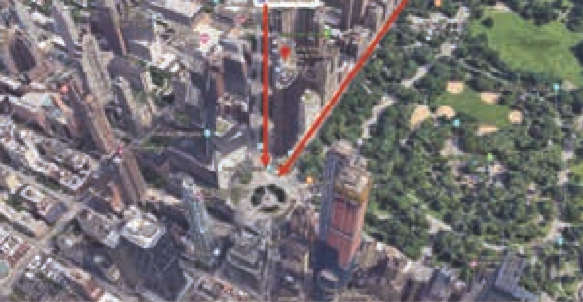
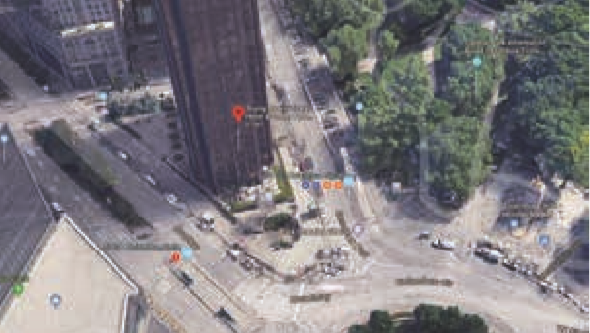
Trump Tower stands at the intersection of Columbus Circle and Broadway in Manhattan, New York, facing Central Park.
On a map, the building sits precisely where two main roads meet, a classic example of “scissors sha” at the mouth of the scissors, while its connection to Columbus Circle brings traffic from all directions, further intensifying the harmful energy. Scissors sha is a major harmful configuration in feng shui, readily causing bloody accidents, disputes and lawsuits, financial losses and harm to family members.
This explains why, before its refurbishment, the building was regarded as one of New York’s most loss-making properties.
Scissors sha
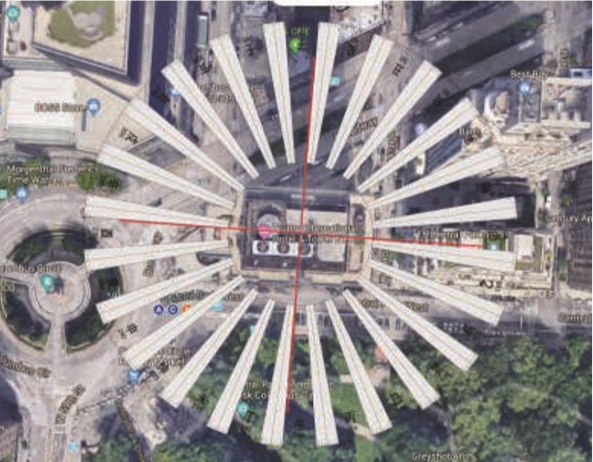
Blocking scissors sha requires a reflective object associated with the metal element, so the feng shui practitioner recommended placing a stainless-steel globe facing the roundabout.
Because of its round shape, the globe belongs to the metal element in the five-element system. Combined with its reflective stainless-steel surface, it is ideally suited to reflecting harmful energy from different directions.
The globe can also attract influential supporters and strengthen personal connections. This design played an important role in his subsequent business development.
The stainless-steel globe reflects harmful energy from different directions
2. Enlarging the foundations and changing the entrance orientation
During Trump Tower’s refurbishment, the foundations were deliberately enlarged and the main entrance was repositioned to face Central Park.
There were two reasons for these changes: first, to draw in the park’s flourishing qi, benefiting reputation and social standing; second, to avoid the influence of harmful energy.
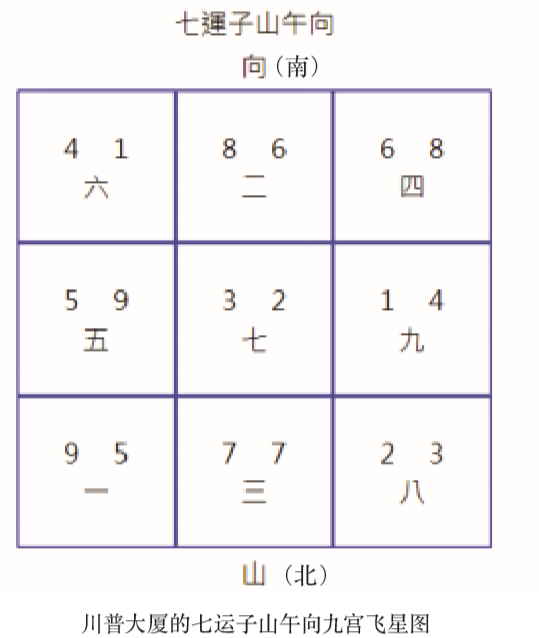
Satellite imagery suggests that the refurbished Trump Tower sits in the zi direction and faces wu. Taking its construction start in 1995 together with the cycles of earth fortune and Flying Star qi analysis in Xuan Kong feng shui, this adjustment could revive the entire building, creating a design that benefits both people and wealth.
Below is Trump Tower’s nine-palace Flying Star chart. We can see one particular feature — the mountain stars combine to make ten throughout the chart, an auspicious configuration linking yin and yang that greatly benefits “people”.
Here, “people” refers not only to enhancing personal reputation and supporting the development of an internal team, but also to strengthening external connections, which can in turn increase clientele and income.
After taking on this property, Trump used the reputation of the Trump hotel to launch further Trump hotels and other major investment projects across the United States and around the world. As his capital and connections subsequently expanded, his interests spread across numerous industries, including property, construction, hotels, entertainment, book and magazine publishing, media, model management, retail, financial services, food and dining, business education, online travel and aviation.
Every aspect of this business expansion was closely linked to his connections and popularity.
The Trump Organization has 515 subsidiaries around the world, managing his assets worth tens of billions.
The feng shui displayed by the Trump hotel is only part of this case study. I believe his other properties are also subject to subtle feng shui influences.
3. Central Park’s natural qi
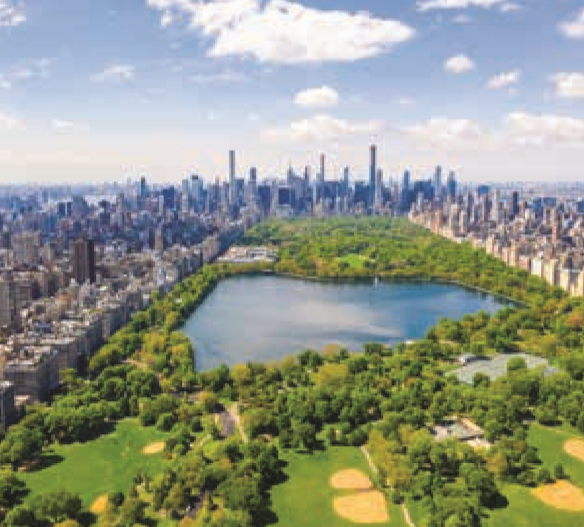
Trump Tower faces New York’s world-famous Central Park.
In feng shui theory, large open spaces such as parks are excellent places for “storing water”, helping to build a reputation. The more moving water visible in such a place, the more it supports a growing reputation. This moving water can take many forms: pedestrian flows, traffic lanes and roads, and clean water sources — water with life — can all be described as moving water.
Central Park’s many encircling paths, enormous annual visitor numbers and numerous lakes bring the vital qi of this green space to its fullest expression.
Furthermore, when used appropriately, “water” also governs wealth.
In this Trump hotel example, the building faces south with its back to the north, and its entrance occupies an auspicious position, so the method of drawing in water can generate wealth.
The property’s subsequent increase in value is the best proof.
Trump Tower can be described as a case of high investment and high returns. However, high investment inevitably brings high risk, and how that risk is managed directly affects the rate of return. In this case, alongside Trump’s background, experience and luck, the importance he placed on feng shui alterations played a substantial role in his high returns.
How can luxury hotels make comprehensive use of feng shui?
Prominent figures in business empires, such as Cheung Kong Group chairman Li Ka-shing, Alibaba president Jack Ma, Vanke Group founder Wang Shi and Microsoft president Bill Gates, have all used feng shui to create wealth and establish enduring foundations for their respective domains.
Why can feng shui achieve all this?
Because feng shui studies natural qi: the influence that changes among all things in the universe exert on a particular area.
It has an exceptionally precise system for analysing and assessing environmental energy through principles, numbers, qi and form.
A good feng shui practitioner can therefore provide protection and support for commercial investment.
So, before embarking on a major commercial development such as a luxury hotel, private club or commercial building, which feng shui considerations deserve our attention?
1. Choosing a location
Choosing a location involves more than simply considering whether it lies on a major commercial route. Several other points require particular attention:
- Whether the roads around the building are appropriately planned。
In urban feng shui, vehicles flowing along roads and streets represent “water”, and where there is “water”, there is “qi”.
The speed and direction of this water flow — traffic — and the configuration of the “water mouths” where roads meet are crucial to determining whether qi gathers.
Generally, traffic should not move too quickly, and an embracing curve in its direction of travel is preferable.
- Whether the shapes of surrounding buildings create harmful configurations.
Buildings in commercial areas are generally closely packed, and polygonal designs are popular in contemporary architecture. This makes it easy for harmful forms to arise between buildings, adversely affecting people and causing financial losses.
Common examples include sharp-corner sha, wall-blade sha and Vermilion Bird sha. I have discussed the appearance of these harmful forms many times in my column; interested readers can follow those articles.
2. Determining the orientation
A building’s orientation, which determines the main entry point for qi, is also extremely important.
This qi opening, usually the direction of the main entrance, determines whether the incoming qi is auspicious or inauspicious.
It also determines the relationship between the entire building and surrounding road intersections — one involves the qi of the Nine Stars, the other the qi of the Dragon Arrangement.
This is why changing the direction of an entrance during Trump Tower’s refurbishment brought such a significant change in its fortune.
3. Arranging the internal layout
Good qi does not necessarily mean that qi is distributed appropriately within a building. Its distribution depends on the internal layout.
Within any space, auspicious and inauspicious forces are mixed, so some positions will inevitably be better and others worse.
Making the most of favourable positions and reducing the influence of unfavourable ones is the primary feng shui consideration in spatial planning.
Next, interior design choices, including colours, furniture and decorative objects, can harmonise the qi of the five elements, encouraging good fortune and averting misfortune.
In feng shui, this stage is called “regulating qi”.
In a luxury hotel, for example, reception is an important department for welcoming guests and establishing external relationships. Placing it in a peach-blossom position or a reputation position can further strengthen its effectiveness;
the hotel’s finance department or management, meanwhile, is best placed in a wealth position, because control over finances is key to coordinating the entire operation.
Moreover, because everyone has a different destiny configuration, each person has their own auspicious and inauspicious positions within a space. Property owners and business owners also need to take this into account.
4. The importance of choosing an auspicious date
With their busy lives, people today seem to have lost the habit of selecting an auspicious date and time before important undertakings. Yet choosing an auspicious day can further enhance efforts to attract good fortune and avoid misfortune.
Calculating a suitable date involves assessing whether the day is appropriate for the undertaking — generally, Yellow Path days are auspicious, while Black Path days and Break days are inauspicious — and matching it with the favourable and useful influences in the person’s destiny chart.
It also requires analysing clashes, conflicts, controlling relationships and harmful interactions involving the building’s orientation and the owner’s life trigram. Selecting auspicious dates is a highly specialised art within Chinese divination, involving far more than simply consulting a traditional almanac.
Although choosing a date cannot “turn everything around”, it can “increase good fortune and reduce misfortune”.
This provides an additional safeguard as we go about our daily affairs.
Alongside selecting an auspicious date, performing a ritual to settle and protect the premises before moving or refurbishing can make the undertaking even more secure.
About the author
JOJO holds a bachelor’s degree in clinical psychology from Victoria University of Wellington and a master’s degree in clinical psychology from Massey University in New Zealand. Trained in the Southern schools of Zi Wei Dou Shu and Xuan Kong, JOJO is a life planner and environmental consultant specialising in Zi Wei Dou Shu psychology, design feng shui and environmental energy.
JOJO has extensive experience in commercial property consulting and feng shui services. The research team to which JOJO belongs has provided feng shui consultancy for more than 50 major commercial property projects, including those for MSN in the United States, American Express, Malaysia’s THE CARAT international jewellery group, Bank of China and China’s Trends Media Group. JOJO is an experienced commercial property feng shui analyst.