
Huang Weixiong: building strength and setting sail
The first Asian executive director and member of the top decision-making team (Rear Commodore) at Bucklands Beach Yacht Club (BBYC), New Zealand’s second-largest sailing and boating club; member of the Royal New Zealand Yacht Squadron’s House and Membership Committee; chairman of the New Zealand Sailing and Yachting Centre; specially invited overseas guest at the Chinese Yachting Association summit; principal of the New Zealand College of Business; one of Guangdong’s ten outstanding young overseas Chinese; overseas delegate attending the Chinese People’s Political Consultative Conference as an observer; council member of Sun Yat-sen University; and editor-in-chief of the first jointly produced China–New Zealand textbook on the Belt and Road Initiative
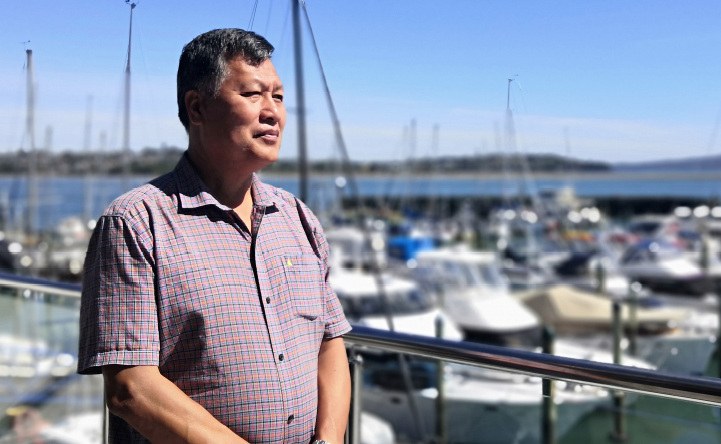
Despite his long list of impressive titles, Huang Weixiong defines himself in the simplest of terms: “I am someone who came from China to make a living and build a future in New Zealand.”
And so, on this summer afternoon, we sit in BBYC’s reception room, listening to this man from China tell his story of making a living and building a future in New Zealand, and share his boundless hopes for what lies ahead.
{ad}
Wholehearted commitment to something meaningful
“Many people have asked me why, having been a successful entrepreneur and a leader in education management, I moved into the boating industry. At my age, with my experience, a single reason would certainly not be enough to draw me in.
My longstanding interest in water sports, my own career development needs and the industry’s tremendous prospects all appeal to me. Most importantly, though, I realised that I could fill many gaps and make my own contribution to this industry. Taken together, these factors make me feel that this choice is very worthwhile.” — Huang Weixiong
On fine, calm evenings when he is not out on the water, Huang likes to stand on the terrace of BBYC’s upstairs restaurant, looking out over Half Moon Bay. Close by is the club’s marina, where berths are precious and hard to secure; further out, boats and sails fill the view against a blue sea and sky, the setting sun and glowing clouds. It is a scene of quiet prosperity.
Occasionally, Huang entertains friends here too. With reverence and pride, he talks not about his own boat but about BBYC’s history, the glorious stories behind each sailing boat model mounted on the walls, and the New Zealand athletes in the photographs who have earned their place in world sailing history.
8 years ago, Huang’s love of boating led him to become one of more than 1500 members of New Zealand’s second-largest sailing and boating club.
Over those 8 years, he has shared New Zealanders’ pride in the country’s pre-eminent position in sailing. He has grown increasingly fond of cutting through wind and waves, obtained his skipper’s certificate and developed considerable skill in handling powerboats. “This is more than recreation; it can genuinely help people. If someone gets into trouble at sea, I have the ability to reach them as quickly as possible and help with the rescue,” Huang says.
Gradually, as he spent more time in the industry and deepened his understanding, Huang remained captivated by its prospects but also began to see gaps in the development of BBYC and New Zealand’s wider sailing and boating industry. Vast stretches of sea, an excellent climate, world-class coaches and athletes: New Zealand has exceptional natural advantages for developing sailing.
Yet at BBYC, for example, a shortage of emerging talent was beginning to show. Neither the facilities nor the training resources at the club’s youth training centre had kept pace with the times.
“A barrel can hold only as much water as its shortest stave allows. I have the confidence, ability and resources to address this weakness in youth sailing training.”
Huang likes to say: “We Guangdong entrepreneurs build the future through practical action.” As BBYC’s Rear Commodore, he oversees the management and promotion of powerboating, which has also been his own boating pursuit over the years. Yet in just six months after taking office, he
threw himself wholeheartedly into addressing the gaps in sailing training. In September last year, BBYC held its first Chinese and English bilingual forum for the Chinese community on youth water sports and learning to sail.
“The forum brought together two groups that had previously had almost no contact, creating benefits for both. The club had never imagined that so many Chinese people would be interested in the sport;
and the Chinese people who attended had never had such an opportunity to learn about and try this unfamiliar sport.” During the New Year holiday just gone, the club organised sailing training specifically for young Chinese people.
Drawing on the extensive network he had built over many years, Huang also established the New Zealand Sailing and Yachting Centre. Through partnerships between private individuals and clubs, it covers training, talent exchanges, coastal cruising, recreational fishing, operations and marina management.
“Some things require individuals to take the first step, starting small: collaborating with educational institutions in China, for example, or promoting overseas summer camps centred on sailing. These initiatives can lead the way and provide the impetus to move the whole industry forward gradually.
”Using revenue from these activities, Huang and his club colleagues have also invested in improving the existing youth training centre, working to create a first-class New Zealand training base for the local community and young people.
Opportunity favours the prepared
“I have been fortunate to witness and benefit from China’s 40 years of reform and opening up. In the early nineteen-80s, I had the chance to make it through the fierce competition for university admission and enter Sun Yat-sen University, where my attachment to home and country took root;
in the early nineteen-90s, China’s opening to the world and friendly China–New Zealand relations enabled me to come to Auckland, the world’s most liveable city, and study at the University of Auckland, ranked among the world’s top 200. New Zealand’s fair and inclusive society has enabled me to establish businesses, enter politics and develop here through 20 years of pioneering effort. I have always retained a sense of gratitude and attachment to home and country. I hope to do all I can, putting what I have learnt into practice, to participate actively in exchanges, cooperation and development between the industries in which New Zealand and China excel, contribute to the Guangdong–Hong Kong–Macao Greater Bay Area, and fill gaps in the international integration of sport, healthcare and aged care.” — Huang Weixiong
Huang is someone who sets clear goals and works hard to achieve them.
During our interview, he repeatedly stresses: “People need goals, and they must never set their sights too low.
”Starting as an international student who worked to support his studies, he spent 15 years securing his livelihood. After achieving financial freedom, he chose to enter politics. Following six years of political experience, he became interested in New Zealand’s sailing and boating industry.
“Often, if you define your career solely in terms of financial gain, it is hard to go much further. When you no longer have to worry about short-term income, you can take a broader, more expansive view and act with greater freedom.
”Huang is particularly fond of a famous quotation from US President Abraham Lincoln: “I will prepare and someday my chance will come.”
An outstanding leader undoubtedly understands both themselves and others clearly.
Huang knows exactly what draws him to BBYC, and why he ultimately won the approval of so many club members. His experiences over the past 28 years in New Zealand have given him many of the qualities the club needs in someone who can fill its gaps: experience in business, politics and international cooperation.
A local tertiary education. Huang crossed the ocean to New Zealand in 1992.
Five years later, he gained a master’s degree in economics, a field then rarely chosen by students from mainland China.
His formal training gives his understanding of New Zealand’s economy a strong academic background and a solid theoretical foundation.
Practical experience running a business. After graduating from the University of Auckland, Huang started with tutoring classes and eventually established the New Zealand College of Business, gaining successful practical experience in business and education.
Six years of political experience
Huang began his political career in 2007. He was elected first to a community board in Manukau City and later to the Howick Local Board in the wider Auckland region.
During his time in office, he helped secure official recognition of the Mid-Autumn Festival as an Auckland celebration, with dedicated government funding.
Politics and business are entirely different experiences. His political work gave him a different perspective and distinctive insights into how society and the economy function.
Experience serving business associations. From 2002, Huang spent 16 years serving the New Zealand Chinese Chamber of Commerce, the country’s largest chamber for Chinese-funded businesses and Chinese businesspeople. His roles included secretary-general and vice-president, giving him extensive experience in helping lead and serve business associations.
A heartfelt love of water sports. Since joining BBYC, Huang has taken an active part in its activities. During those eight years, he identified gaps in the industry’s development that aligned closely with the club’s needs.
A deep understanding of Chinese and Western culture, economics and politics. Although ethnicity was not the fundamental reason for Huang’s election, there is no denying that, with Auckland’s growing Chinese immigrant population and increasingly close China–New Zealand economic and trade ties, his experience in educational cooperation between China and the West is an unexpected asset for a BBYC seeking to grow.
Ambitious goals require steady, practical progress at every step.
Over 28 years, Huang has moved from China to New Zealand, switched from chemistry to economics, and expanded from education into politics and economics. He has helped manage a well-known local state primary school as a board member and participated in industry decisions as a yacht club director. He acknowledges that every transition has required a breakthrough, continual exploration and overcoming difficulties. Yet what he prefers to share is not the obstacles but his positive approach: keep learning, work quietly and steadily, and persist in improving yourself every day. By building a strong foundation, you can face challenges confidently and seize opportunities.
During Chinese New Year this year, Huang added another “first” to his record: after attending training organised by Yachting New Zealand, he became the first Chinese person to undertake formal sailing instructor training in New Zealand and gain an internationally recognised certificate.
“After becoming Rear Commodore, I have an even greater responsibility to keep developing my knowledge and abilities in this field.” This is just another small step for Huang as he works steadily towards his goal of building an international platform integrating sport, healthcare and aged care. China–New Zealand cooperation to support industry development. “New Zealand has internationally leading strengths in talent management, industry development and global influence in sailing and boating.
In the development of sport, economic relations and trade between China and New Zealand,
there is considerable scope for mutual benefit. I hope that, while helping China develop its sailing and boating industry, I can also support the longer-term development of this industry in New Zealand.
” — Huang Weixiong. Drawing on the experience accumulated through more than 20 years of hard work in New Zealand, Huang opened the door to the yacht club, a traditional mainstream New Zealand institution. This is highly significant for his own career development, and is it any less so for New Zealand’s Chinese community as a whole?
The first introductory presentation for the Chinese community attracted 14 children and 3 adults to the club’s subsequent short holiday courses. Over the following Christmas and New Year holidays, the number of Chinese children attending short sailing courses rose to forty or fifty.
At the same time, the club’s Chinese membership also increased.
During the interview, Huang mentions Korean New Zealand golfer Lydia Ko several times, emphasising her influence on both New Zealand golf and the Korean community.
“She has not only brought honour to Koreans, but also helped take New Zealand’s golf industry to a new level internationally.
”He adds that, with Auckland’s Chinese population growing, he hopes to strengthen ties between the yacht club and the Chinese community and nurture the next generation, so that Chinese people will have a place in New Zealand sailing in the future.
“Chinese families traditionally place great importance on their children’s education, so why not give Chinese children another option? Sailing is more than a competitive sport. Learning to sail can improve children’s fitness, develop determination and teamwork, and strengthen future applications to Ivy League universities. Its benefits extend into many tangible and intangible aspects of life.”
For an outsider, knowledge of sailing may extend no further than knowing it is an Olympic sport.
Sports enthusiasts may also know about the America’s Cup, ranked among the world’s four great traditional sporting events, and the famous athletes who compete in it.
But to an insider such as Huang, who has spent years in the field: “This sport encompasses an entire industry chain, from sailing boat design and manufacture, marina maintenance and management, and competitive racing to leisure, health and wellbeing.
Sailing boat design alone involves many specialist fields, including engineering, advanced technology and new materials.
”It is better to teach someone to fish than to give them a fish. Huang’s ideal of international cooperation does not involve using money to poach talent and undermine the source industry. Instead, it means exchanging and learning from New Zealand’s successful experience in this field with China, building together and sharing the benefits.
He is putting that vision into practice. His sailing and yachting centre brings together a former New Zealand Olympic sailing champion, a world youth sailing champion, and New Zealand experts in industrial and urban sustainable development, among others. “Through exchanges and mutual learning between these specialists and their counterparts in China, we hope to help China build its own sustainable industry system.
”Huang firmly believes: “New Zealand still has considerable room to develop in sailing talent management, industry development and international influence.
There is considerable scope for mutual benefit in the development of sport, economic relations and trade between China and New Zealand.
Helping China develop its sailing and boating industry will also support the longer-term development of this industry in New Zealand.
”With a life spanning China and New Zealand, Huang hopes to contribute to exchanges and the shared development of Chinese and Western cultures. But his ambitions extend far beyond broadening BBYC’s influence, serving the Chinese community and supporting development in his home region.
In 2017, New Zealand regained the America’s Cup after 17 years. As defending champion, it is due to host the 36th America’s Cup from the end of this year to March next year.
If BBYC opened the door for Huang to sailing and boating, an industry in which New Zealand excels, the approaching America’s Cup has revealed further opportunities and challenges for him and the wider New Zealand industry.
Huang firmly believes that people should have different goals and make different contributions at different stages of life. As his involvement in this industry grows and deepens, he will discover a wider arena and identify and fill more gaps.
“At this important moment in the history of an industry in which New Zealand excels, I hope to contribute and achieve something, doing all I can to play a positive leading role and add to its success.”