
Saving costs and staying compliant: tax on Airbnb and other short-term rentals
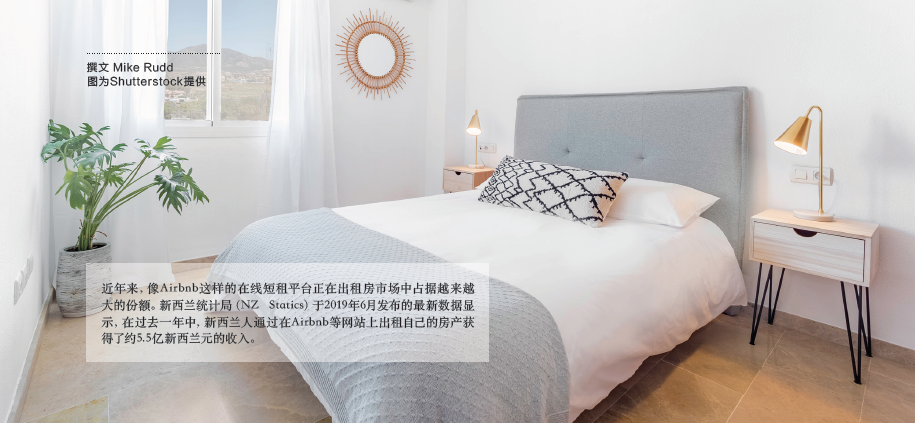
Online short-term rental platforms such as Airbnb have taken an increasingly large share of the rental market in recent years. The latest figures released by Stats NZ in June 2019 show that New Zealanders earned approximately NZ$550,000,000 over the previous year by renting out their properties through websites such as Airbnb.
Are short-term rentals major contributors to tax evasion and underpayment?
The growing popularity of short-term rentals in New Zealand has attracted Inland Revenue's attention.
A study jointly released by Victoria University of Wellington and Inland Revenue in April 2019 estimated that New Zealand lost NZ$800,000,000 in tax revenue through the so-called 'hidden economy'.
Alongside taxpayers with a reputation for receiving undeclared cash payments, such as builders, plumbers and restaurant owners, Airbnb hosts and other short-term rental operators were also included in the hidden economy.
Inland Revenue has been using intelligent data technology to identify tax evasion and underpayment in the short-term rental sector. Government agencies are seeking Airbnb's transaction records. Although some records are held offshore, Inland Revenue is working with overseas tax authorities under existing data-sharing agreements to obtain the information.
Airbnb's public policy team for Australia and New Zealand said the platform had begun working with governments and short-term rental hosts to ensure compliance with the relevant tax requirements.
To clarify the rules and ensure enforcement, Inland Revenue published a document in mid-2019 outlining the tax implications for short-term rental hosts. It provided practical guidance on how the rules apply to hosts' circumstances, leaving them with no excuse for failing to declare income from these sources.
We expect Inland Revenue to begin targeted enforcement in the short-term rental sector after the end of the 2019/2020 tax year.
Taxpayers who have not declared rental income may receive warning letters, tax assessments and penalties. Where undeclared income is discovered, Inland Revenue usually looks back at least five years.
With this in mind, we discuss below how to calculate income from different types of short-term accommodation and whether renting out a private home requires goods and services tax (GST) registration. Inland Revenue has issued standard-cost rules for people providing boarding services and short-term accommodation.
Hosts who meet the relevant conditions need to declare only the income exceeding the amount calculated under the standard-cost method.
The aim is to reduce compliance costs for small-scale accommodation providers. Inland Revenue sets the standard costs each year based on the average annual cost of providing boarding services or short-term accommodation.
{ad}
The standard-cost method for boarding in your own home
From the 2020 income year, hosts providing boarding services in their own homes can elect to claim tax relief on their rental income under Inland Revenue's Determination 19/01 (Inland Revenue Determination DET 19/01).
To qualify, hosts must:
• Be one or more natural persons, meaning an individual or individuals.
• Have no more than four boarders at any one time during the income year;
• Exclude boarding income from their GST-taxable activity;
• Have boarding income to which no other tax determination applies. The standard-cost method for boarding has three components:
A weekly standard cost per boarder—NZ$186 for the 2020 income year—plus an annual housing standard cost, which must be calculated with reference to the relevant provisions in Determination 19/01;
plus an annual transport standard cost for transport expenses included in the accommodation services provided to boarders. This is calculated from the kilometres travelled using Inland Revenue's published kilometre rates.
Under this determination, only the balance of the weekly boarding payments remaining after deducting NZ$186, the annual housing standard cost and the annual transport standard cost is taxable.
The standard-cost method for Airbnb-style short-term accommodation
Inland Revenue's Determination 19/02 (Inland Revenue Determination DET 19/02) provides a similar standard-cost method for hosts offering guests short-term accommodation in their own homes.
Short-term accommodation means accommodation provided to an individual or group for no more than four consecutive weeks. To qualify, hosts must:
• Be one or more natural persons, meaning an individual or individuals;
• Rent out a room or rooms in their own home to guests for short-term accommodation;
• Rent out rooms for no more than 100 nights in total during an income year, calculated separately for each room;
• Exclude the short-term accommodation activity from their GST-taxable activity;
• Have short-term accommodation activities to which no other tax determination applies.
For the 2020 income year, the nightly standard cost for short-term accommodation is set at $50 where the host owns the property, or $45 where the host rents it.
When the standard-cost method does not apply
Where boarding or short-term accommodation services do not qualify for the standard-cost method, the actual profit—rental income less expenses—must be calculated and declared to Inland Revenue as taxable income.
This usually requires property expenses to be apportioned between the accommodation services provided and the host's private use.
The mixed-use asset rules may be used for this calculation, but they are complex and require care.
GST registration
If revenue from short-term accommodation of less than 4 weeks exceeds the GST registration threshold of NZ$60,000 in any 12-month period, the host must register for GST and file GST returns with Inland Revenue.
Once registered for GST, hosts can claim input tax deductions on the costs of providing short-term accommodation.
These may include second-hand goods purchased or GST paid when buying the property.
Correspondingly, a GST liability may arise when the host stops providing short-term accommodation or disposes of the property. As technology makes renting out property increasingly easy, it is essential to consider carefully the cost-saving tax calculation methods Inland Revenue provides.
It is equally important to ensure that obligations for any applicable taxes, such as GST, are met.
Using a property for short-term accommodation or boarding can therefore involve complex tax calculations.
We recommend consulting a tax adviser to avoid unexpected outcomes.

About the author
Mike Rudd
Baker Tilly
Staples Rodway tax advisory partner
Mike has over 20 years of professional tax advisory experience. He is passionate about helping clients understand the complexities of tax law and specialises in managing business tax risks, designing domestic and international tax structures, and resolving IRD audit disputes.
Mike is also an executive committee member of Property Council New Zealand and has provided tax advice to many prominent property developers and builders in New Zealand and overseas.