
Restrictions set to ease! Is recovery in sight? Ahead of the world at the pandemic turning point, New Zealand awaits an economic turning point
With New Zealand's daily confirmed COVID-19 cases now largely remaining in single figures, attention is turning to the impact the pandemic will have on the country's economy. CBRE has brought together economic forecasts from various sources to provide an answer.

New Zealand's economic outlook amid the global pandemic
Although COVID-19 continues to affect New Zealand broadly, the latest economic forecasts from major institutions suggest the extent of its impact is gradually stabilising compared with trends in previous weeks. These forecasts predict an overall economic contraction of 5% to 10% in 2020, averaging 6.2%. Output during Level 3 is expected to be 15–25% below normal, compared with 30–40% during Level 4.
{ad}
Some forecasts anticipate a relatively rapid recovery in New Zealand's economy, while others expect a slow recovery that will not begin until 2021.
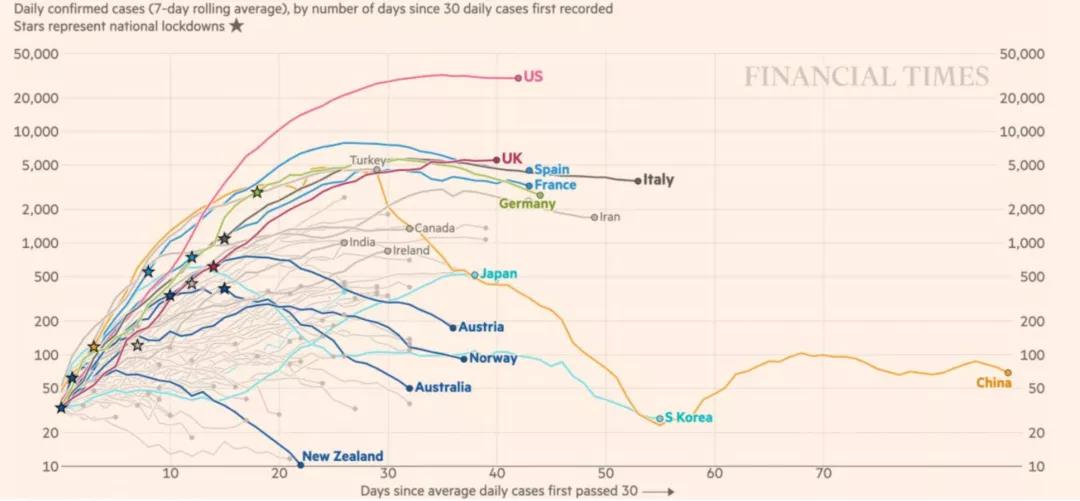
Turning points in new cases in selected countries
- Financial and share markets have generally rebounded from their lows as risk capital returns, moving from emergency selling to more fluid trading. This reflects the substantial boost from quantitative easing, which supports share trading, maintains low interest rates and flattens the yield curve. However, market volatility remains.
- In the property market, investors and tenants are primarily focused on rent in the short term. There are no hard-and-fast rules here, but there are still many options. For ADLS leases to which clause 5 applies, prevailing market practice appears to be a 50% reduction in net rent only where no emergency assistance is available. Where tenants can access other assistance, deferrals rather than reductions are generally used—for example, relief of 50% of rent for up to 3 months, repaid progressively over the following 6 months. Investors' interest appears largely speculative, with their main questions being:
- How long will the disruption to office work last?
- What percentage of rent can tenants pay?
- How will the tenant market hold up?
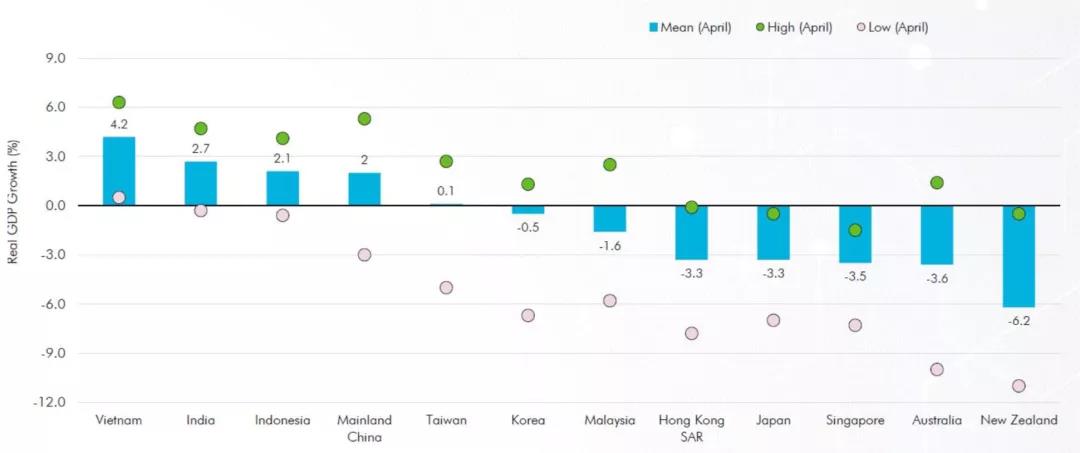
GDP forecasts for selected countries and regions in 2020 — consensus forecast chart
Consensus Forecasts suggest New Zealand's recession could be deeper than those of most countries in the Asia-Pacific region. This may partly reflect New Zealand's strict lockdown and assumptions about its duration—many of the consensus forecasts were made two weeks ago—and partly the country's heavy reliance on international trade.
New Zealand's unprecedented government policy response
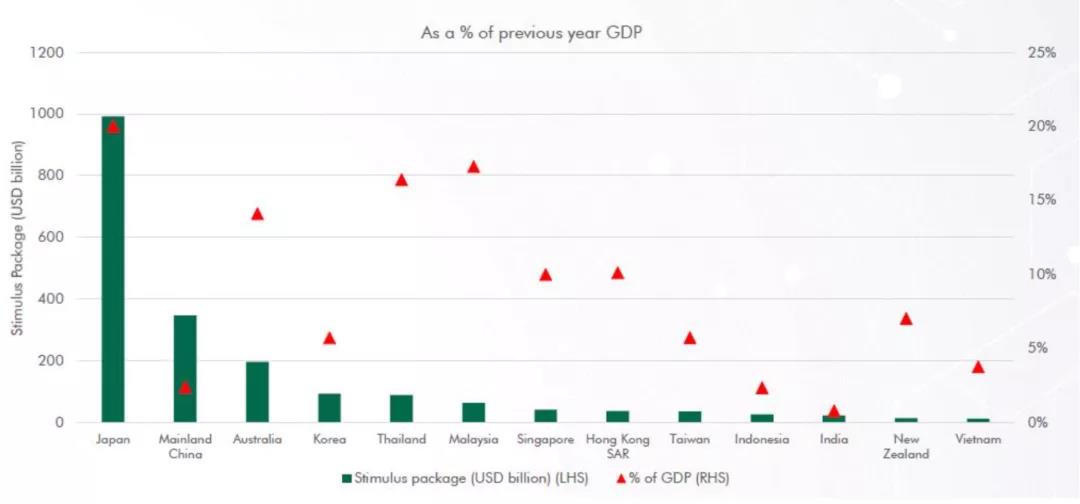
New Zealand's fiscal stimulus as a share of GDP compared with other Asia-Pacific countries
Relative to GDP, New Zealand's initially announced 21,000,000,000 fiscal stimulus was one of the world's largest responses. Several other countries have recently announced larger stimulus packages relative to their GDP.
- NZ$500,000,000 for healthcare.
- Up to NZ$12,000,000,000 in wage subsidies for affected businesses across all industries and regions.
- An NZ$2,800,000,000 income support package, including a permanent weekly benefit increase of $25 and a doubling of the Winter Energy Payment for 2020.
- NZ$2,800,000,000 in business tax changes to free up cash flow, including:
- Temporarily raising the tax threshold;
- Reinstating building depreciation;
- Writing off interest on late payments.
- An NZ$600,000,000 aviation support package.
The government subsequently announced a further series of financial support measures:
- A six-month suspension of principal and interest payments for mortgage holders and small and medium-sized business customers whose incomes have been affected by COVID-19 economic disruption.
- A $6,250,000,000 Business Finance Guarantee Scheme for small and medium-sized businesses.
- A Term Lending Facility (TLF) to ensure banks have funding to support the Business Finance Guarantee Scheme.
- Legislative changes allowing debt to be placed on hold with the agreement of most creditors, protecting companies from insolvency caused by the coronavirus.
- Delaying increases in bank capital requirements to help support lending.
- Changes to residential tenancies, including:
- A rent freeze. No increases are permitted from 25 March.
- Landlords cannot terminate tenancies except by mutual agreement or in limited circumstances.
- Even where a termination notice has already been issued, tenants can remain during lockdown if they need to.
- Tenants can still choose to terminate their tenancies.
On 15 April, the day after the Treasury released its forecasts of the pandemic's impact, a further set of measures was introduced to support small and medium-sized businesses, particularly their cash flow:
- A $3,100,000,000 tax loss carry-forward scheme, representing its estimated cost over the next two years.
- Changes to tax loss continuity rules, expected to save businesses $60,000,000 annually.
- Funding of $25,000,000 over the next 12 months for business advisory support.
- Greater flexibility in tax payments for affected businesses.
There are also measures for commercial tenants and landlords:
- Extending the previous 10-working-day notice period, allowing commercial landlords to cancel leases with 30 working days' notice. This applies both to the period of rent arrears before tenants receive notice and to the period allowed to remedy the breach.
- Extending lenders' timeframes for land mortgages from 20 to 40 working days, and for mortgages over goods from 10 to 20 working days. This applies to both commercial mortgages and home loans.
The government has also made corresponding monetary policy adjustments:
- The OCR was cut by 75 basis points to 0.25%.
- The Reserve Bank of New Zealand will buy $30,000,000,000 in government bonds. This is more aggressive than the quantitative easing policies implemented by other countries' central banks in recent years.
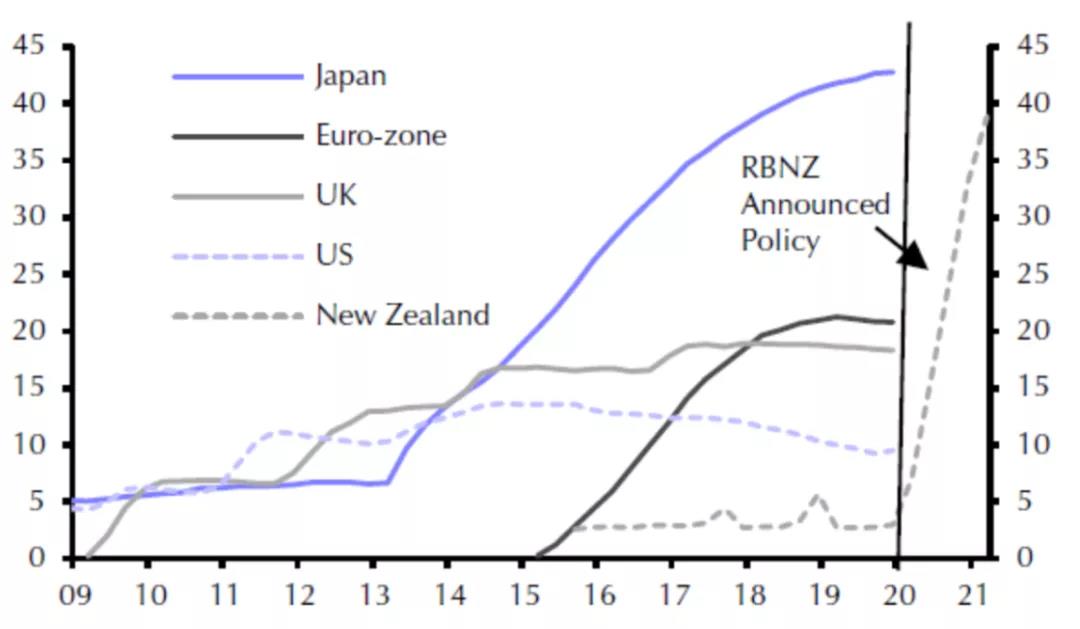
- The Reserve Bank may cut the OCR below zero, as the impending surge in unemployment will make its inflation and employment targets very difficult to achieve.
- Further quantitative easing may follow to meet borrowing demand across all parts of the market.
The pandemic's impact on New Zealand's industries and regions
COVID-19 is delivering both a demand shock to New Zealand's economy—affecting tourism, education and goods exports—and a supply shock, affecting imports and disrupting the labour market as people cannot work. This differs from situations typically limited to demand shocks, such as the 2007–08 global financial crisis.
Analysis of the impact on different industries:
- Tourism and travel have come to an abrupt halt.
- Export logistics are disrupted. Although the situation in China is returning to normal, conditions in other countries are deteriorating.
- Disruptions to imports, such as manufacturing and construction supply chains, may have increasingly evident effects in the future.
- The global recession will severely depress prices for New Zealand commodities and create difficulties for other exports.
- A shock to confidence will weaken investment and employment, and, for households, the property market and everyday spending.
- Falling share prices will have a wealth effect.
- Pressure in global and local financial markets, in terms of liquidity and risk spreads, will put businesses under strain.
- Social distancing has a major impact on the service sector.
Analysis of differences in regional impacts:
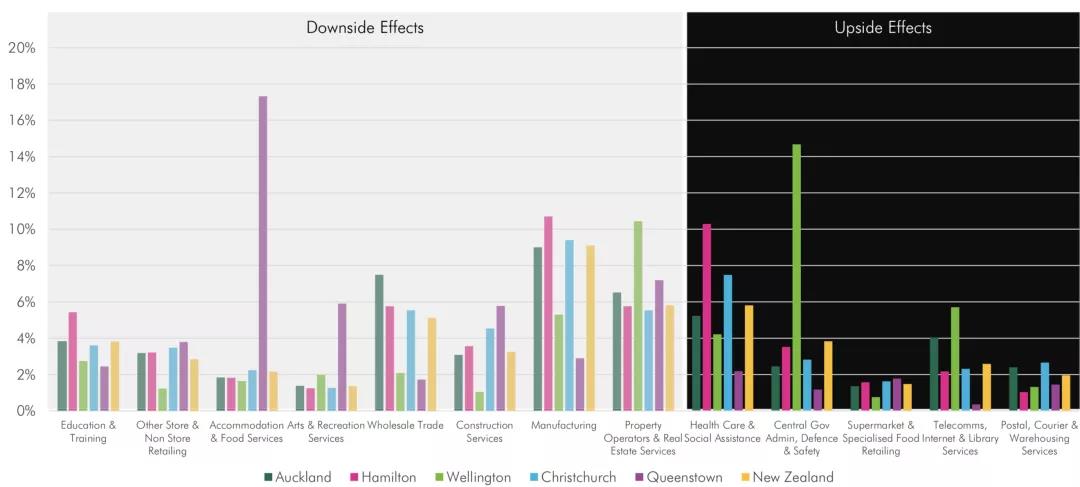
The main industries affected by COVID-19 in each region and their contribution to city GDP
Based on their contribution to regional GDP, the main affected sectors in each city are as follows.
- Auckland: wholesale trade and manufacturing ☹; healthcare and telecommunications ☺
- Hamilton: manufacturing ☹; healthcare ☺
- Wellington: positive impact from central government ☺; property operators and services ☹
- Christchurch: wholesale trade, construction services and manufacturing ☹; healthcare ☺
- Queenstown: heavily affected, with accommodation, food services, arts and entertainment ☹
Overall, COVID-19 has a negative impact nationwide, with manufacturing, education and wholesale trade experiencing the greatest market volatility, although increased spending on healthcare and central government may bring some benefits. Regionally, Queenstown faces the greatest negative impact, while Wellington sees the greatest positive impact. Auckland has the largest positive and negative impacts across its industries, with a net GDP impact of -21%.
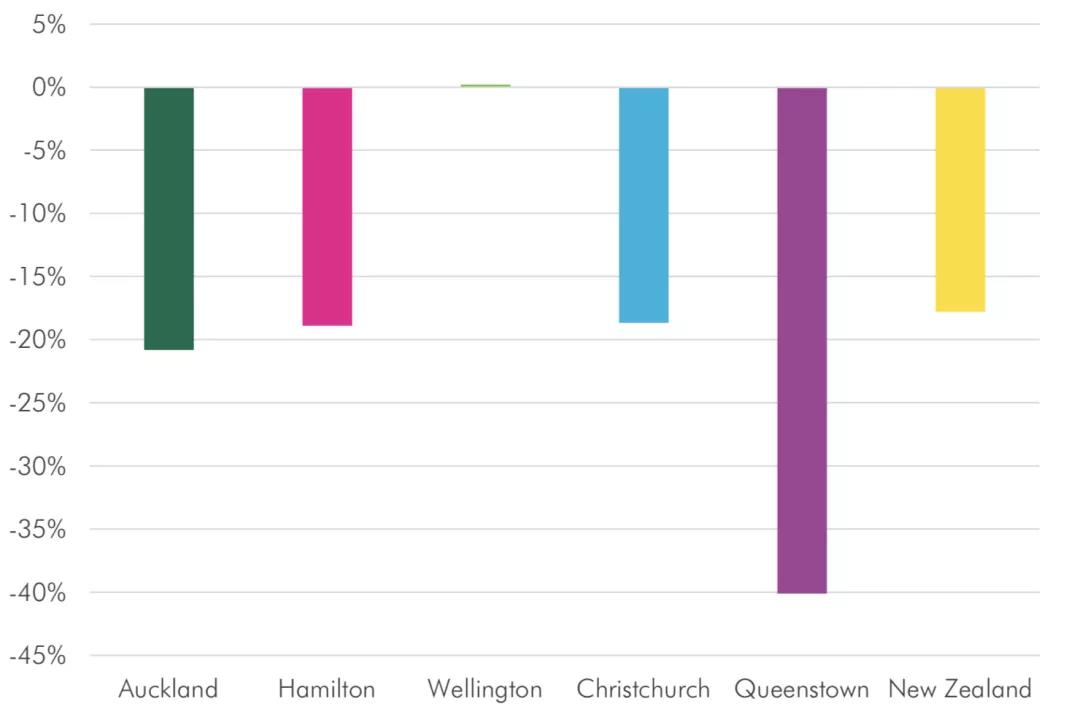
Estimated net impact of COVID-19 on regional GDP