
The housing market during the pandemic: sales stabilise, prices recover and investment opportunities return
With the impact of COVID-19 on New Zealand's economy still highly uncertain, property market activity and price movements seem to have become a barometer, with every forecast and statistic stirring emotions. Puzzlingly—or perhaps reassuringly—more than three months have passed since New Zealand entered its 33-day lockdown on 26 March, yet the figures and conclusions in housing market reports remained relatively positive, at least through the end of June.

With the impact of COVID-19 on New Zealand's economy still highly uncertain, property market activity and price movements seem to have become a barometer, with every forecast and statistic stirring emotions. Puzzlingly—or perhaps reassuringly—more than three months have passed since New Zealand entered its 33-day lockdown on 26 March, yet the figures and conclusions in housing market reports remained relatively positive, at least through the end of June.
March: six days of lockdown push sales to a 9-year low
Property sales hit a nine-year low, with nationwide sales down 4.8%: that was the price New Zealand's NZ$55,000,000,000 residential property market paid after just six days of lockdown. The Real Estate Institute of New Zealand (REINZ) estimated that the industry was losing around NZ$125,000,000 in sales each day, equivalent to NZ$3,600,000,000 over the entire lockdown.
Before lockdown, New Zealand's housing market was performing strongly. The national median house price rose 14% in February to NZ$640,000, up from NZ$560,000 a year earlier—the largest percentage increase in 53 months. After remaining flat for two years, Auckland house prices had recorded year-on-year growth for five consecutive months.
The REINZ report showed that 6866 residential properties were sold nationwide in March, down 347 from a year earlier and the lowest sales total in March for 9 years. Chief executive Bindi Norwell noted that new listings in the first quarter were 2000 lower than a year earlier. Taking that into account, alongside the impact of six days of pandemic lockdown, the nearly 5% decline in March sales was understandable.
“The extent of the pandemic's impact remains open to debate, but it will depend on a range of factors, including how long the country remains in Alert Level Four lockdown, unemployment levels, consumer and business confidence, people's ability to access finance and mortgages, and how long the wider economic recovery takes,” Norwell said.
{ad}
April: fewer listings and a further decline in sales
What changes have COVID-19 and the 33-day lockdown brought to New Zealand's property market? Are these merely short-term fluctuations, or the start of a medium- to long-term trend? Reports from REINZ and prominent real estate agency Barfoot & Thompson examined the state of the housing market in April and forecast its possible direction.
REINZ's April Residential Confidence Report showed that property sector activity was very subdued because of COVID-19. In April, only 1300 residential properties were sold nationwide, worth NZ$1,051,000,000. In a “typical” April, sales usually total NZ$4,358,000,000, with around 1600 homes sold each week.
Barfoot & Thompson's figures showed that it sold 552 residential properties in Auckland in April, down 50% from the 1096 sold in March. This was its lowest April sales total since the global financial crisis in 2008, when it recorded 453 sales.
Auction numbers also fell sharply, sale-price-to-valuation ratios declined and properties took longer to sell. This indicated that the Level 4 lockdown had a substantial impact on New Zealand's residential property market.
Surprisingly, however, house prices remained unchanged in April, with the median even reaching a record NZ$732,786. During the pandemic, homes generally continued to sell above their capital values (CVs), particularly in Auckland.
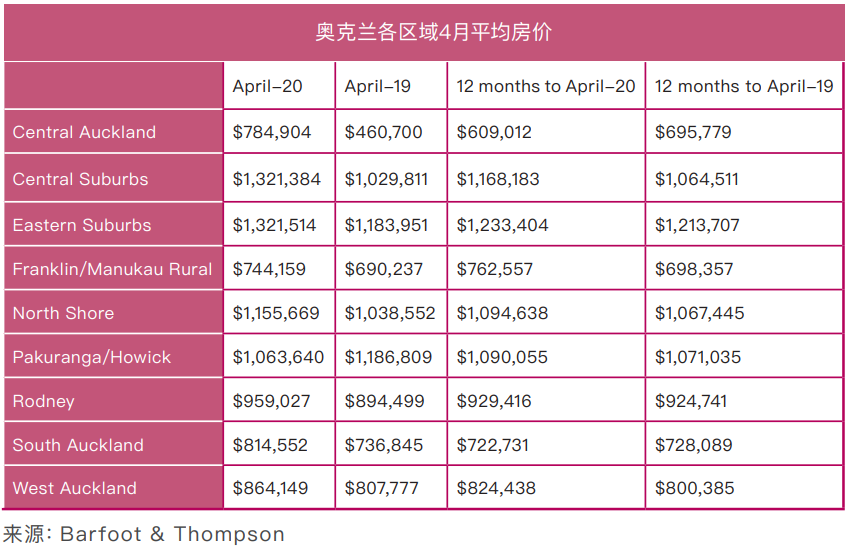
The sharp fall in new listings was the lockdown's most obvious effect on the property market. Just 239 properties were newly listed in April, less than a quarter of the number expected at this time of year. That was down 86% from March and 80% from April last year. Lower-priced properties were more popular.
Although changes in the mix of properties sold at different price points helped pull down average and median prices, house prices in April broadly maintained their upward momentum. The average sale price in April fell from March's record NZ$993,528 to NZ$962,136, but remained well above the averages for the first two months of the year and was 3.6% higher than a year earlier. This also explains why, despite the steep fall in sales volumes, the total value of sales fell only 17% year on year.
Barfoot & Thompson managing director Peter Thompson said the figures were better than expected. However, he noted that the stages involved in property transactions create a lag in market data. Although some transactions in the report were completed during Level 4 lockdown, many had been agreed in March and only completed in April. A comprehensive picture of the lockdown's true impact on the housing market might therefore have to wait until early June, when May's sales results could be reviewed.
May: asking prices reach record highs in several regions
However, the subsequent May reports from property companies still showed no signs of a weakening property sales market. Strong demand, demand exceeding supply and high prices remained the defining features of the May housing market.
COVID-19 appeared to have had little negative impact on average housing prices. Live data from realestate.co.nz showed the national average asking price rose 10.3% year on year to NZ$724,058, with seven regions recording all-time highs. The three regions with the most notable increases were:
- Manawatu/Whanganui: the average price reached a record NZ$495,294, up 8% on last year;
- Central North Island: up 1% to NZ$565,636. The region's price was nearly NZ$29,000 above its previous record, set in January this year.
- Taranaki: the average asking price exceeded NZ$500,000 for the first time since co.nz's records began in 2007, up 16.3% year on year.
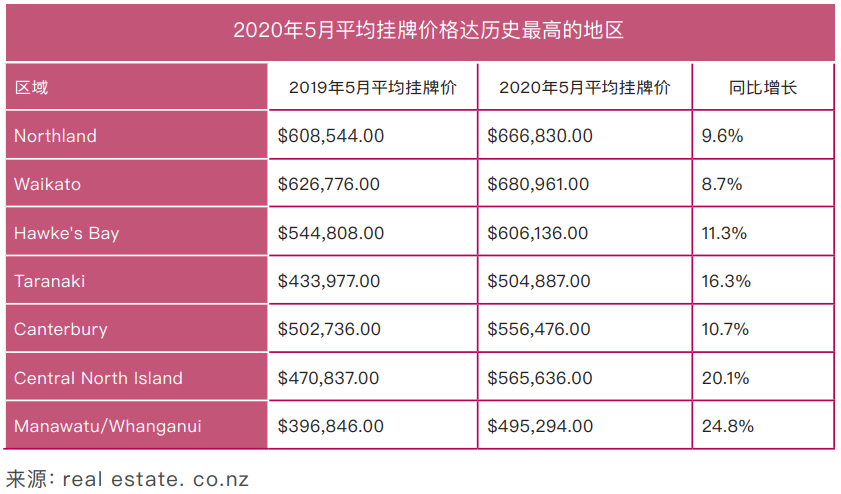
Although average asking prices primarily reflect sellers' expectations rather than actual sale prices, they are usually also a barometer of market sale prices.
Joint research by realestate.co.nz and REINZ showed a close relationship between asking and sale prices. A five-year analysis found that the gap between the two nationwide was generally around 2–3%.
Realestate.co.nz spokesperson Vanessa Taylor said: “Despite widespread speculation about property prices after lockdown, record average asking prices in seven regions show that most sellers still have high expectations for what their properties will sell for.”
Vanessa also said demand from prospective buyers showed no signs of weakening. Visits to realestate.co.nz in May were comparable to those in February, before the pandemic began. The summer month of February is usually a peak period for website traffic.
Nationwide, although new listings and total inventory both declined in May, they were broadly comparable with winter figures from 2019 and 2018.
Vanessa therefore believed the supply of listings could recover faster than expected.
Infometrics economist Brad Olsen believed the following factors could explain why the property market remained active in May, even as economic fundamentals changed: strict lockdown had interrupted many transactions, so May's sales and prices might reflect a continuation of pre-lockdown activity;
restrictions on going out and spending during lockdown meant many people saved more than they spent, increasing their available cash; KiwiSaver was beginning to recover;
mortgage rates continued to fall; and the government's relief policies had achieved their intended effect of cushioning the pandemic's severe impact, thereby also preventing disruption to the property market.
June: no sign of a slowdown as new listings flood onto the market
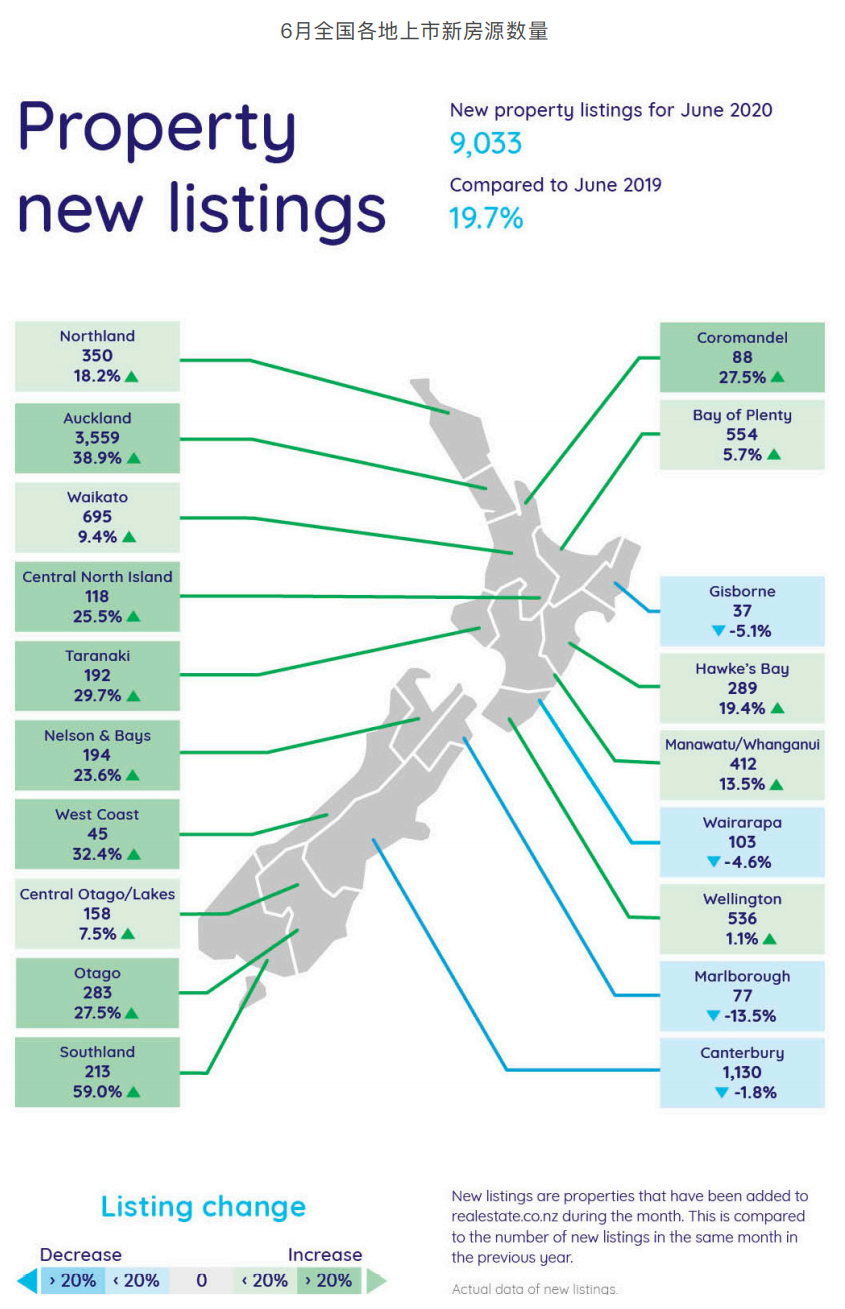
Although new listings inevitably declined during lockdown, nationwide new listings rebounded markedly in June, rising 19.7% year on year.
1 July WeChat image 1
The latest realestate.co.nz data showed that in June 2020, average asking prices remained stable nationwide, while 4 regions, including Auckland, became buyers' markets.
New listings also increased in most other regions. This indicated that New Zealand's property market remained active after the pandemic—good news for prospective homebuyers.
Vanessa Taylor said substantial numbers of new listings had come onto the market in almost every region last month. New Zealanders did not appear to be shying away from selling property, which she regarded as a positive sign.
“Generally, in times of economic uncertainty, people tend to delay selling their properties while they wait to see what happens.
” Vanessa said, “At present, rising new listings and stable prices suggest that New Zealanders in most regions are still selling their homes, with no intention of making substantial price cuts.”
Compared with June 2019, Southland, Auckland and the West Coast recorded the largest increases in new listings, at 59.0%, 38.9% and 32.4% respectively. Nationwide, only Gisborne, Wairarapa, Marlborough and Canterbury recorded fewer new listings. The figures showed that these declines were relatively small.
Despite the sharp increase in listings, property prices remained stable in June, with none of the declines some had predicted. The national average asking price was NZ$727,749, up slightly by 0.5% from May 2020 and 10.4% higher than in June 2019.
Realestate.co.nz's inventory data also showed that Auckland, Nelson & Bays, Canterbury and Central Otago/Lakes became buyers' markets in June.
Auckland had last been a buyers' market in July 2019. For the other three regions, it was the first time in many years.
Vanessa explained that these were called “buyers' markets” because slowing sales were generally good news for buyers. This could mean a temporary respite from the scramble to outbid other buyers that had become common in these regions in recent years. “For prospective buyers, this could be a good time to buy in these regions.”
Looking ahead: five forecasts reveal investment opportunities
Whether through short-term fluctuations or long-term trends, COVID-19 has undeniably had a major impact on New Zealand's housing market.
What changes might emerge in New Zealand's housing market after the pandemic? Where will future opportunities lie? Here are 5 forecasts from property experts.
- Wellington will be the strongest-performing city
Based on unemployment forecasts arising from COVID-19, New Zealanders unable to find work locally may move from smaller regional towns to major cities in search of jobs.
Employment opportunities will be the biggest determinant of housing market prices over the coming months.
Gareth Kiernan, chief forecaster at economic analysis firm Infometrics, said Wellington had the largest number of government jobs, giving it an employment advantage over other major cities.
“The public sector, concentrated in Wellington, provides a large number of jobs. Unlike private businesses, the government is unlikely to cut staff.”
James Wilson, director of valuations at OneRoof's data partner Valocity, believed Wellington had maintained strong value growth throughout lockdown.
A shortage of local listings had both supported sales activity and protected the capital's property market. “Wellington has had very low housing inventory since the global financial crisis, which has helped property values remain relatively buoyant.”
- Diversity will save Auckland
Although Auckland has fewer public sector jobs than Wellington, as New Zealand's largest city it has consistently offered more employment opportunities.
Auckland's housing market will inevitably face challenges after the pandemic. However, because the city does not depend entirely on tourism or other vulnerable, high-risk industries, major price fluctuations are not expected.
Wilson believed Auckland was not a single housing market. Beyond the central city, it had a vast and diverse suburban market, with each area responding to the pandemic's impact differently and to varying degrees. “There are plenty of jobs in the central business district, South Auckland and Manukau. Those areas' markets will perform well.”
- Agriculture and forestry will support the housing market
Agriculture and forestry are two major industries that economists expect to remain unaffected by the pandemic and economic downturn. Hawke's Bay, Waikato and parts of Canterbury have substantial agricultural and forestry sectors, making large-scale housing market declines unlikely in these areas.
“Where there are strong resources in products such as dairy, beef and lamb, international demand, particularly from China, will keep those regions' housing markets stable.
But I still expect that these regions could see price declines and softer markets, as they did in previous years,” Kiernan said.
Canterbury may be something of an exception compared with other agricultural centres. He added: “The region is still experiencing the aftermath of the major earthquakes, and the closer you get to Christchurch, the greater the housing oversupply.”
- Popular investment markets face risks
Housing markets in places such as Whanganui, Gisborne and Timaru, which attracted many out-of-town investors seeking inexpensive property, will see a marked slowdown and price declines in the near term.
Kiernan expected demand for investment properties to weaken because of uncertainty about the economic outlook.
He believed out-of-town investors might wait 18 to 24 months before returning to the market. “More and more people expect property prices to fall. Investors make money through capital gains, so naturally they do not want to expose themselves to the risk of falling prices.”
Wilson believed investors would shift their focus towards areas where rental properties and employment opportunities could deliver higher long-term returns—usually some of New Zealand's main cities.
- Quality suburban neighbourhoods are worth watching
Kiernan believed people who could afford homes in desirable neighbourhoods were generally less sensitive to economic crises.
“If you are a New Zealander working overseas, New Zealand currently looks like a more attractive place to live.
So I can see demand for homes in desirable neighbourhoods remaining high over the next six months or so, even if it is not permanent.”
He cited Auckland suburbs in the Double Grammar Zone, such as Remuera, Epsom and Mt Eden, where property values would prove more resilient during the crisis.
“These neighbourhoods' markets will not be completely unaffected, but they may remain insulated for longer when the wider market declines.”