Where is the New Zealand dollar heading? What will sustain New Zealand’s economy? Eight questions on the state of the economy
More than four months have passed since the country went into lockdown because of COVID-19. Although New Zealand has been praised as one of the world’s best performers in tackling the pandemic and restoring its economy, the market still faces many unknowns, uncertainties and even risks.
Since the country went into lockdown because of COVID-19, more than four months have passed.
Although New Zealand has been praised as one of the world’s best performers in tackling the pandemic and restoring its economy, the market still faces many unknowns, uncertainties and even risks.
Many questions about the future of New Zealand’s economy also remain for time to answer.
In the meantime, economists have been putting forward their views. Market analyst and columnist Roger J Kerr has offered his interpretation of eight major questions facing New Zealand’s economy.
{ad}
1. Will the retail rebound end soon?
The rebound in consumer spending after New Zealand came out of lockdown far exceeded most people’s expectations, and the reasons are now clear.
- New Zealanders spend NZ$9,000,000,000 a year on overseas holidays, particularly winter trips to Europe and Pacific island countries. This year, that spending has shifted to the domestic market.
- The residential property market has not run into trouble as most experts predicted.
- Outside tourism-related industries, unemployment appears to be less severe than previously expected.
- Apart from the absence of overseas visitors, life in New Zealand has largely returned to normal, and consumer spending behaviour has consequently returned to its usual level.
Given that these factors may remain unchanged over the coming months, Roger J Kerr is relatively optimistic and believes the retail rebound should continue.
He says this will ultimately depend on consumer confidence, and in turn business confidence. The government’s next economic support package after the wage subsidy scheme ends in September will be crucial, particularly for those who truly need help.
2. What is behind the sharp rise in New Zealand shares and the dollar?
Local financial and investment markets show that investors with substantial cash reserves are more inclined to expand their investments.
With returns on investments such as bank deposits and bonds close to zero, dividend-paying shares are in strong demand on New Zealand’s stock market.
Many large New Zealand listed companies, such as F&P Healthcare and A2 Milk, have also benefited from this shift.
The large numbers of overseas investors putting money into New Zealand’s share and currency markets also send a clear signal: New Zealand’s economic prospects could outperform those of other economies because of its major trading relationship with China, whose economic recovery is far ahead of the United States and Europe.
Markets often provide a clearer and more accurate outlook than many economic forecasters.
3. Has domestic political risk suddenly increased?
Until recently, so-called political risk had relatively little influence on the New Zealand dollar’s exchange rate.
The “kind and sharing” policies promoted by Jacinda and her government have made them highly popular with the public. There should be little doubt that Labour will either win an outright majority in the forthcoming election or continue governing through a coalition.
The latest polls show New Zealand First fading from view, with the Green Party potentially taking its place.
If that happens, and the Greens secure major policy concessions in post-election negotiations for a two-party coalition, their opposition to agriculture, business and construction development could lead to policy changes that damage the economy and investment. This could cause the New Zealand dollar to depreciate. Roger J Kerr says foreign exchange markets are expected to respond more frequently to political polling trends over the coming weeks.
4. Why is China so important to New Zealand’s economy?
It is no coincidence that New Zealand’s economy has maintained relatively strong GDP growth over the past 12 years, since the China–New Zealand Free Trade Agreement was signed in 2008.
- Exporters can take New Zealand’s high-quality food directly into a vast market of 400,000,000 middle-class consumers.
- Consumer goods importers, meanwhile, benefit greatly from China’s large-scale manufacturing economy.
Strong exports and low inflation are good news for every New Zealander.
Roger J Kerr considers the argument that excessive reliance on a single market could expose New Zealand’s economy to major risks not worth rebutting.
He argues: “As the response to the pandemic over recent months has demonstrated, China is more disciplined and organised in dealing with crises or shocks than our American allies.”
5. Will we be dragged into the global recession?
Economic theory holds that a global recession will drive down the prices of goods and services as consumer demand contracts.
But Roger J Kerr does not believe the central bank can accurately assess this unprecedented crisis.
He believes the current global recession differs from every previous recession: the downturn is faster, but so is the recovery.
Commodity prices have not fallen as economists would normally expect; many have risen.
There are, of course, many challenges on the supply side of the market, which means inflation in New Zealand is largely driven by supply rather than demand.
He therefore believes New Zealand will be less severely affected by the global recession than forecast, with domestic, non-tradable inflation continuing at an annual rate of 3%.
6. Where is the government’s next economic plan?
Roger J Kerr praised the government’s economic decision-making team for its earlier decisions to tackle the public health crisis and save the economy, describing them as very wise.
However, he also criticised the way the approaching election has left the government hesitant to develop policies for the economic recovery phase.
Taking universities as an example, he noted that New Zealand’s universities had proposed plans to restart their substantial international education operations, but the government was unwilling to take any risks before the election.
This preference for doing nothing out of fear of making a mistake has frustrated many struggling businesses seeking a way forward.
7. Has agricultural exporting become the economy’s saviour through sheer luck?
It is rather ironic that the government is now full of praise for agricultural and horticultural exporters for rescuing the national economy from trouble.
Not long ago, however, relations between the government and the agricultural sector were very tense over policies on carbon emissions, water use and resource consent.
Roger J Kerr believes these industries’ steady performance in exceptional times is far more than a matter of luck.
Agricultural science has always underpinned New Zealand’s economy and wellbeing. In future, people working in New Zealand agriculture will continue to innovate and sell high-quality food and agricultural products to the world.
8. Will US dollar movements continue to dominate exchange rate trends?
Roger J Kerr’s answer is “absolutely”.
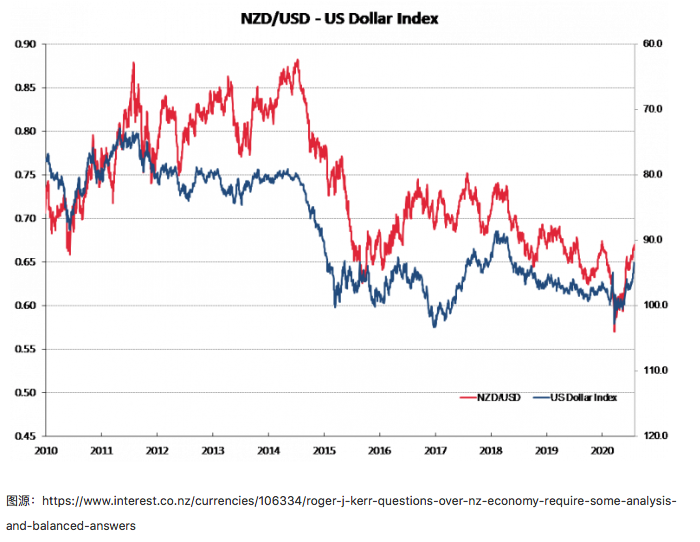
In July, the US dollar had its worst month on international foreign exchange markets in a decade, falling 4.4% against other major currencies.
The US dollar continued to weaken against the euro, falling 6% as the rate moved from US$1.1200 in January to US$1.1900.
By comparison, the New Zealand dollar rose just 3% against the US dollar, from US$0.6500 to a high of US$0.6700. This may reflect subdued speculative interest in the currency as the election approaches.
Roger J Kerr expects the US dollar to correct upwards in the short term following the recent sell-off. The New Zealand dollar is therefore very likely to fall against the US dollar from the current spot rate of 0.6625 to 0.6500 / 0.6400.
However, over the medium term of three to nine months, the US dollar will depreciate further, causing the New Zealand dollar/US dollar exchange rate to rise.
If the US Dollar Index falls to 80, from its current level of 93.5, the New Zealand dollar will reach 0.7500 against the US dollar.