
Affordable, energy-efficient and warm: could the first Chinese prefabricated homes to reach New Zealand help solve its housing crisis?
Yesterday, several major New Zealand media outlets reported on a batch of new homes prefabricated in Guangzhou and shipped to Auckland. Could these homes, which can be assembled like cars in just a few hours, offer first-home buyers an ideal, affordable option? Could their efficiency solve the housing crisis that has troubled New Zealand for years? Industry opinion remains divided.
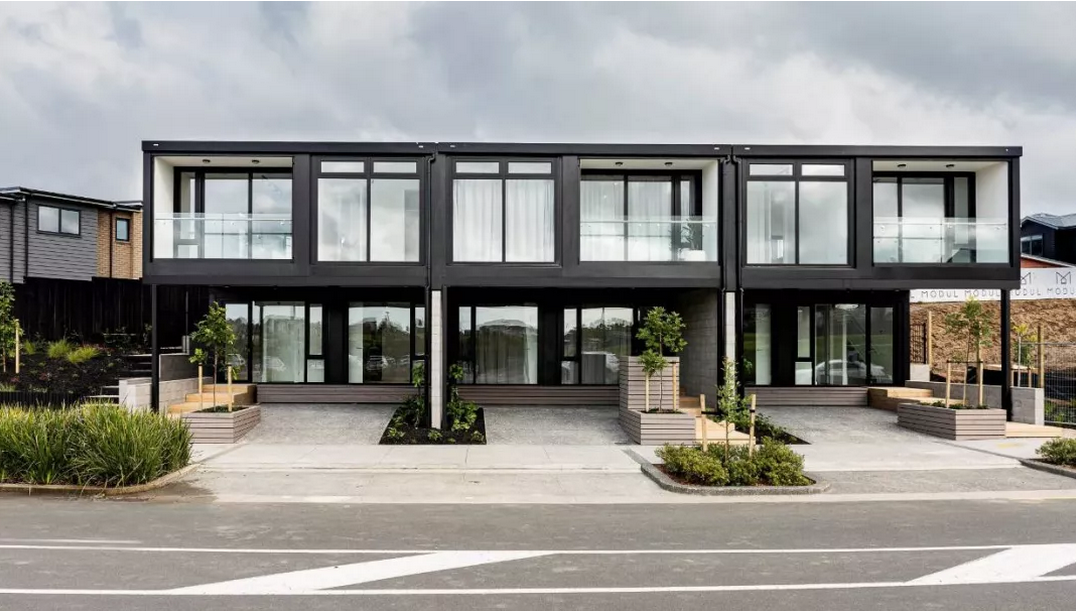
Three townhouses built in a day
The NZ Herald used the word “Prefabulous” in its headline to describe the work of New Zealand home builder Neilston Group.
The company unloaded building components for its first three townhouses at the Port of Auckland, then transported them to the construction site on Nugget Ave in Hobsonville Point, where they were assembled within a day.
The company is building 26 new homes in the area. Of these, 12 are understood to be affordable Axis homes, with prices starting at NZ$650,000.
The first three completed homes are all two-storey townhouses measuring 99 square metres. Each consists of four main modules, with the upper modules craned into place on top of the lower ones.
{ad}
The homes have three bedrooms and 1.5 bathrooms. The range has received multiple certifications from New Zealand’s Ministry of Building, Innovation and Employment. On handover, the homes will include all fittings, finishes and furniture, along with double glazing and insulation.
The design firm, Shanahan Architect, says the homes are designed to achieve a six-star Homestar rating, which would save owners NZ$5,000 in energy costs over five years.
Neilston Group Managing Director Tony Houston said the company had spent the past three years developing the system so that most of each home could be built off site.
“These homes are built in Guangzhou. New Zealand’s costs are too high for us to do it here. Our core business is providing affordable homes, particularly in the KiwiBuild sector.
Over the past three years, we have also been working with companies such as Kianga Ora and HLC.
In the past three years, only 385 KiwiBuild homes have been completed and delivered, while other parts of New Zealand’s construction market have actually built 75,000 homes over the same period.
The reason is that there is insufficient funding to provide the labour and building materials needed to build affordable housing at scale.”
Houston said the factory in China had enough capacity to build the equivalent of New Zealand’s entire annual housing output in just 12 weeks. New Zealand currently builds around 35,000 homes a year.
The new system developed by Neilston Group can deliver 500 to 1000 homes annually.
Background
What is prefabricated housing?
Also known as prefab construction or off-site manufacturing, it involves building homes using industrialised production methods.
Some or all of a home’s components are highly modularised and prefabricated in a factory, then transported to the construction site and assembled using reliable connections. In Europe, North America and Japan, these are known as industrialised homes.
Although the components are prefabricated, concrete still needs to be poured on site, as with traditional construction, so the finished homes are indistinguishable in appearance.
What are the advantages of prefabricated housing?
In an earlier interview with YIJU New Zealand, Huang Haixin, head of Archiland Architectur, outlined three main advantages of prefabricated construction:
- Lower labour costs.
The main building modules are manufactured in a factory, leaving workers on site to assemble them and saving a substantial amount of labour.
- Greater efficiency and shorter construction times.
Assembling modules on site is much faster than conventional house building.
- More reliable construction schedules.
New Zealand’s rainy winters often prevent work on construction sites, causing delays. Building modules, however, are mainly manufactured in factories and are unaffected by the weather.
In interviews with local New Zealand media, Houston also highlighted other advantages of prefabricated homes: “Manufacturing these homes elsewhere, overseas, and then transporting them to residential sites in the simplest way possible can effectively reduce costs—for example, by avoiding New Zealand’s expensive local building materials—and therefore reduce purchase costs for home buyers.
It can also greatly reduce construction waste, particularly given that around 50% of New Zealand’s landfill waste comes from the construction industry.”
He also noted that these homes could reduce disruption to neighbours and the community.
“Large components are generally transported by truck and lifted into place by crane, after which only a small workforce is needed to finish the home and landscape its surroundings. Neighbours no longer face months of disruption and hazards from construction machinery.”
The challenges facing prefabricated housing in New Zealand
Prefabricated housing has been popular in Europe, North America and Japan for years, and New Zealand construction companies have long recognised its commercial potential. So why has it been so slow to gain traction here?
As a key part of the New Zealand satellite event for the Shenzhen International Finished Housing Exhibition, construction and design experts from New Zealand recently joined their Chinese counterparts in an online forum. They discussed the challenges and possible solutions in implementing and developing prefabricated construction, and the new technologies and processes that could advance it during this exceptional period.
Colin Leuschke and Paul Brown, founding directors and principal architects of Leuschke and Paul Brown respectively—New Zealand’s first- and second-ranked residential architectural practices—spoke candidly at the forum about the barriers to widespread adoption of prefabricated housing in New Zealand.
- Limited overall time savings.
Prefabricated housing appears to save time, but that is often because only time spent on site is counted.
In reality, prefabrication brings some stages forward. Planning can take a long time, and logistics also add to the time spent off site.
- Logistics risks can be high.
Most manufacturers are overseas, in countries such as China. Complex procedures and long supply routes can pose significant risks to timely delivery.
Construction companies need to plan thoroughly in advance and store substantial quantities of prefabricated components to ensure installation happens on time, without unforeseen risks delaying construction.
The two experts proposed a targeted solution at the forum: establish local prefabrication factories in New Zealand to address the logistics challenges.
The forum also explored future living environments and communities. The participating experts agreed that green buildings and smart buildings would be the two defining features of future construction.
They also believed that establishing prefabrication factories in New Zealand would be more beneficial from a sustainability perspective: 85% of New Zealand’s electricity comes from hydropower, a renewable energy source, making it greener than China, where 60% of electricity comes from thermal generation.
But establishing factories in New Zealand presents another challenge:
- Persistently high construction costs.
Yu Weiwei, founder and secretary-general of the Liveable China Housing Industrialisation and Green Development Alliance, told the forum that even in China, exploring and promoting prefabricated construction still had a long way to go. Its higher cost compared with conventional construction was currently a major obstacle to its development. Colin Leuschke and Paul Brown strongly agreed.
Indeed, as Tony Houston said, China’s low material and labour costs make these homes affordable in New Zealand. Once prefabrication factories are established locally, that price advantage will disappear.