
Thinking of renting out rooms at home for extra income? First, learn how to set the rent so no tax is payable
The unpredictable course of the pandemic has put many people under financial pressure. Some households that own or rent larger homes are considering renting out one or more rooms to supplement their income. But do you need to pay tax when you take in people at home?

When we rent out one or more rooms in our own home on a long-term basis, the relationship between the householder and the occupant generally takes one of two forms: a boarding arrangement or a flatmate arrangement. Before discussing the tax treatment of these arrangements, we first need to establish a few conditions:
- Your own home means a property you live in yourself, whether you own it or rent it.
- You are renting out only one or more rooms in the home, rather than the entire property.
- A long-term arrangement generally lasts at least four weeks and excludes short stays such as Airbnb bookings.
{ad}
Boarding arrangements
In a boarding arrangement, the householder provides not only accommodation, including water, electricity, gas, internet and furniture, but also meals. Depending on the agreement, transport and other services may also be provided. The most common example is a homestay for international students.
New Zealand has long had a threshold for tax-free boarding income. The latest rules, in effect since 1 April 2019, replaced the previous blanket threshold based on boarding payments with a combination of 3 separate standard costs:
- Weekly standard cost per boarder: living costs;
- Annual housing standard cost: housing costs;
- Transport standard cost: transport costs.
Conditions apply to the use of these standard costs. If you do not meet the following conditions, or if you have a larger mortgage and higher expenses, you can use the actual cost method to calculate your rental profit or loss.
- The householder must be an individual, rather than a company;
- There must be no more than 4 boarders at any one time throughout the financial year;
- The boarding services must not form part of the householder's other GST-taxable activities;
- The householder must not have short-stay guests, such as Airbnb guests, while hosting boarders;
- No one in the household may be using another standard cost when applying for other benefits or subsidies, such as the standard cost for home-based childcare;
- Income tax deductions must not be claimed twice. For example, no one in the household may claim home office expenses.
Next, let's look at how to calculate these three types of costs:
- Living costs are updated annually
Inland Revenue (IRD) updates the standard living cost for boarders each year based on the Consumers Price Index (CPI) published by Statistics New Zealand. For the 2019–2020 financial year, the standard living cost is $191 per week.
If you have a homestay boarder and charge $190 a week, your income is tax-free because it is below the standard living cost. This standard applies to each boarder, with a maximum of 4 at any one time. Please note that children under 5 need care from a parent or guardian, so this standard does not apply to children under 5.
If you charge $192 a week for board, this exceeds the standard living cost. Whether the excess is taxable depends on the housing costs.
- A formula for housing costs
Housing costs must be calculated using a formula.
If you own the home, the formula is:
(Property purchase price including renovations × 4% − accommodation assistance) × number of boarders / total number of residents × weeks of boarding / 52 weeks
If you rent the home, the formula is:
(Rent − accommodation assistance) × number of boarders / total number of residents × weeks of boarding / 52 weeks
The formulas may look complicated, so let's use an example to make them easier to understand.
Suppose your home has three bedrooms. You bought it 5 years ago for $450,000 and spent another $50,000 on renovations 2 years ago. Your older son is now at university in the South Island and can return home only for 2 months over summer. Your younger daughter is just 4 and lives with you and your spouse. Kate, a single mother with a 5-year-old child, boards with you for $320 a week, including meals and accommodation. Do you need to pay tax in this situation?
Because Kate's child is under 5, the standard living cost does not apply to the child, who is also excluded from the boarder count. Kate's weekly boarding payment of $320 therefore exceeds Inland Revenue's standard living cost of $191 per week, so we need to look at the housing costs:
- The property purchase price plus renovation costs is $500,000;
- Kate is the only boarder counted;
- Your older son lives at home for less than half the year, so he is excluded from the resident count. Your younger daughter is under 5, so she is also excluded. The total resident count is therefore 3: Kate, you and your spouse;
- Assume Kate boards for a full year, totalling 52 weeks;
- You receive no accommodation assistance.
Applying the formula, your housing costs are: ($500,000 × 4% − 0) × 1 / 3 × 52 / 52 = $6,667
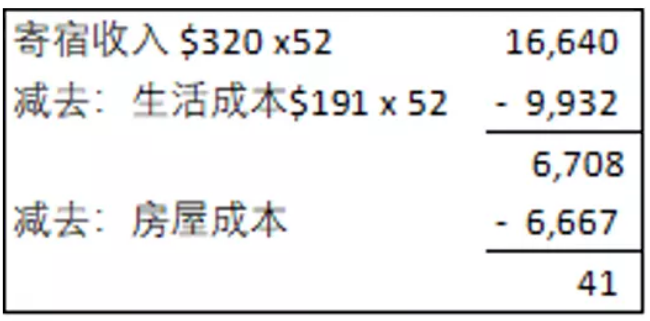
Is the remaining $41 taxable? That depends on whether transport costs can also be deducted.
- Transport costs are calculated by distance
Suppose Kate cannot drive, and the boarding agreement requires you to take her and her child to dance lessons every weekend. The return journey from home to the dance school is 2 kilometres, totalling 104 kilometres a year. Inland Revenue's current mileage rate is 79 cents per kilometre, so your deductible transport costs as the householder are 104 × 0.79 = $82.16.
Inland Revenue updates its mileage rates annually. You can also use the AA's mileage rates.
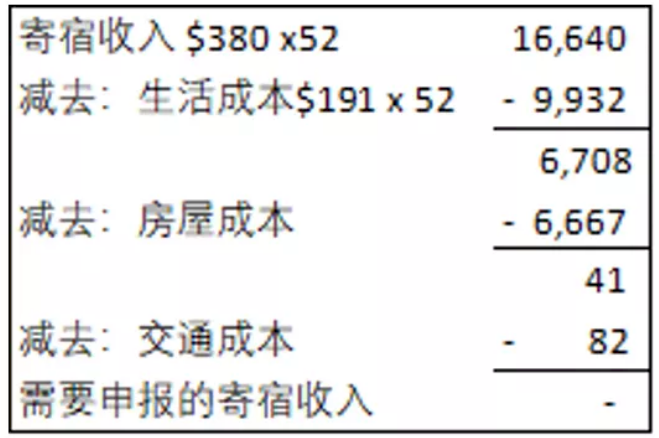
Putting these calculations together, your boarding income is negative after deducting transport costs. It is therefore tax-free and does not need to be declared. If the result remains positive after deducting transport costs, that amount is boarding income that must be declared.
Note: the main purpose of the transport costs must be to transport the boarder. For example, if a homestay student and your child attend the same school, you cannot count the cost of driving them to and from school each day, because you would still need to take your own child without the student. However, if you drive the student to a football match each weekend and take your own child along to watch, those transport costs can be counted.
Flatmate arrangements
Flatmate arrangements are simpler than boarding arrangements: you rent out a room without providing meals or transport.
Here, a flatmate arrangement does not mean a group of friends or classmates renting an entire home together and sharing the costs. In that situation, no one makes a profit, so there are no tax implications. The situations we are discussing are:
- Renting out rooms. After buying a home with a mortgage, you take in occupants to ease the repayment burden.
- Subletting. For example, you rent an entire three-bedroom home for $1000 a week, live in one bedroom and sublet the other two for $400 per room per week. Everyone then shares the electricity, water and internet costs.
When one flatmate profits from the others, the actual cost method must be used to determine whether the rental arrangement makes a profit or loss and whether income tax is payable.
The steps for calculating actual costs are:
- Calculate all rental income received during the financial year.
- Identify expenses incurred wholly to earn rental income. These can be deducted from that income. Examples include advertising for occupants, cleaning or repairing their rooms, and fees paid to a letting agent to find occupants.
- Identify expenses shared by you and the occupants, such as water, electricity, gas, internet and rent you pay to the landlord. If you own the home, these also include council rates, insurance and mortgage interest.
- Calculate the home's total internal floor area; assume it is 100 square metres.
- Calculate the area used exclusively by the occupants. If two occupants' bedrooms total 30 square metres, then 30% is for their exclusive use.
- Calculate the shared area, which may include the shared lounge, kitchen and bathroom. Assume this totals 50 square metres. Half of that, or 25 square metres, representing 25% of the total floor area, is allocated to the occupants' use.
- Add the occupants' exclusive-use area of 30% to their half of the shared area, 25%. Their total allocated area is therefore 55% of the home, so 55% of the shared expenses calculated in step 3 above can also be deducted.
- Add steps 2 and 7 to obtain total deductible rental expenses.
- Calculate the number of days the rooms were available for rent during the financial year and divide by 365 days to obtain a proportion.
- Multiply total deductible rental expenses by the proportion from step 9 to obtain the actual costs that may be deducted from rental income.
- Finally, subtract the allowable deductions calculated in step 10 from the total rental income calculated in step 1. If the result is positive, you have a rental profit and must declare it for income tax. If it is negative, you have a loss that can be carried forward to the following year and offset against future rental income.
About the author:

Tony Su
Baicheng Chartered Accountants was established in 2009. Its founder, Tony Su, is a licensed Chartered Accountant (CA) and member of Chartered Accountants Australia and New Zealand (CAANZ), a Fellow Certified Practising Accountant (FCPA) with CPA Australia, and a Chartered Certified Accountant (ACCA) in the United Kingdom. Tony has 17 years of professional experience, with specialist knowledge and extensive experience in taxation, tax audits, business planning and business advisory services.