Worldwide taxation does not mean double taxation: how can you pay tax correctly while protecting your rightful income?
China has announced that it will tax Chinese people worldwide. As a Chinese person living and working in New Zealand, how can you pay tax in a way that complies with both countries’ laws? How can you remain compliant without losing income you are entitled to keep? Let us clarify some common concerns and easily confused issues.

Many Chinese people have long been unclear about the concept of tax residency. China’s announcement that it will tax Chinese people worldwide has heightened concerns about double taxation. As an individual, you first need to establish which country you are tax resident in. In some circumstances, you may be tax resident in more than one country.
(1) Does obtaining New Zealand PR make you a New Zealand tax resident? Does not having PR mean you are not a New Zealand tax resident?
First, whether you are a New Zealand tax resident is not directly related to whether you hold New Zealand permanent residence or citizenship. An individual’s New Zealand tax residency depends on whether they meet the days test or the permanent place of abode test.
The days test
If you spend more than 183 days in total in New Zealand within 12 months, you are regarded as a New Zealand tax resident from the first day you arrived in New Zealand during that 12-month period.
Note: These 183 days do not have to be consecutive.
{ad}
The permanent place of abode test
Even if you do not meet the days test, you may still be regarded as a New Zealand tax resident if you have a ‘permanent place of abode’ in New Zealand. Under Inland Revenue’s criteria, this generally means a home in New Zealand where a person lives on an indefinite, long-term basis rather than temporarily, even if they sometimes spend time overseas. The person does not need to own the home or have exclusive use of the whole property.
Note: An income-producing investment property in New Zealand is unlikely to be considered a permanent place of abode. However, a property in New Zealand where you regularly live may be regarded as your permanent place of abode.
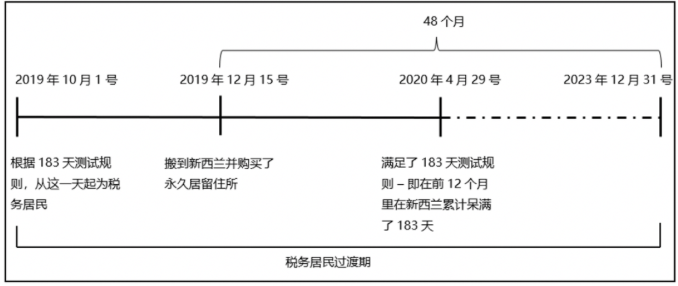
(2) If you become a New Zealand tax resident for the first time, or return to New Zealand after being away for 10 years, how do you calculate the transitional tax residency period of 48 months?
Taxpayers who qualify as ‘transitional residents’ may be exempt from income tax on income sourced outside New Zealand. However, this exemption does not cover overseas salary income from employment with an overseas employer or overseas income earned from providing services. Transitional residency begins on the first day of New Zealand tax residency and ends at the close of the 48th month after the month in which a permanent place of abode is acquired or the 183-day test is met, whichever occurs first.
(3) As a New Zealand tax resident, must you declare overseas property income in New Zealand if it has already been taxed in another country, such as China?
- If the country where your overseas property is located, such as China, has a bilateral tax agreement with New Zealand, and you are defined as a New Zealand tax resident under that agreement, New Zealand has priority taxing rights over you.
- Therefore, as long as you are a New Zealand tax resident, you must declare and pay tax in New Zealand on income generated by overseas property, regardless of whether it has already been taxed overseas.
In other words, any income earned or deemed to arise in connection with overseas property is taxable in New Zealand for New Zealand tax residents. This applies regardless of whether the country or territory where the property is located taxes the same income. What should you bear in mind when paying New Zealand tax on overseas property income?
- You cannot simply enter the net profit or loss from overseas rental income in your New Zealand tax return. Instead, you must calculate the net profit or loss to be declared using New Zealand tax rules on income, depreciation and allowable expenses. Because New Zealand’s tax rules differ from those overseas, taxable income in New Zealand and the overseas country is unlikely to be exactly the same.
- New Zealand’s standard balance date is 31 March, which differs from those of other countries and territories. For example, Australia’s standard balance date is 30 June, the United States and China use 31 December, and the United Kingdom uses 5 April. This means you may need to consider income and expenses arising over the corresponding period when calculating taxable overseas rental income.
- Many people borrow from overseas banks when buying overseas rental properties. Inland Revenue may therefore advise you that you need to calculate interest expenses under the financial arrangements rules and pay New Zealand non-resident withholding tax or approved issuer levy (NRWT/AIL).
- If the country where the property is located has a bilateral tax agreement with New Zealand, and that agreement gives the overseas country the right to tax this type of income, you may be able to claim a foreign tax credit when declaring the income in New Zealand to avoid double taxation. However, supporting evidence may be required, such as proof that the foreign tax has been paid. The foreign tax paid must also be substantially similar in nature to New Zealand income tax.
(4) As a New Zealand tax resident, do you need to pay tax on overseas share or fund investments?
As Inland Revenue explains, the foreign investment fund (FIF) rules apply to offshore investments held by New Zealand tax residents. However, the following exceptions apply:
- They do not apply to interest earned on term deposits, bonds or money lent;
- They do not apply to shares in Australian-listed companies;
- They do not apply where an individual’s investment amount does not exceed NZ$50,000 at any time;
- If a foreign company meets the definition of a controlled foreign company (CFC), your investment in it is subject to the CFC rules rather than the FIF rules.
Under the FIF rules, tax is not simply based on income you actually receive. Instead, the taxable amount must be calculated using the methods below. In other words, dividends actually received and/or actual profits from selling shares may be treated as tax-free income and need not be taxed.
FIF income or losses should be calculated using one of the following methods:
- The fair dividend rate method;
- The comparative value method;
- The cost method;
- The deemed rate of return method; or
- The attributed income method: this applies only to shareholders with an equity interest of between 10% and 50% in a non-controlled foreign company.
Here, we discuss the most common methods: the fair dividend rate method and the cost method. Both use the same formula: (5% × opening value for the tax year) + quick sale adjustment. As this formula shows, if shares are purchased during the tax year, their opening value for that year is ‘0’. A quick sale adjustment applies when a taxpayer buys shares and sells some or all of them within the same income year. If such transactions occur, the adjustment must be calculated using the formula: (5% × peak holding differential × average cost). If no such transactions occur, the quick sale adjustment is also ‘’, meaning no tax is payable.
(5) Does a bilateral tax agreement between two countries guarantee there will be no double taxation?
Generally, where two countries have a bilateral tax agreement, there will be no ‘double taxation’. However, the following situations may result in it:
- A taxpayer pays tax overseas without first consulting a tax adviser, but New Zealand rejects the foreign tax credit and advises that the country where the overseas income arose did not actually have the right to tax that type of income;
- A taxpayer fails to consult a tax accountant or adviser in advance and establish an investment structure that effectively reduces tax losses, ultimately resulting in ‘double taxation’.
Disclaimer: This article is for general information only and does not provide advice for practical implementation. If you have any questions, we recommend contacting your tax accountant for tax advice tailored to your circumstances.
About the author
Ellen Mao
Founder of FE Consulting Limited and an experienced New Zealand chartered accountant. Ellen previously worked as a tax auditor at Inland Revenue (IRD) and has a thorough understanding of New Zealand tax law and Inland Revenue’s procedures. She also worked as a senior tax consultant at BDO Auckland, part of the world’s fifth-largest accounting firm, advising New Zealand and international companies on a broad range of tax matters. Her experience in tax planning, tax returns, IRD tax disputes, debt remission and the tax penalties regime helps clients manage their businesses effectively, reduce tax losses, avoid tax problems and maximise their benefits.