
New Zealand’s economy shows early signs of weakness, but property prospects remain promising: an in-depth look at the pandemic’s impact on the construction market and its future development (part two)
In the previous article, we discussed the pandemic’s overall impact on New Zealand’s construction industry and its prospects. In this article, we look at the outlook for the Chinese construction sector, its development and ways to respond.


Amid the pandemic, early signs of economic weakness are emerging, yet the property and construction markets, widely expected to decline, have performed ‘unexpectedly’ well. The Chinese market has been particularly buoyant, leaving many people struggling to make sense of it. To explore this, James Hardie, a globally renowned building materials manufacturer and leading fibre cement brand, invited YIJU New Zealand to interview Mr Xu Li, president of the New Zealand Chinese Building Industry Association. Thank you for continuing to follow our coverage. In the previous article, we discussed the pandemic’s overall impact on New Zealand’s construction industry and its prospects. In this article, we look at the outlook for the Chinese construction sector, its development and ways to respond.

The interview follows:
Question: What proportion of New Zealand’s construction market currently consists of Chinese-led projects?
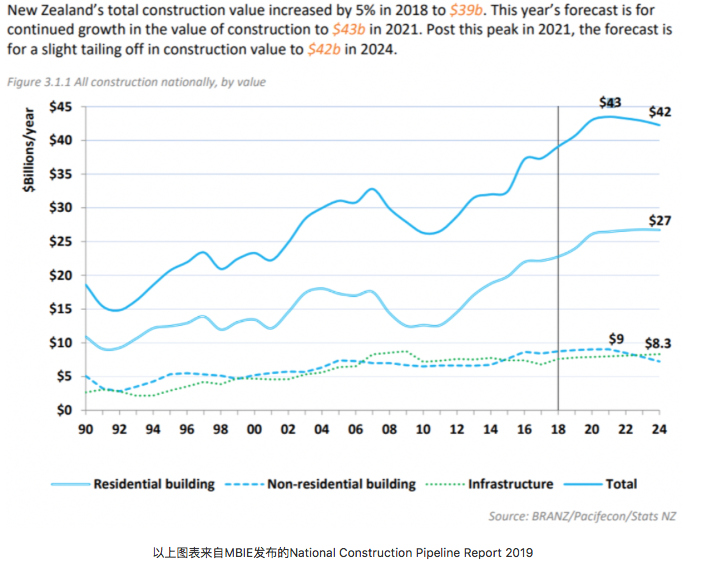
Answer: If we divide the current market into two broad categories, residential projects account for about 62%, while commercial and infrastructure projects together account for about 38%. We estimate that Chinese-led projects account for more than 50% of Auckland’s residential projects. If residential projects are further divided into private and public investment, Chinese-led projects probably account for 80% of privately funded projects.
Question: How do you explain the continued strength of the Chinese property and construction market during the pandemic?
Answer: As I mentioned earlier, the residential market has been less affected. People returning because of the pandemic have increased market demand, while Chinese construction companies have financial advantages and have been less affected. New Zealand’s property market was also already very buoyant before lockdown. Many people had mortgage pre-approvals that would expire if they did not buy, and favourable interest rates meant that buying a home cost much the same as renting. Interest rates are expected to fall further, encouraging more people to commit to buying, so demand has not declined. Another point worth mentioning is that governments and central banks around the world have used quantitative easing to stimulate their economies. Many investors believe currency depreciation is inevitable. In New Zealand, residential property investment has always been one of the best ways to protect against currency depreciation, so lower-priced properties with investment potential are also attracting investors.
This may also explain why developers remain enthusiastic. A common approach recently has been to buy land, demolish the existing house and replace it with medium-density housing, because the calculations still show room for profit.
Question: How do you see the future development of New Zealand’s Chinese construction sector?
Answer: I believe the crisis brought about by the pandemic will actually strengthen the Chinese construction sector’s position in New Zealand’s market. Most businesses in the sector are small or medium-sized, as are their projects, which are generally residential and have been less affected by the pandemic. With ample financial reserves and relatively light burdens, their market share will increase. This does not mean the total value of their projects will rise; rather, it reflects a sharp decline in project values across the wider market.
Question: How do you think the construction industry should respond to the uncertainty brought about by the pandemic?
Answer: Non-Chinese businesses in the construction industry, whether building materials suppliers or providers of related services, should pay greater attention to the Chinese construction sector. They should consider its needs and cultural differences, and promote themselves through approaches and channels that Chinese businesses respond to. For example, they could participate more in Chinese industry events and develop training and education programmes for the Chinese construction sector. Some suppliers could also seek opportunities for early contractor involvement (ECI) in project planning. This would help build a future pipeline, giving them a clear understanding of what comes next. They should also work hand in hand with industry organisations such as the New Zealand Chinese Building Industry Association. We can help bring businesses together and support a more prosperous industry.

For Chinese construction businesses, our message is to ‘pull together and weather the difficulties together’. The Chinese construction supply chain is relatively self-contained, with Chinese companies operating throughout it. The sector is currently undergoing a rapid transition. Previously, we mostly built standalone houses; now we are increasingly involved in medium-density residential projects. These have different construction standards and material requirements, and construction is relatively more complex, making difficulties more likely during the build. Working together can help ensure projects progress smoothly and maintain quality. The pandemic has brought many changes in a short time. Market demand has changed, and we need to change with it. Only by supporting one another can we overcome these difficult times together.
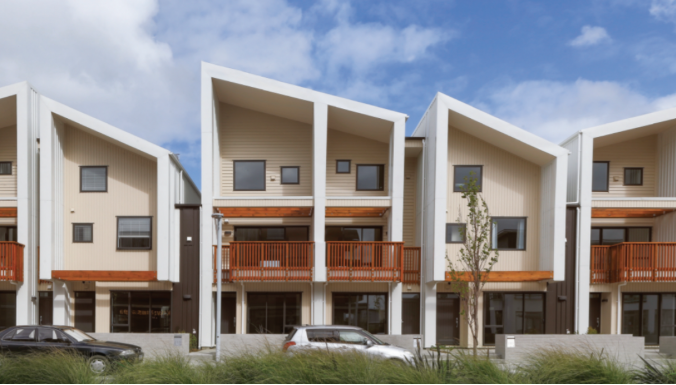
Built using James Hardie fibre cement products: a medium-density project
The Chinese word for ‘crisis’ combines the ideas of danger and opportunity. We should see the opportunity as well as the danger. Understanding the market and turning crisis into opportunity is the key to the Chinese construction sector’s continued growth in an unfavourable market environment.
Thank you for following this interview. Please scan the QR code to follow the official WeChat account of James Hardie, the globally renowned building materials manufacturer and fibre cement products supplier. Stay tuned for more industry news, building materials information and other engaging content.
