
Better after dark? Changes ahead for Auckland's city centre
Council chief economist David Norman and economist Shyamal Maharaj interviewed Auckland industry leaders to understand their views on the commercial property outlook and wider economic implications. Their proposed solution: develop the night-time economy.

During Auckland's two lockdowns, many industries maintained business as close to normal as possible through working from home or trading online. But there is no doubt that the COVID-19 pandemic has fundamentally changed how people live, work and enjoy their leisure time.
Auckland's city centre has been particularly hard hit by the loss of overseas visitors and international students, rising unemployment and large numbers of office staff working from home. Assessing three key indicators—leasing, investment and construction—may give us a clearer picture of the area's economic outlook.
The current situation
Office leasing
Economic downturns and booms are often closely linked to rising and falling office vacancy rates. Since the global financial crisis, New Zealand has experienced its longest economic expansion in recent history, with city-centre office vacancy rates falling to historic lows. Recently, however, the picture has changed, with tenants increasingly seeking quality。
Because this recession is not a financial-sector crisis, demand for premium office space appears to remain relatively strong. In the short to medium term, however, existing businesses will require less space on average, potentially increasing vacancy rates in lower-quality premises. It is not yet clear whether the future balance will favour working from home or collaborating in the office. Many industry leaders nevertheless believe modern businesses' need for collaboration will underpin long-term demand for office space.
{ad}
Commercial property investment
Investor demand accounts for more than 80% of commercial property purchases and has remained strong in recent years. Several positive factors are currently driving investment, including:
- Record-low interest rates worldwide, prompting investors to seek markets offering higher returns;
- Less pessimistic New Zealand economic data over the past two months;
- Strong support from a range of government and Reserve Bank policies.
At the same time, some current conditions may hold investors back, including:
- Higher unemployment, alongside slower employment growth, and lower GDP growth;
- Although premium tenants and low interest rates are keeping property prices stable, rents and yields are expected to decline as vacancy rates rise;
- Tenants' increasing demands for quality require greater expenditure, potentially slowing investment.
Construction and refurbishment
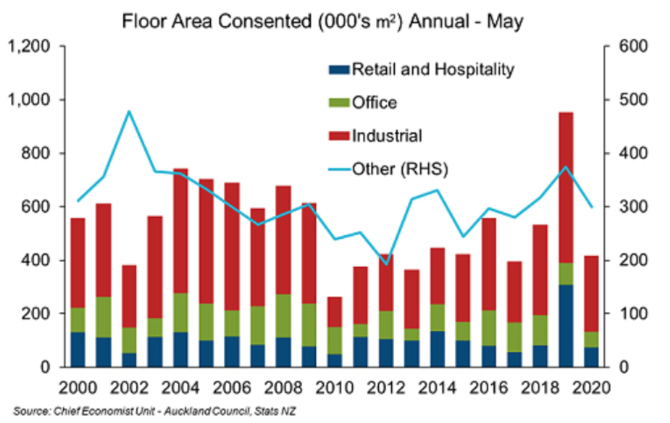
After reaching record highs, commercial building consents began to slow towards the end of 2019. Even so, progress on the pipeline of projects remains worth watching.
Many interviewees believe that, despite slower progress, projects already consented or under construction may still be completed on schedule. However, with unemployment rising and working from home becoming more common, overall demand for office space will fall significantly, and many companies may prefer to secure higher-quality premises by taking less space. The completion of projects such as Commercial Bay may therefore encourage further conversions and refurbishments of office buildings.
The future
Changes in the city centre
Auckland's city centre has long been a major source of employment, with more than 130,000 people working there, many in highly productive industries. The area generates around 19% of Auckland's GDP.
The city centre's success stems partly from its dense concentration of retail and hospitality workers. The maps show (could the last six maps in the link be made into a gallery that slides sideways, as you wanted to do with last week's design?) that six major industries employ 80% of city-centre workers. Financial and professional services account for more than 40%, representing Auckland's greatest productivity advantage as a large city. If working patterns continue to follow the trends seen during pandemic lockdowns, the city centre will face major changes that could reduce the agglomeration benefits and economies of scale traditionally associated with a busy urban centre. 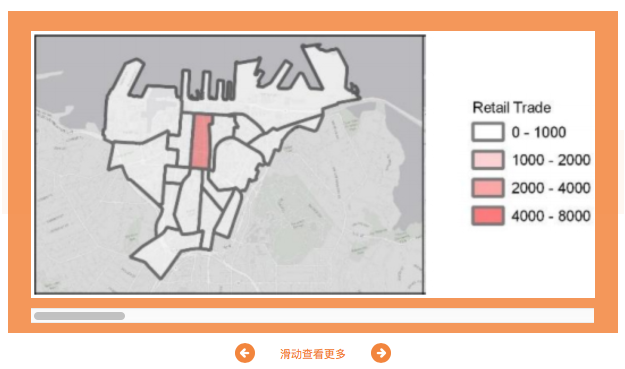
Mixed-use commercial and residential development
The impact on retail of fewer people working in the city centre could be offset by retaining and increasing its permanent population.
Around 37,000 people currently live in Auckland's city centre. They choose to live there to be close to work and enjoy its many amenities. But as the city's outskirts expand and suburban public transport and modern amenities improve, will the city centre retain an advantage in attracting residents? Will working from home encourage employees to choose larger homes rather than homes closer to the office?
A key consideration for the future is how retail should develop beyond primarily meeting the needs of people stepping out for lunch, shopping or coffee during their lunch break. Experience in other major cities suggests that positioning the city centre as a destination for leisure shopping through an “after-work” retail model will be one of the keys to setting it apart.
The role of business and government
The development and future direction of Auckland's city centre require a joint effort by private businesses and government, both central and local, with the aim of bringing more visitors, workers and residents back to the city centre。
- Retail businesses and their staff particularly need to adapt, including by improving products and services and extending opening hours. Although business districts such as Wynyard Quarter have many excellent retailers, eateries and service businesses, city-centre retailers cannot continue to rely solely on office workers. Businesses need to work together to make the city centre a destination better suited to people's evening shopping needs.
- The most positive role central and local government can play is to build confidence: confidence in the health and safety of using public transport and visiting the city centre, and confidence in the economic outlook through supportive policies.
- Central government can make full use of its policy tools to stimulate the economy. An immediate priority, for example, is finding ways to bring international students back to New Zealand under strict controls. International students are an important source of income for city-centre businesses and the export education sector.
- Auckland Council can support the city centre's transformation into a night-time business destination by continuing to improve public transport and making it safer and more attractive, particularly through public services after dark. It can also integrate the service sector with urban planning to support these changes.
- The council should review urban management rules and policies to make Auckland more liveable and continue to encourage residential development. Housing development should prioritise convenient public transport, proximity to workplaces and lower carbon emissions, giving the city centre greater economic potential.
- Government should continue working to attract highly productive businesses to the city centre. Auckland's high-tech sector, for example, accounts for only 5% of city-centre workers.