
Latest figures show unemployment better than expected, with these industries hungry for staff
Three successive rounds of wage subsidies came to an end in September, while unemployment, which had been expected to worsen, showed a slight improvement in August. Small though it was, it offered some hope. Some industries have remained resilient through the pandemic and economic turbulence, even experiencing further staff shortages. We look at which industries currently offer the most stable employment prospects.

Nationwide, an average of 219 people apply for unemployment benefits each day. Yet Stats NZ's employment index for August shows that nationwide employment in August was actually higher than before the pandemic.
Westpac chief economist Dominick Stephens says that although the economy has been hit hard by the Covid pandemic, it has proved more adaptable and resilient to shocks than initially thought.
“I have been pleasantly surprised by the New Zealand economy's resilience to lockdown. Unemployment is lower than expected, and the impact on GDP has been relatively moderate and manageable. This suggests the cost of lockdown has not been as severe as we anticipated.”
{ad}
Job numbers begin to grow
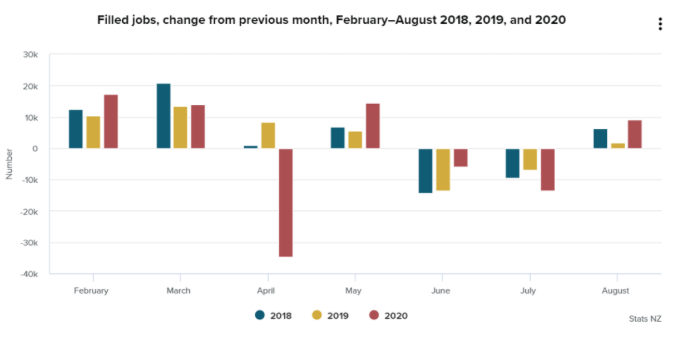
According to the latest employment index report recently released by Stats NZ, in month 8 job numbers increased for the first time after the previous two months。
Compared with July:
- All industries – up 4% (9,147 jobs)
- Primary industries – up 2% (220 jobs)
- Manufacturing – up 2% (1,028 jobs)
- Services – up 5% (7,899 jobs).
The breakdown by industry, region and demographic group was as follows:
- 19 industries, 12 recorded an increase in jobs.
The industries with the largest changes in actual job numbers were:
- Education and training – up 8% (7,409 jobs)
- Public administration and safety – up 3% (1,807 jobs)
- Healthcare and social assistance – up 7% (1,777 jobs)
- Accommodation and food services – down 8% (1,133 jobs)
- 16 regions, 13 recorded an increase in jobs.
Auckland, Gisborne and Hawke's Bay were the only three regions where job numbers fell.
The regions with the largest changes were:
- Canterbury – up 7% (1,877 jobs)
- Wellington – up 5% (1,124 jobs)
- Bay of Plenty – up 8% (1,097 jobs).
- Job numbers increased for women and across all age groups except young people
- The largest increase was among those aged 30–34, up 8% (2,049 jobs), while the 50–54 age group also saw an increase of 0.8% (1,660 jobs);
- Employment among those aged 15–19 fell by 1%, a loss of 3,174 jobs;
- Employment among women increased by 6% (6,684 jobs), compared with 0.2% (2,212 jobs) among men.
Auckland unemployment far better than expected
RNZ reports that the latest figures show overall unemployment was far better than expected, despite Auckland experiencing a Level 3 lockdown last month.
Auckland Council had forecast around 250 job losses a day during Level 3, but since 7 August, the actual average has been about 93 people losing their jobs each day.
Shortages persist in highly skilled and professional roles
Dominick Stephens says it is not difficult to predict which industries will experience high unemployment, “but identifying which sectors will seize new opportunities and grow is much harder”. Some industries, however, have the resilience to weather the storm. Recruitment market surveys suggest the pandemic crisis has actually made it harder for some industries to recruit suitable professionals to fill vacancies.
- Construction needs professionals who communicate well
Recruitment firm Hays' latest construction industry survey shows that most employers in the sector describe recruiting for senior positions as “very difficult” or “difficult”.
According to Trade Me's salary guide, roles facing shortages, such as construction project managers, offer average annual salaries of more than NZ$100,000. Other roles where demand exceeds supply, including site managers and quantity surveyors, also command average salaries of NZ$95,000.
Hays New Zealand managing director Adam Shapley says: “New Zealand's construction industry has long faced a serious shortage of skilled workers. Even the Covid-19 pandemic appears unable to ease the persistent skills shortages in many regions.” He notes, however, that entry-level positions are generally the easiest to fill, while employers are particularly keen to find candidates with strong communication skills. “Many employers have had similar experiences: a candidate looks impressive on paper and has good technical skills, but cannot build effective working relationships with colleagues. This can cause serious problems on site and within the business.”
- Law, government and IT Greater stability across these sectors
Trade Me Jobs figures show substantial year-on-year declines in both job listings and applications in law, government and councils, property, and IT.
- Average job listings and application numbers in the legal sector have halved compared with the same period last year.
- Job listings in government and councils fell 15% year on year, while applications dropped 30%.
- Job listings in property and IT also fell, although numbers remained relatively substantial. Average application numbers declined too, with the two measures down 15% and 12% respectively year on year.
Trade Me Jobs head Jeremy Wade attributes the decline in both job listings and applications to several consequences of the pandemic:
- Legal and IT roles previously attracted more overseas candidates, so border closures have reduced the number of applications employers receive.
- These industries have also experienced relatively few redundancies during the pandemic, with many employees remaining in their existing roles.
- Economic uncertainty and the resulting concerns about the future have made people reluctant to change their circumstances for now, also contributing to the decline in applications.
According to Trade Me's salary guide, median pay is NZ$100,000 in IT and NZ$70,000 in government and councils, while the median annual salary in the legal sector is around NZ$65,000.
- Seasonal staffing in fruit picking reaches a new low
This may suggest that lower-skilled work is more vulnerable to the pandemic. Yet as summer approaches, New Zealand's fruit-picking industry faces a worker shortage because of border closures.
Summerfruit New Zealand chief executive Richard Palmer says: “The summerfruit workforce usually consists of around 20% local New Zealand workers and less than 20% seasonal work visa holders, with the remaining 60% made up of backpackers, working holiday visa holders and other seasonal workers.” With borders currently closed, addressing the worker shortage is therefore a serious challenge.
Some experts suggest introducing robots could partly ease the labour shortage. However, University of Auckland robotics professor Bruce MacDonald believes current technology has yet to reach a satisfactory standard and is unlikely to resolve the immediate workforce gap.
Perhaps leaving Auckland to pick fruit over the coming summer holidays could be a good employment option for young people.