
Move aside, big cities: Auckland performs worst! Where in New Zealand offers the best property investment returns? The answer may surprise you
Auckland is the most economically developed city, Wellington is the seat of government, and Christchurch is the South Island's largest city… Yet when it comes to New Zealand's best regions for residential investment, these big cities all have to step aside.

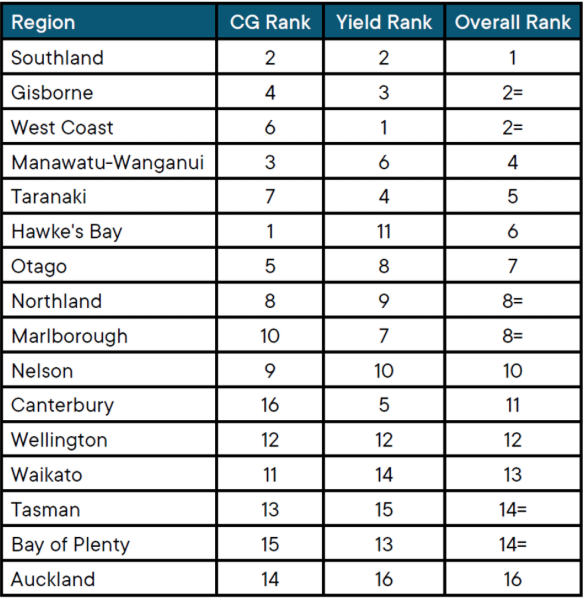
According to REINZ's latest Capital Gains and Rental Yields Report, Southland is New Zealand's strongest-performing region for residential property investment, ranking second nationally for both capital gains and rental yields.
Auckland delivers the weakest investment returns
In the three months to June this year, Southland residential property investments recorded capital gains of 19.3% compared with the same period last year, with the median house price rising from NZ$285,000 to NZ$340,000.
Its rental yield in the second quarter this year was 4.9%.
Gisborne and the West Coast followed closely behind.
{ad}
Gisborne has ranked among the top three in five of the past six quarters, placing second for investor returns in the second quarter this year.
The region ranked fourth nationally for capital gains, with prices rising 16.2% from NZ$370,000 to NZ$430,000, and third for rental yield at 4.6%.
The West Coast, which tied with Gisborne for second place overall, ranked only sixth for capital gains, with prices rising 12.8% from NZ$195,000 to NZ$220,000. However, it had the country's highest rental yield at 6.7%.
REINZ chief executive Bindi Norwell said: “Southland's continued delivery of such positive returns for investors through both capital gains and rental yields shows that investing in the region is a strategically astute move.
The region will undoubtedly remain on investors' radar, particularly with the temporary removal of LVR restrictions, which means a 40% deposit is no longer required, and with some major banks offering investors lending terms close to those available to owner-occupiers.”
By contrast, Auckland's performance was hardly satisfying for investors.
In the second quarter this year, Auckland ranked third from the bottom nationally for capital gains, with annual growth of 7.6%. Its rental yield was the lowest at just 3.2%, making it the weakest-performing region for residential property investment.
A closer look at the leading regions for capital gains
Comparing the second quarter of 2019 with the second quarter of 2020, the New Zealand regions with the strongest residential property capital gains were, in order:
1. Hawke's Bay: up 19.7%, from NZ$470,000 to NZ$562,500;
2. Southland: up 19.3%, from NZ$285,000 to NZ$340,000;
3. Manawatu/Wanganui: up 17.3%, from NZ$358,000 to NZ$420,000;
4. Gisborne: up 16.2%, from NZ$370,000 to NZ$430,000;
5. Otago: up 14.1%, from NZ$463,000 to NZ$528,500.
At the lower end of the capital gains rankings, Auckland and Canterbury again lagged behind in positions 14 and 16 respectively, while Bay of Plenty replaced Nelson in second-to-last place.
However, this also indicates that property markets in these regions were relatively stable during the second quarter.
“Although COVID-19 forced most property transactions to a halt in April, strong increases in median house prices meant residential investors in every region recorded steady capital gains.
The report shows that every region except the bottom three — Auckland, Bay of Plenty and Canterbury — achieved double-digit capital gains. This demonstrates the exceptional strength of the property market despite the pandemic's adverse impact on New Zealand,” Norwell noted.
She attributed the nationwide capital gains on residential investments in recent months to a combination of factors, “including the temporary removal of LVR restrictions, growing demand and low interest rates, which have made this one of the periods in the past 20 years when investors have felt most confident about borrowing.”
Rental yields generally edge down year on year
In the second quarter of 2020, the regions with the highest rental yields nationwide were:
1. West Coast: 6.7%, down from 7.5% last year;
2. Southland: 4.9%, down from 5.5% last year;
3. Gisborne: 4.6%, down from 4.9% last year;
4. Taranaki: 4.6%, down from 4.9% last year;
5. Canterbury: 4.5%, unchanged from last year.
Across the country's 16 regions, rental yields fell year on year in the vast majority. Norwell linked this to the rent freeze introduced in March.
“A six-month rent freeze was introduced in March following the COVID-19 outbreak, so it is hardly surprising that rental yields, expressed as percentages, fell across most regions.
Although there is no particularly clear evidence, initial concerns that COVID-19 would lead to higher unemployment also influenced changes in rental yields to some extent.”
Tasman was the only region to record a slight increase in rental yield, edging up from 3.4% in the second quarter last year to 3.5% in the second quarter this year. “
This is largely because the region recorded the largest rent increase over the past year,” Norwell said.