
Does commercial property have lasting appeal? What do the data say?
The wave of returning New Zealanders and economic policies prompted by the COVID-19 pandemic have driven the country's residential market to unprecedented levels of activity. But how has the commercial property market changed? Recent Colliers International surveys show that industrial property and office buildings are following different trends.

Colliers International's latest two major vacancy surveys show weakening conditions in both Auckland's industrial property and central city office markets, although their future paths may diverge. Strong leasing demand suggests industrial vacancy is at or near its peak. Meanwhile, central city office vacancy could continue rising over the coming year as tenants relocate, reduce their leased space and adopt flexible working arrangements.
{ad}
Industrial property
- Vacancy may be near its peak
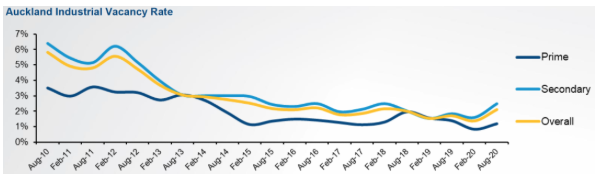
Despite the economic downturn caused by COVID-19 and lockdown measures, vacancy increases across Auckland's industrial precincts have been relatively limited and may already have reached, or be approaching, their peak. In the six months to August 2020, the overall vacancy rate rose from 1.4% in February to 2.1%, equivalent to an additional 90,850 square metres of vacant stock available to lease. Over the same period, vacancy increased in 9 of the 13 industrial precincts surveyed, with the survey recording an additional 67,135 square metres overall. Despite this increase, the overall rate remains no higher than the ten-year average of 2.1%. In East Tamaki, the city's largest industrial precinct, vacancy rose from 1.2% in February to 1.7%. Mt Wellington's rate increased from 1.3% to 2.2%, while vacancy in the airport corridor remained relatively stable at below 0.5%. The increase is linked to property quality: prime industrial vacancy remains very low at just 1.2%, unchanged since February, while secondary industrial vacancy rose from 1.6% to 2.5%. Reports from agencies indicate that demand for industrial premises remains strong across the city's business sectors, suggesting limited scope for further vacancy increases.
- Investors and owner-occupiers compete for limited stock
Economic stimulus measures introduced in response to COVID-19 have pushed bank interest rates to historic lows, where they may remain for a long time. This has increased demand for income-producing investment properties, particularly resilient assets. High-net-worth individuals, property companies and large groups have consequently rushed into the market, intensifying competition for industrial property.
Low interest rates also give business owners an opportunity to buy the premises they occupy, reducing their exposure to future rent increases while improving their prospects for capital gains.
The industrial sector's resilience and market dynamics driven by record-low interest rates have created a severe shortage of available industrial property. Owners now need compelling reasons to sell.
- Industrial building consents get the green light
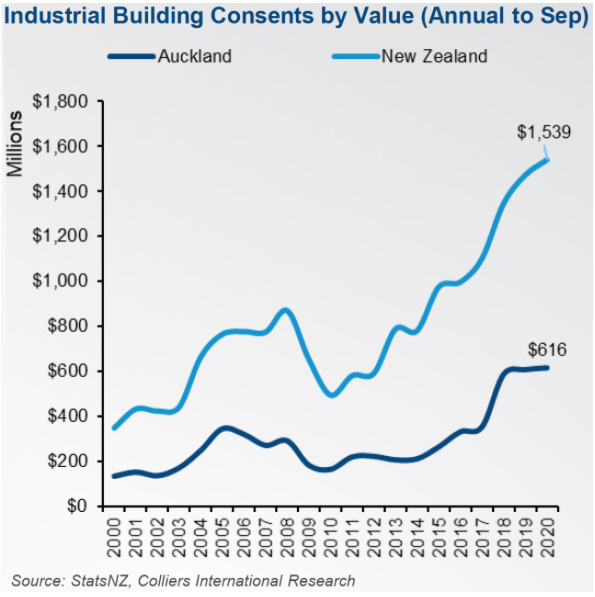
Building consent data recently released by Stats NZ vividly illustrate developers' confidence in the industrial sector's prospects.
Industrial building consent values released in September reached record highs both in Auckland and elsewhere in New Zealand. In Auckland, consent values hit a record NZ$115,000,000 in August and exceeded NZ$119,000,000 in September. The total for the latest two months exceeded that of the preceding six months combined.
Nationally, building consents worth NZ$210,000,000 were approved in September, surpassing the record of NZ$200,000,000 set in March 2018. The combined floor area for August and September was 223,200 square metres, the highest two-month total since May 2019.
The surge in building consents over the past two months has also pushed annual totals to new records. In the twelve months to September, consents continued to get the green light, with new developments in Auckland valued at nearly NZ$615,000,000, while the national figure exceeded NZ$1,500,000,000 for the first time.
Office buildings
- Central city office vacancy rises
Auckland's central city office vacancy rate rose noticeably in the six months to September 2020, reversing the trend forecast in an earlier Colliers International survey, which had anticipated a rate below 5%. Overall vacancy rose from 4.7% in February to 6.3%, equivalent to an additional 28,120 square metres of vacant space. Total vacant space currently stands at 108,970 square metres.
The latest survey also shows that prime building vacancy rose from 2.0% in March to 3.3% in September, while secondary building vacancy increased from 5.5% to 7.3% over the same period.
Weakening market demand was evident throughout the city fringe and CBD. East Auckland was an exception, recording the smallest vacancy increase in the survey. This area includes Botany, Howick and East Tamaki. Overall vacancy in the CBD fringe, which accounts for 40% of the central city market, rose by 120 basis points to 6.8%, similar to the North Shore's main office market, where vacancy was 6.4%. In the south, office space in Manukau's central business district remained relatively scarce, with just 1.7% of stock vacant. 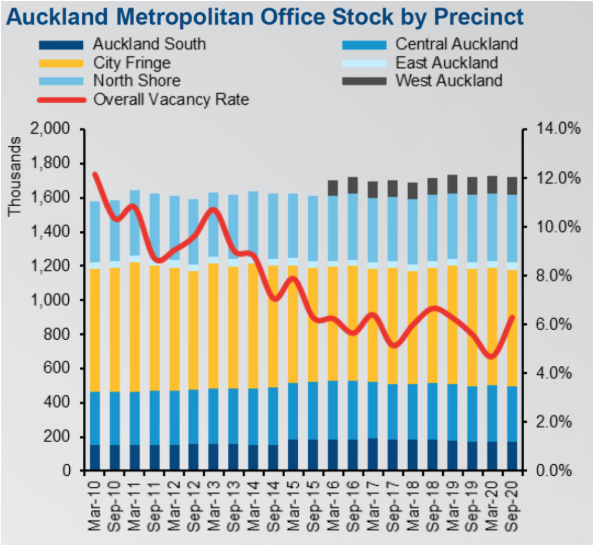
- Changes driven by company finances and tenant relocations
The financial impact of COVID-19 has led many companies to reduce their office space requirements through redundancies or more flexible working arrangements. This has added vacant space to the market, with numerous premises exceeding 1,000 square metres becoming available.
Tenant relocations will also add more vacant space to the central city market over the coming year. Completion of 136 and 155 Fanshawe Street will enable major companies including 2 Degrees and Fidelity Life to move staff from their current offices to the CBD's Wynyard Quarter, freeing up more than 10,000 square metres in Newmarket and Grafton.
Investors focus on long-term fundamentals
Investors continue to monitor changes in office occupancy caused by COVID-19, with greater interest in well-located properties backed by strong tenant fundamentals. For example, 22 Amersham Way in Manukau recently sold for NZ$11,000,000 at a yield of 6.44%, while 15 Lambie Drive was purchased by a private investor for NZ$12,000,000 at a yield of 6.1%.
Retail
The latest ANZ–Roy Morgan Consumer Confidence survey shows a clear rebound in consumer confidence and optimism about the future. In October, the index rose 9 points to 108.7. Although still slightly below its historical average of 120.0, the rebound is encouraging, marking the highest confidence level since the first Level 4 lockdown in March.
Asked to compare their financial position with a year earlier, 5.5% of respondents said they were better off rather than worse off, the first improvement after three consecutive months of declining responses. More respondents also considered it a good time to buy major household items, the first positive result since June. Confidence in the outlook is gradually improving too, with 28% of respondents, up 6 percentage points, expecting their financial position to improve over the next year.