Audiences linger and speakers have more to share: land subdivision offers a wealth of practical knowledge to explore!
Who is to blame for New Zealand’s high house prices and heated property market: investors, returning New Zealanders, the Government or the central bank? Whatever other forces are at work, inadequate supply is unquestionably a fundamental driver. Allowing large sections in more areas to be subdivided and building more medium- and high-density homes is no longer a question of New Zealanders’ dream of a quarter-acre section. It is an unavoidable trend for the housing market.
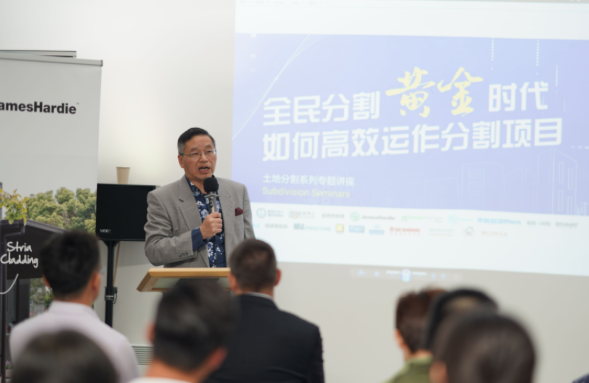
Following a successful opening session at the end of October, the seminar series jointly presented by YIJU New Zealand and the Chinese Building Industry Association, “The golden age of subdivision for all: can anyone manage a land subdivision project?”, held its second session as scheduled yesterday afternoon: “The middle stages: subdivision, engineering, materials and law”.
{ad}
Seven guest experts in architectural planning and design, engineering, materials, law and policy interpretation drew on their specialist fields to provide professional explanations and case studies. They outlined the investment and preparation needed at different points in the middle stages of a land subdivision project, and how to avoid potential risks effectively.
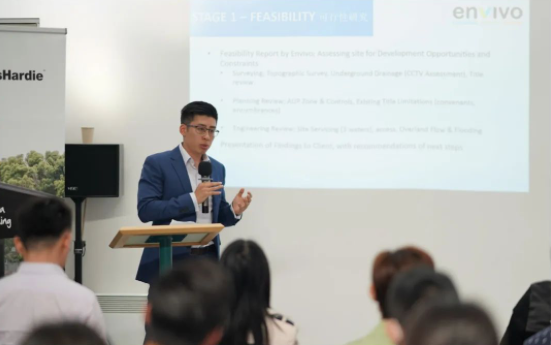
- John Yan, planning team leader at design consultancy Envivo, and civil engineer Jim Jiang explained how understanding clients’ needs and applying professional experience could maximise development outcomes within council requirements, from land planning through to construction. Using several real projects of different types, they emphasised the importance of preliminary advice and investigations into existing site conditions and effects on the surrounding environment. They also explained in detail how to manage subsequent approval applications and construction as efficiently as possible after resource consent is granted.
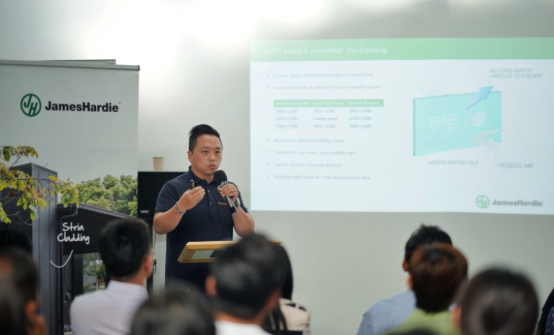
- James Hardie general manager of business development Meng Zhang gave a detailed introduction to fibre cement cladding, currently among the most popular exterior wall materials on the market. These newer building materials offer a contemporary look, design flexibility and maintenance intervals of twelve or thirteen years, making them well suited to long-term investment. As development following subdivision often involves medium- and high-density housing, Meng Zhang focused on how exterior wall materials can meet fire protection and fire resistance requirements while combining different colours, styles and layers to satisfy market and council expectations for environmental fit and appearance.
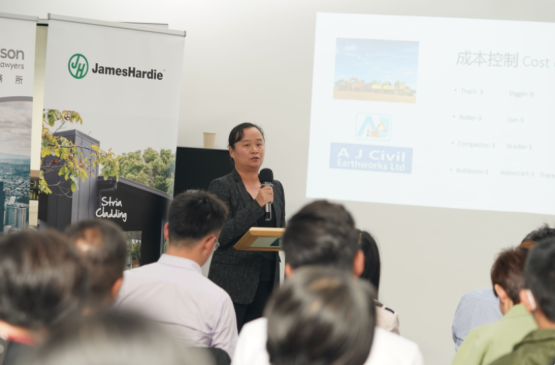
- Kelly Lin, marketing manager at AJ civil earthworks Limited, shared her experience of controlling costs and improving efficiency in earthworks. She reminded developers that materials were central to cost control. When contracting out work, she advised retaining responsibility for materials procurement and comparing suppliers before choosing a reliable long-term partner, which could substantially reduce costs. Engaging an experienced engineer to carry out thorough site investigations in advance was another effective way to control unexpected expenditure. Improving construction efficiency required a team with well-trained, skilled staff and the flexibility to schedule work as needed.
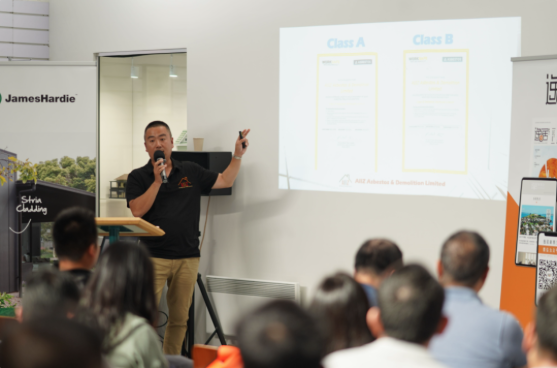
- Da Bo, general manager of AIIZ ASBESTOS & DEMOLITION LTD, focused on a seemingly very specific subject: asbestos removal. Land development inevitably raises the question of what to do with existing houses. Homes built in New Zealand as late as the beginning of century 21 still used asbestos for fire protection, moisture resistance and insulation. This makes asbestos management unavoidable when demolishing old houses. As well as systematically explaining asbestos removal safety rules and procedures, Da Bo offered advice to audience members planning minor DIY repairs at home: avoid drilling holes in cement sheets wherever possible, and use effective protective measures when drilling is necessary.
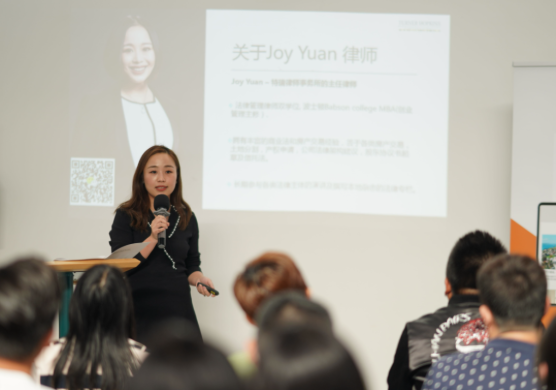
- Joy Yuan, a principal lawyer at TURNER HOPKINS, discussed how comprehensive legal documents can prevent and reduce potential disputes and risks in property development partnerships. Because land development requires substantial funding, collaboration between several parties is common. Yet collaboration can bring disagreement, and uncertainty creates risks for many reasons. Within the available time, she explained how to draft provisions in shareholders’ agreements, joint venture agreements and limited partnership agreements for different forms of collaboration, protecting the interests of all parties.
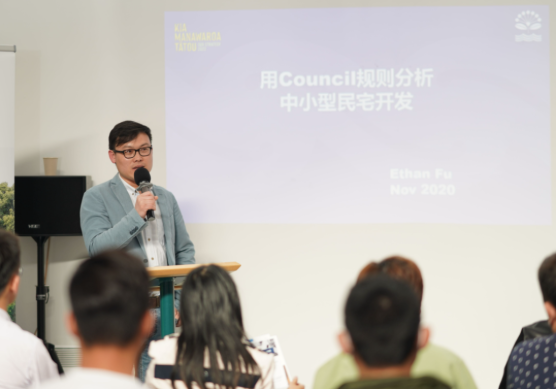
- Following his popular presentation at the first seminar, Ethan Fu, a guest lecturer at BIET and an Auckland Council development engineer, returned yesterday to explain council rules for small- and medium-scale residential developments. He detailed development restrictions in different zones and the relevant regulatory engineering rules. Using parking requirements as an example, he analysed differences between zones and how planning and design could meet council requirements on less-than-ideal sites. Drawing on his own experience, he also offered practical advice on situations where case-by-case negotiation might secure approval despite non-compliance with current written rules, and situations that must be avoided.
Prize draw and auction generate excitement
This seminar again included a prize draw and an auction with bidding starting at $1. The draw prizes were sponsored by Germany’s BRAVAT bathroom brand. After spirited bidding, a latest-model air conditioner supplied by Midea, valued at NZ$1399, sold for the bargain price of NZ$1008. Every attendee also received a Midea voucher worth NZ$100. 
Speakers and audience alike wanted more
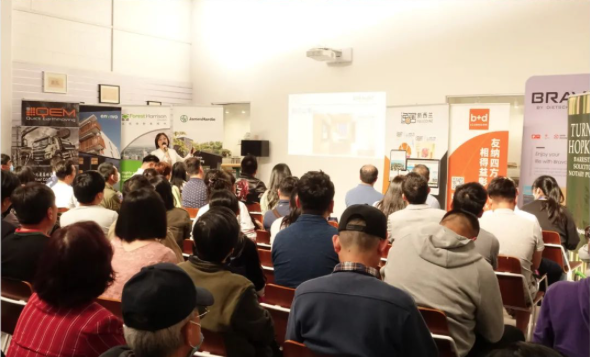
More than 130 people came to yesterday’s seminar, drawn by its reputation. With seating limited, some late arrivals stood throughout the event. Audience members could be seen taking notes and photographing the speakers’ slides. Enthusiastic questions repeatedly pushed back the finishing time, and many people still gathered around the speakers afterwards for further advice. Some said they had made mistakes and suffered losses during subdivision developments, so they had rushed to attend when they heard about the seminar and had indeed gained a great deal. Others hoped to expand their networks: “You cannot develop land alone. You need good teams across different fields, and there are plenty of resources here.”
The guest speakers also felt they had more to share. While the size of the audience surprised them, its professional knowledge was an even greater revelation. After speaking with several attendees, Meng Zhang said their questions were highly informed, clearly showing that they had come with specific needs and goals. He enjoyed talking with such engaged listeners. John Yan said frankly that yesterday’s session was too short and hoped the organisers would give him another opportunity to share more land planning tips.
Scan the QR code to register.