
Will restoring LVR restrictions bring house prices under control? 67% of respondents say: I don’t believe it!
Are you already tired of news reports about the booming property market and sky-high house prices? Like it or not, the latest housing confidence survey shows that the housing market will remain a hot topic heading into 2021.

ASB today released its housing confidence survey report for the third quarter of 2020, which found that:
- Housing confidence has soared as New Zealand’s housing market climbs;
- However, affordability has left people questioning whether now is the best time to buy a home;
- The market shows no sign of slowing, so these mixed feelings look set to continue into 2021.
{ad}
Housing confidence ↑ versus Buyer sentiment ↓
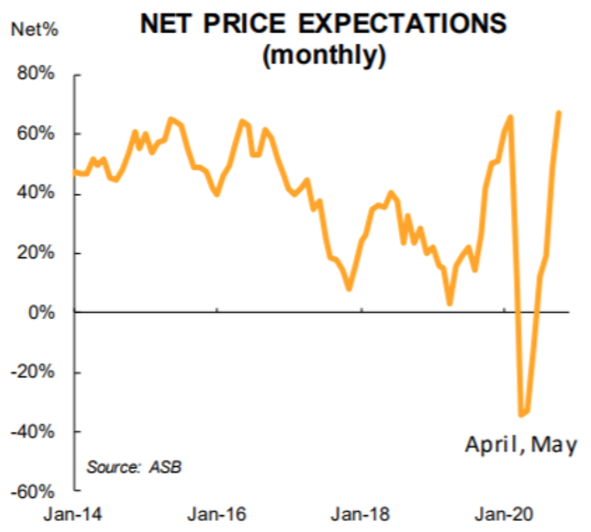
The survey results show that New Zealanders’ confidence in housing is stronger than ever. Following a brief pandemic lockdown, 67% of respondents now expect house prices to keep rising over the next 12 months. This is the highest third-quarter confidence reading in the survey’s 24-year history. ASB economists also support this outlook, forecasting double-digit house price growth until at least the third quarter of next year.
But does this confidence conceal risks? Opinions differ. The survey suggests that investing in housing is increasingly seen as a ‘one-way bet’. In response to this trend, the Reserve Bank is already considering restoring LVR restrictions earlier next year and introducing debt-to-income ratios to curb excessive lending. Whether these measures can cool the red-hot property market remains to be seen.
Meanwhile, the survey shows that buyer sentiment is falling sharply, in stark contrast to soaring housing confidence. The number answering yes to the question ‘Is now the best time to buy a home?’ has almost halved since the previous survey. This clearly reflects the considerable pressure rising house prices are placing on affordability. In other words, it has become a seller’s market.
Price expectations: a sharp turnaround
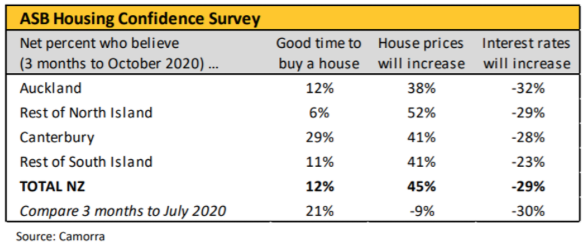
Public expectations for house prices in New Zealand turned strongly positive in the third quarter. A net 45% of respondents expected house prices to continue rising over the next 12 months. This represents a very significant change and reversal from the second-quarter survey, when a net 9% expected prices to fall. In other words, with the nationwide lockdown over 4–May, economists were not alone in misjudging house price movements: the public was also caught off guard by changes in the market.
In this sense, housing confidence joins many other economic indicators in pointing to a V-shaped recovery in New Zealand’s economy, rebounding from its low point. A closer look at monthly housing confidence data shows that the October reading reached 67%, the highest level in the survey’s 24-year history. The evidence increasingly suggests that the housing market is seen as a ‘one-way bet’. Housing supply looks likely to remain low for some time, while mortgage interest rates are unlikely to rise.
Regionally, the North Island outside Auckland remains the most optimistic, consistent with observed house price data. Prices in Gisborne, Hawke’s Bay and Wellington have remained high. Across these regions, a net 52% of respondents throughout the third quarter expected house prices to rise over the next 12 months, above the South Island’s 41% and Auckland’s 38%.
Buyer sentiment: a seller’s market
During lockdown, the general view was that the property market would become a buyer’s market. That view appears to have changed. A net 12% of respondents in this survey thought now was a good time to buy a home, well below the previous quarter’s 21%.
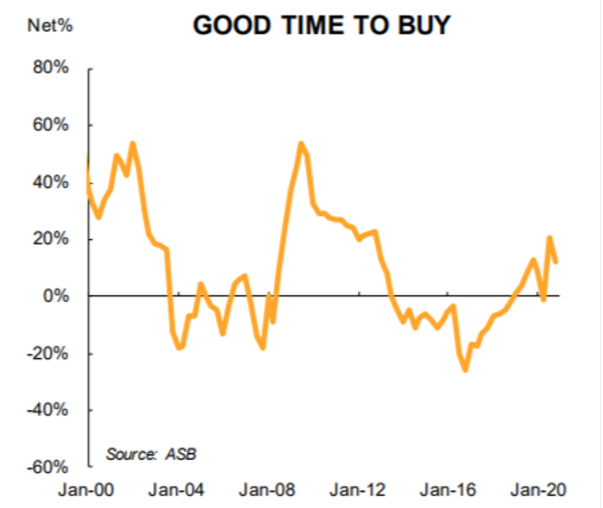
On the face of it, this seems at odds with the current buoyant market. After all, mortgage interest rates are at record lows, LVR restrictions have been temporarily removed, the mortgage holiday scheme has been extended, and most people seem to expect house prices to keep rising for some time.
Affordability may therefore be a major reason for this sentiment. Analysis of the survey results reveals a very strong inverse relationship between rising house prices and views on whether to enter the market. With the current property boom forecast to last until at least the middle of 2021, buyer sentiment could come under further pressure. This is clearly now a seller’s market. The number of properties listed has recently surged as sellers rush to act. Affordability pressure indicators are already close to record highs and look set to worsen.
Interest rate expectations: the lower, the better
Public expectations for interest rates remained very low throughout the third quarter. A net 29% of respondents expected rates to fall further. Looking back, the net share expecting further falls has hovered around 30% since March.
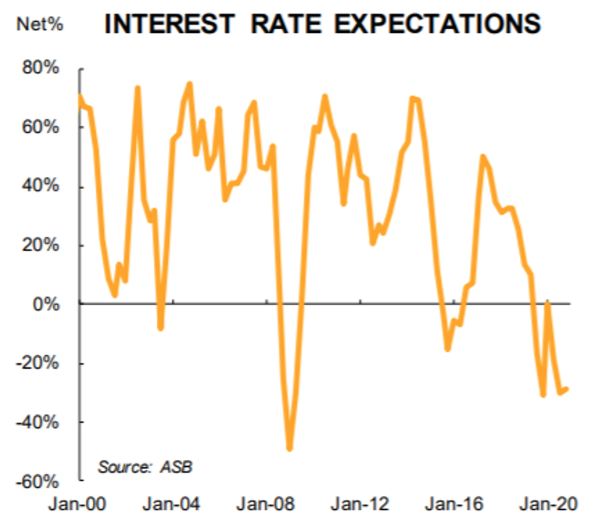
For the most part, respondents’ perceptions have been correct. Although the Reserve Bank of New Zealand’s Official Cash Rate has remained at 0.25% since March, retail interest rates have continued to decline slowly.
ASB economists believe the Reserve Bank is unlikely to adopt negative interest rates. However, with the OCR at its ‘effective lower bound’, the Bank has taken, or will take, a range of other measures to lower rates. The latest is the so-called ‘Funding for Lending Programme’, due to launch in December, which is expected to keep mortgage and term deposit rates on a downward path. For example, one-year and two-year mortgage rates could fall further from their current level of around 2.5% to close to 2%.
Economists therefore predict further increases in both house prices and housing confidence.