
Carefree apartment living? Know your rights and responsibilities for greater peace of mind
Central locations, convenient public transport, easy upkeep and secure living: these advantages are why many owners buy apartments. But is apartment living really as convenient as it seems? Once you have bought an apartment, can you truly stop worrying and enjoy a lock-and-leave lifestyle?
Central locations, convenient public transport, easy upkeep and secure living: these advantages are why many owners buy apartments. But is apartment living really as convenient as it seems? Once you have bought an apartment, can you truly stop worrying and enjoy a lock-and-leave lifestyle?
To some extent, the answer is yes! However, truly enjoying carefree apartment living requires planning ahead when you buy. Understanding owners’ responsibilities and obligations equips you to deal confidently with problems as they arise.
So what do we need to know about apartments?
{ad}
Apartment ownership: different arrangements inside and outside the unit
When buying property in New Zealand, you will generally encounter the following types of title:
Freehold title, also known as fee simple, is New Zealand’s most common form of ownership and provides the broadest and most complete property rights. The property belongs entirely to the owner in perpetuity and can be sold or transferred freely. Buyers acquire both the property and the land it occupies, which may be subdivided, extended or altered with approval from the authorities.
Leasehold ownership (Leasehold. Title) gives the property owner exclusive use of the land for a specified period under lease terms agreed with the landowner. In other words, the homeowner does not own the land. The land lease generally needs to be renewed periodically, with rent adjusted to reflect the market at the time.
Cross-lease ownership (Cross. Lease. Title) means the owner and other cross-lease holders share equal interests in the exclusive use of the land for a specified period, while holding leasehold interests in their buildings and the particular areas they occupy.
Unit title is commonly used for units such as flats or apartments in multi-storey buildings. Because individual units do not have entirely independent structures in the way other homes do, ownership is defined by each unit’s three-dimensional boundaries. This is known as unit title.
The concept and legal framework of unit titles are more complex than those of freehold properties.
Put simply, as a unit title owner, you own your unit and automatically become a member of the body corporate, comprising all owners in the building. You have absolute freehold ownership of your unit, while the building’s structure and common areas, such as the gym, lifts and
swimming pool, are held collectively by the body corporate.
Day-to-day management: owners’ meetings keep the building running smoothly
The body corporate comprises all owners, but who represents them? Who makes decisions about its affairs?
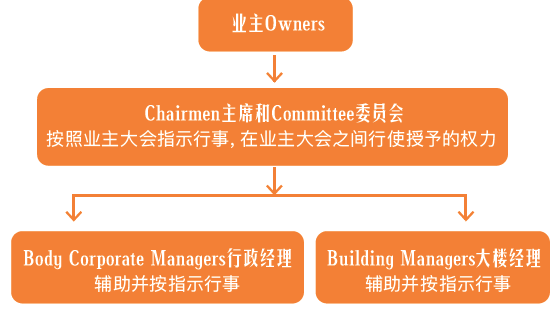
The committee and chairperson are elected by all owners. Members must be owners. If a unit is held by an entity rather than an individual—for example, a limited company—the representative must be that company’s chairperson.
Although the body corporate chairperson and committee chairperson are usually the same person, these are separate roles. The committee makes decisions by a simple majority at its meetings and reports to all owners at the annual general meeting on how it has carried out its duties.
A body corporate must have a chairperson.
Although decision-making authority rests with the committee, the chairperson is the primary contact for third parties such as the building manager and account manager.
The chairperson acts as the body corporate’s contact and spokesperson, with the property account manager and building manager assisting in carrying out the work.
The building manager is primarily responsible for day-to-day maintenance and repairs, supervising and liaising with tradespeople, inspecting the building to ensure it remains in good condition, and making sure residents comply with the property rules.
The account manager handles day-to-day administration, such as paying expenses on the body corporate’s behalf, collecting levies from owners according to the approved annual budget, and preparing financial statements and meeting minutes.
The body corporate must hold an annual general meeting to review the previous year and discuss the coming year’s affairs, including:
1. Renewing property insurance;
2. The property’s annual budget, which, once approved, is allocated according to ownership shares (ownership/utility. interest), determining the annual body corporate levies you must pay;
3. Re-electing the body corporate chairperson and committee, and authorising them to fulfil the body corporate’s duties on all owners’ behalf and oversee the building’s routine operations.
Owners planning renovations must first determine whether any work involves common property or will affect the building’s structure. If so, they must submit a formal application to the committee for permission to carry out the proposed work. Installing air conditioning is a common example. The external walls of most apartment buildings are common property. If
an owner needs to install air conditioning to meet the Healthy Homes Standards, they must prepare installation plans and specifications and submit them to the committee for consideration. Where an apartment committee has already adopted a standard installation plan, owners need only engage the designated installer to complete the work according to that plan.
Owners’ obligations: following the rules for a better living environment
Buying a unit title property means sharing a living environment with others. You and the other owners must therefore comply with strict rules and restrictions intended to create a better place to live.
When living in an apartment or another unit title property, what obligations apply beyond maintaining your unit, paying council rates and body corporate levies on time, and avoiding conduct that damages the building or disturbs other residents’ peaceful enjoyment?
Owners must:
1. Comply with the property rules;
2. Cooperate with maintenance and inspections arranged by the body corporate, including allowing workers into their units for routine fire system checks and related work, or routine inspections of compliance with property rules;
3. Carry out or comply with body corporate decisions.
Property rules (Operational. Rules) are established to maintain a degree of order and protect quality of life in high-density housing. The initial rules are set when the unit titles are created, by the developer as the original major owner.
Owners can subsequently resolve to amend the rules at a general meeting following discussions or a review.
If an owner repeatedly breaches the rules or fails to pay levies on time, the committee can engage a lawyer to apply to the Tenancy Tribunal on the body corporate’s behalf to pursue legal action.
Owners’ rights: what do your body corporate levies cover?
As noted earlier, the body corporate holds the building’s common areas and structure, and all owners share the resulting costs. The body corporate therefore prepares an annual operating budget and collects levies from each owner according to their ownership share.
The budget generally covers building insurance, cleaning and maintenance of common areas, regular testing and maintenance of building systems, rubbish collection, and communal water and electricity.
Because the budget is based on previous years’ spending and forecasts for the coming year, the amount can change. General meetings also consider adjustments to some instalment arrangements, so the budget is highly likely to change after each annual general meeting.
Although the annual budget is discussed and approved at the general meeting, the committee oversees the body corporate’s day-to-day expenditure. Beyond routine minor maintenance such as mowing and cleaning, unusual or substantial expenses, such as exterior washing or replacing major machinery components, require committee approval.
About the author:

Franklyn Young
A Bachelor of Property graduate from the University of Auckland, he has worked for several major property companies in residential, commercial and body corporate property management. He is currently a business development and project manager at Crockers Property Group.
One of the committee’s roles is to review the building’s service providers. If dissatisfied, it can replace them or reconsider the building’s maintenance plan.
A good community requires all owners to contribute to its management and upkeep. Owners need to volunteer as body corporate representatives and, with managers’ assistance and cooperation, run the community well, protect owners’ interests and preserve the property’s value.