
Homes selling like hotcakes! Nearly ten thousand sold in November's 30 days! ANZ announces higher deposit requirements today
After the major banks successively announced that they would voluntarily reinstate loan-to-value ratio (LVR) restrictions on investor lending, another major announcement arrived today: ANZ is lowering its LVR for property investors from 70% to 60%, effective immediately. This means buyers who are not purchasing their first home need a 40% deposit. Commercial banks have repeatedly acted ahead of the Reserve Bank, unable even to wait for its decisions. The latest REINZ monthly report makes it easy to understand why.

Auckland sales in month 11 were 1.5 times the level a year earlier
According to the latest figures from the Real Estate Institute of New Zealand (REINZ), residential property sales nationwide in November increased by 29.6% year on year, from 7,627 to 9,885. This was the highest monthly sales total since March 2007, a gap of 164 months, and the busiest November since November 2006, 14 years earlier.
- New Zealand excluding Auckland: sales rose 3% year on year, from 5,205 to 6,157. This was the highest total since March 2016, a gap of 56 months, and the busiest November since November 2006, 14 years earlier.
- Auckland: sales in November increased 9% year on year, from 2,422 to 3,728. This was the highest total since March 2007, a gap of 164 months, and the busiest November on record.
Only three regions recorded year-on-year declines in sales. Although the falls were modest, each recorded its lowest November sales total in three years.
- Marlborough: -5.3% (from 95 to 90 homes, a net decrease of 5);
- Gisborne: -4.3% (from 70 to 67 homes, a net decrease of 3);
- Hawke's Bay: -1.8% (from 275 to 270 homes, a net decrease of 5).
{ad}
REINZ chief executive Bindi Norwell said: “November was an incredible month for the number of homes sold, with nearly 10,000 changing hands over the past 30 days. The last time we saw a sales boom on this scale was 164 months ago, in March 2007, before the domestic recession and global financial crisis had affected New Zealand's property market.”
In November, more than half the country's regions—10 out of 16—recorded double-digit annual sales growth, demonstrating the market's strength and activity. Norwell attributed the surge in November sales to several factors: people wanting to complete transactions before Christmas; the Reserve Bank's announcement in early November that it would consider bringing forward the reinstatement of LVR restrictions in December; and concerns among many buyers that house prices could rise further over the coming months.
Auckland remained an exception, however. “Sales volumes in Auckland have increased by more than 50% year on year for three consecutive months. New listings rose 45.8% in November, and there is little sign of the usual Christmas slowdown. It will be worth watching how long sales can remain this high,” Norwell said.
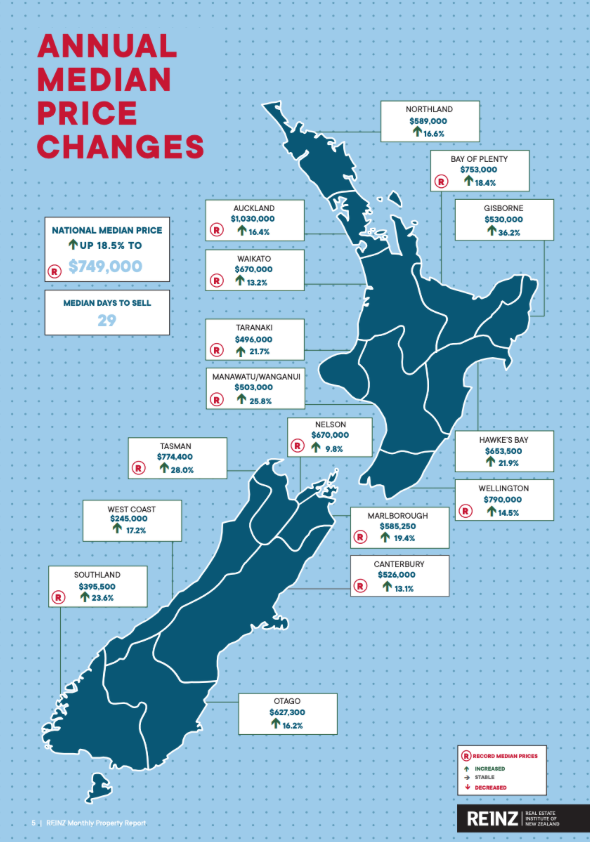
11 regions record new median house price highs
Naturally, New Zealand's median house price rose alongside sales, reaching a new record of NZ$749,000 in November. This was 18.5% above the NZ$632,000 recorded a year earlier, and NZ$24,000 higher than the previous month's NZ$725,000.
- New Zealand excluding Auckland: the median house price reached a record NZ$615,100, up 0% from NZ$535,000 in November last year, and 2.5% above the NZ$600,001 recorded in October.
- Auckland: the median house price increased 4% year on year, from NZ$885,000 to a record NZ$1,030,000. It was also 3.0% above the NZ$1,000,000 recorded in October.
In November, 11 regions recorded all-time median house price highs. Alongside Auckland were Tasman, Manawatū/Whanganui, Southland, Taranaki, Marlborough, Bay of Plenty, Wellington, Waikato, Canterbury and Nelson.
Norwell said the previous time the market had performed like this was in October 2003, when house prices were also rising sharply. Median house prices have recorded annual increases every month since October 2011, a run of 110 consecutive months, with double-digit growth in the most recent 5 months.
However, Norwell said: “This situation is unsustainable. Figures released earlier this week show that home ownership is at its lowest level in 70 years. Unless effective action is taken promptly to address housing shortages and supply, the gap between renting and owning a home will continue to widen.”
“Hopefully, over the coming months we will hear more from the Government about its plans to reform the Resource Management Act (RMA) and address the time and cost challenges developers and builders face in residential construction. Unless we can build at scale in an affordable way, affordability will remain a major barrier for New Zealanders trying to enter the property market and buy their own homes,” Norwell continued.
REINZ House Price Index (HPI) reaches another record high
The REINZ House Price Index, which measures price movements in New Zealand's property market, rose 15.3% year on year to 3,343, surpassing 3,300 for the first time.
- New Zealand excluding Auckland: the HPI showed house prices were 5% higher than in November 2019, reaching a new high of 3,303 in November 2020.
- Auckland: house prices rose 2% year on year, taking the index to a record 3,393. This was the region's largest annual increase in 54 months.
For three consecutive months, no region recorded a decline in the REINZ HPI, demonstrating the potential of property markets throughout New Zealand.
Median time to sell reaches a 164-month low
In November, the national median time to sell fell from 33 days in November 2019 to 29 days, the shortest since March 2007. Across the country, 11 regions recorded median selling times below 30 days. The previous time 11 regions had selling times below 30 days was in December 2003.
- New Zealand excluding Auckland: the median fell from 32 to 28 days, its lowest in 180 months, since November 2005.
- Auckland: the median fell year on year from 36 to 30 days, its lowest in 62 months.
8 regions record their lowest inventory levels
Just one measure continued to decline: the total number of properties available for sale nationwide fell from 22,049 in November 2019 to 18,319 in November this year. This was a decrease of 3,730, or 16.9%. In addition, 8 regions—Bay of Plenty, Hawke's Bay, Manawatū/Whanganui, Marlborough, Nelson, Northland, Waikato and the West Coast—recorded their lowest inventory levels on record.
More than a quarter of properties sold by auction
In November, auctions accounted for 26.9% of all housing transactions, or 2,661 homes. This was up 16.8% from 1279 homes a year earlier, and up a further 22.8% from October this year. This was the highest proportion of auction sales in New Zealand's property market in 62 months, since September 2015.
Gisborne had the highest proportion of auction sales, at 74.6% (50 properties). Auckland followed at 43.6% (1,626 properties), compared with just 31.8% (769 properties) a year earlier. This was Auckland's highest proportion of auction sales in 51 months, since August 2016.
Record share of higher-priced properties
Nationwide, homes selling for less than NZ$500,000 failed to account for more than 20% of total transactions for the first time. Their market share fell from 31.5% (2,401 homes) in November 2019 to 19.5% (1,932 homes) in November 2020.
The share of homes sold in the NZ$500,000 to NZ$750,000 price bracket fell from 32.6% (2,484 homes) to 30.5% (3,014 homes).
Meanwhile, the share of homes selling for NZ$1,000,000 or more rose from 17.0% (1,295 homes) in November 2019 to a record 28.0% (2,766 homes) in November 2020.
You could say that, over recent months, REINZ's monthly reports have offered nothing new, yet something new everywhere: records are constantly being set, and figures that remained out of reach for more than a decade are now being surpassed every month. If the report for month 11 left any question unanswered, it was this: in 2020, how much higher could the property market rocket fly in the final month of the year? It turns out we are all witnessing history.