
Latest figures: 77 more homes sold nationwide each day in December!
The Real Estate Institute of New Zealand (REINZ) released its latest figures today, showing that in December 2020, New Zealand’s median house price set a record for the fourth consecutive month. It attributed the result primarily to the continued pressure on prices from the total number of properties available for sale falling to a record low.
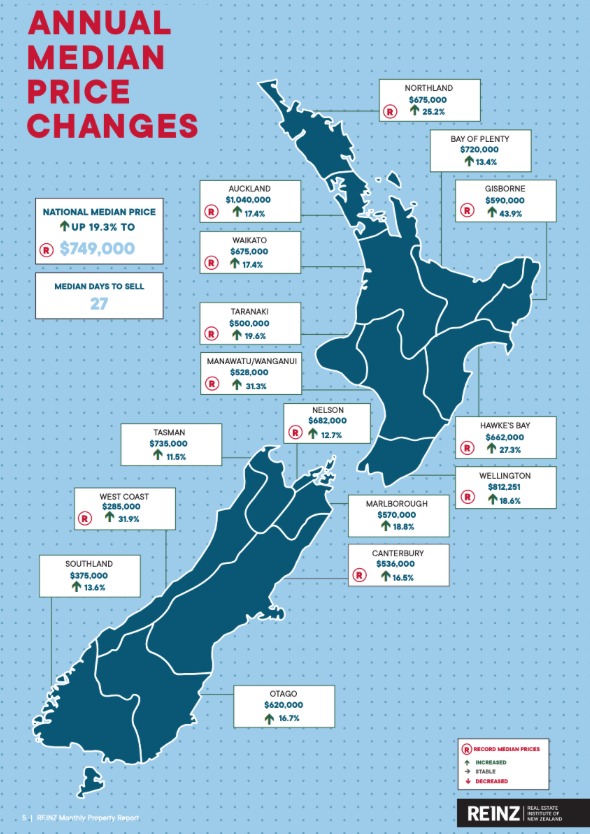
According to the latest figures from the Real Estate Institute of New Zealand (REINZ), the national median house price rose from NZ$628,000 in December 2019 to NZ$749,000 in December 2020, an increase of 19.3%.
- Outside Auckland, the median house price rose from NZ$535,000 in December 2019 to NZ$630,000 in December 2020, an increase of 8%.
- Auckland’s median house price rose from NZ$886,000 in the corresponding period of 2019 to NZ$1,040,000 in December 2020, an increase of 4%. This was Auckland’s fifth consecutive month of record house prices.
{AD}
In December 2020, 11 regions nationwide recorded record median house prices. Alongside Auckland, they were Gisborne, the West Coast, Manawatu/Wanganui, Hawke’s Bay, Northland, Taranaki, Wellington, Waikato, Canterbury and Nelson.
REINZ chief executive Bindi Norwell said this continued the buoyant housing market conditions of recent months, highlighting the strength of residential markets across the country.
“The number of properties available for sale is currently only half the level seen in December 2018. That leaves prospective buyers with very limited choice and puts significant pressure on house prices across most of the country. Add in record-low interest rates, and the appetite for buying residential property is very strong,” Norwell said. “Limited choice, combined with very high confidence, means properties are selling at their fastest pace in 17 years. The median time to sell a home is now just 27 days, showing that people tend to act quickly to secure a ‘good’ property for fear of missing out.”
Norwell also commented specifically on Auckland house prices.
“Auckland City remains the most expensive area in New Zealand, with its median house price reaching a record NZ$1,280,000 in December last year, close to the NZ$1,300,000 mark. North Shore City followed at NZ$1,235,000, then Rodney District at NZ$1,005,000. This shows that house prices in the Auckland region are becoming increasingly unaffordable for many people, particularly first-home buyers. The only Auckland area with a median price below NZ$800,000 is Franklin District, at NZ$790,000. Although this may be Auckland’s ‘cheapest’ area, buying there also means spending a substantial amount of time commuting each day.”
Norwell said: “Today’s figures further demonstrate the urgent need for the Government and the industry to respond together to address the growing pressure on housing affordability.”
Auckland’s annual sales growth exceeds 6 tenths
The number of residential properties sold nationwide in December 2020 rose 36.6% compared with December 2019, from 6,543 to 8,935, the highest December sales total on record.
- Across the country excluding New Zealand, the number of homes sold rose 2% compared with the same period a year earlier, from 4,604 to 5,716.
- In Auckland, the number of homes sold in December rose 0% year on year, from 1,939 to 3,219, the highest December total on record. This was the fourth consecutive month in which Auckland’s annual sales growth exceeded 50%.
Outside Auckland, the other regions with the largest annual increases in sales in December were the West Coast, Canterbury, Waikato, Gisborne and Taranaki.

Norwell said: “If 2020 taught us anything, it is that even the most unusual things can happen. The sales figures for December 2020 demonstrate that, as this was our highest December home sales total since REINZ began keeping records. Compared with December 2019, an additional 77 homes were sold each day.”
“As we have seen in recent months, with market confidence generally high, buyers may anticipate further house price increases and move to complete purchases before LVR restrictions are reintroduced. We therefore expect the housing market to remain very busy over the coming months. However, continued sales growth could be affected if more properties are not brought to market,” Norwell concluded.
Gisborne/Hawke’s Bay REINZ HPI rises by a quarter
The REINZ House Price Index (HPI), which measures changes in property prices across New Zealand, also rose 17.3% year on year in December 2020 to a record 3,417 points. This was the largest annual increase in 63 months, since September 2015.
In addition, 11 of the 12 regions recorded double-digit annual growth, the first time the index had shown such strength in 15 years.
- The HPI for New Zealand excluding Auckland showed prices rising 6% from December 2019 to a record 3,385 points in December 2020.
- Auckland house prices rose 1% year on year, taking the index to a record 3,457 points. This was also the region’s largest annual increase in 61 months, since November 2015.
In December, Gisborne/Hawke’s Bay again recorded the strongest annual house price growth, rising 24.8% to a record index level of 3780 points. Wellington again ranked second, with annual growth of 20.5% taking its index to a record 3,509 points, while Manawatu/Wanganui ranked third with price growth of 20.4%.
Median days to sell falls to a 204-month low
In December, the national median time to sell fell 4 days year on year, from 31 days in December 2019 to 27 days. This was the lowest level in 204 months, since December 2003.
- Outside Auckland, the median time to sell fell from 30 days to 26 days, a year-on-year reduction of 4 days.
- Auckland’s median time to sell fell from 34 days to 29 days, a reduction of 5 days and the lowest December figure in 17 years.
Of the country’s 16 regions, 14 had an average time to sell of fewer than 30 days, also a record. The only two exceptions were Northland and the West Coast. Taranaki had the shortest selling time, at just 20 days, down 7 days on the same period a year earlier.
Wellington has just 4 weeks of housing inventory
In December, the total number of properties available for sale in New Zealand fell 29.1% year on year to 12,932, a substantial drop from 18,230 in December 2019 and the lowest inventory level on record. Every region except Auckland and Gisborne also recorded its lowest-ever inventory level.
Inventory measured in weeks fell to record lows in every region. Wellington had the lowest level, with just 4 weeks of stock available for prospective buyers to choose from. Northland and the West Coast had the highest levels, with 17 weeks of stock available, compared with 43 weeks and 59 weeks respectively in the same period a year earlier.
More than 46% of Auckland properties sell at auction
In December, auctions accounted for 27.9% of home sales, or 2,494 properties, compared with just 13.6% (892 properties) in the corresponding period of 2019 and 26.5% in November 2020. This was the highest proportion of New Zealand property transactions completed by auction in 63 months.
Outside Auckland, auction sales accounted for a record 17.4% of all transactions, up from 8.1% in December 2019.
Gisborne had the highest proportion of auction sales, at 68.3% (43 properties), up from 50.0% (24 properties) in December 2019.
Auckland ranked second nationwide, with auctions accounting for 46.6% of sales (1,501 properties), compared with just 26.8% (519 properties) in December 2019. This was Auckland’s highest monthly proportion of homes sold at auction in 52 months, since August 2016.
Share of million-dollar-plus property sales surges
Across New Zealand, homes sold for less than NZ$500,000 fell from 32.1% of all transactions (2,099 properties) in December 2019 to 19.3% (1,721 properties) in December 2020.
Homes sold in the NZ$500,000 to NZ$750,000 range fell from 33.0% of transactions (2,158 properties) to 30.8% (2,752 properties).
At the upper end of the market, the proportion of homes sold for NZ$1,000,000 or more rose from 16.4% (1,071 properties) in December 2019 to 27.9% (2,493 properties) in December 2020.