
They probably will not go any lower: economists broadly agree mortgage rates have bottomed out
Figures show Auckland’s property market remained active in January, but more major commercial banks have tightened investor LVR restrictions, while economists generally expect mortgage rates to remain at current levels for some time. How will these changes—and the lack of change—affect a property market as hot as the weather?

Real estate agency: the busiest January in 17 years, with the highest sales volume for month 1 of the year
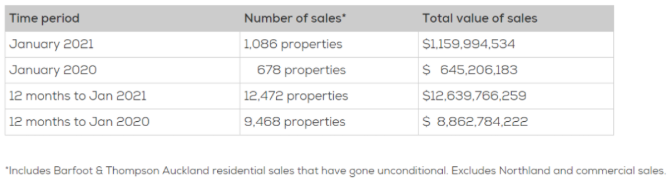
Barfoot & Thompson’s January market report, released yesterday, shows that the Christmas and New Year holiday period did not slow the rapid sales momentum Auckland’s property market has experienced since the second half of last year. The company sold 1086 homes in January, at an average price of NZ$1,068,000, making it the busiest January for sales in 17 years.
Managing director Peter Thompson said the company had never recorded such high sales volumes in January, even at the peak of the previous property cycle. Although both the average and median prices in January were lower than in December—down 2.2% and 3% respectively—Thompson said average and median prices in January were usually lower than in December. This simply reflected the smaller number of buyers for high-end properties during the holidays. It therefore could not be taken as evidence that prices had peaked in December last year. High-end sales usually began picking up again by March.
Of the properties sold in January, 72 fetched more than NZ$2,000,000, down from over a hundred per month in the preceding three months. However, sales of rural and lifestyle properties reached 63, reflecting changing housing needs brought about by the pandemic and working from home.
Major banks: tighter investor LVR restrictions
Rather than waiting indefinitely for the central bank to reconsider reinstating LVR restrictions, banks have moved themselves. One of the hottest topics among property investors over the past couple of days is that, following ANZ’s announcement in December last year that it was tightening its investor LVR requirement to 40%, BNZ and Kiwibank both announced this week that property investors applying for loans would need 40% deposits. There is reason to believe the other major commercial banks, which usually move together, will soon follow. But will this cool the market? Economists have already argued that LVR restrictions have far less influence than low interest rates. After all, the larger group of first-home buyers has a genuine need for housing, and current interest rates make mortgage repayments less of a burden on weekly spending than rent.
Economists: mortgage rates have bottomed out
However, low interest rates—widely regarded as another major driver of today’s exceptionally active property market—also appear to have reached their limit. According to the Stuf website, economists believe mortgage rates are almost at rock bottom, so borrowers should seize the opportunity, potentially even halving the time needed to repay their loans.
Independent economist Shamubeel Eaqub said: “I feel mortgage rates are close to the bottom, but I don’t think they will rise again in the short term.” He said rock-bottom mortgage rates could give many people a once-in-a-lifetime opportunity to pay off their home loans.
The latest unemployment figures released by the government yesterday show that the seasonally adjusted unemployment rate was 4.9% in the final quarter of last year, down from 5.3% in the third quarter. Even before those figures were released, economists did not expect any further cuts to the Official Cash Rate in 2021.
At the same time, Eaqub believes that although the economy no longer needs further stimulus, the Reserve Bank would not want to dampen borrowing enthusiasm and cool the housing market by raising interest rates. “The central bank does not want to adopt a policy that would adversely affect homeowners already weighed down by their mortgages.
Borrowers: is it necessary to lock in long-term rates?
Eaqub believes borrowers need not lock into four- or five-year fixed mortgage rates, because the major banks generally charge around 0.7 to 1.1 percentage points more for those terms than for one-year loans.
However, another independent economist, Cameron Bagrie, recently fixed part of his own mortgage for five years. “Before Christmas last year, I decided to move my mortgage to a five-year fixed rate, something I hadn’t done for a long time. Usually I choose one or two years, which is the best period for adjusting a home loan.”
Bagrie made this choice for the first time in many years because he sees good reason to believe that longer-term pressures could cause inflation to rise sharply. However, he does not expect inflation to surge or mortgage rates to rise this year.
Currently, one-year fixed mortgage rates at New Zealand’s five major banks range from 2.29% to 3.2%, while two-year fixed rates range from 2.59% to 3.25%. At most banks, however, buyers with deposits below 20% are required to pay the highest rates.
Borrowers can obtain more favourable rates than those offered by the major banks at some smaller banks, such as Heartland and The Co-operative Bank, or foreign-owned banks such as Industrial and Commercial Bank of China (New Zealand).
Nevertheless, Bagrie believes mortgage rates have bottomed out. While banks may offer some lower-rate mortgage specials this year, these are likely to be short-term products designed to exploit current commercial opportunities, attract customers and gain market share.
“There will be some fluctuations as banks occasionally offer special rates while competing for market share,” Bagrie said. “But clearly, the New Zealand economy does not need any further interest rate cuts. Lower rates could create a property market bubble.”
Of course, one lesson the past year has taught everyone is to expect the unexpected. Bagrie also said: “If New Zealand experiences more cases of COVID-19 community transmission, the economy could take a completely different path.”
Bagrie also believes another factor limits the scope for further rate cuts. Banks have important internal considerations when lowering rates, he said. Deposit rates are already so low that savers are slowing the pace at which they put money into banks, while wholesale funding costs in money markets have also risen over the past few weeks.
Kiwibank economist Jeremy Couchman shares this view. He expects the OCR to remain unchanged over the next few years. “That will support mortgage rates and keep them low.” He also does not believe banks will face funding pressures that force them to raise mortgage rates.