
Auckland’s average house price tops $1,200,000 as Reserve Bank announces LVR reinstatement timetable. Will it curb prices? Economists are doubtful
On the first working day after the long weekend, New Zealand property market news once again dominated media coverage. The latest house price report from Quotable Value (QV) shows prices running out of control like a derailed train. Meanwhile, the Reserve Bank’s long-awaited plan to reinstate LVR restrictions has finally been clarified, and the government says it will introduce measures to curb property speculation by the end of February. Will they work? Independent economist Tony Alexander’s analysis pours cold water on those hopes.
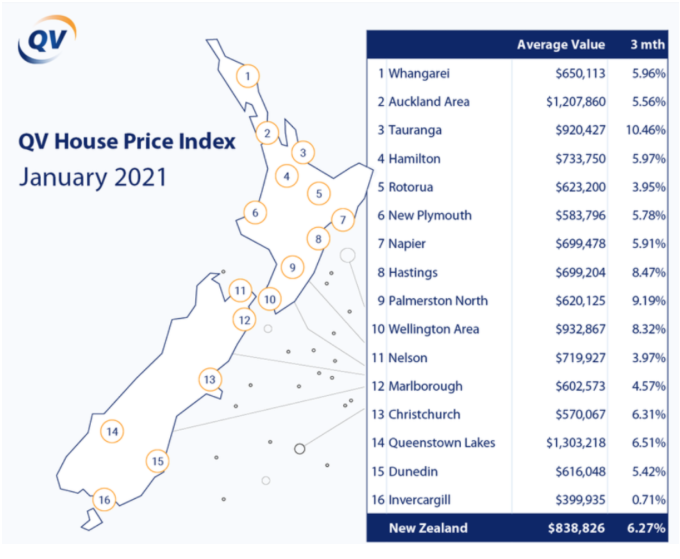
The latest QV House Price Index, released today, shows:
- Average house prices nationwide rose 27% over the past three months, exceeding the 5.35% increase in the final quarter of last year;
- The national average price now stands at NZ$838,826;
- Year-on-year growth was 11%;
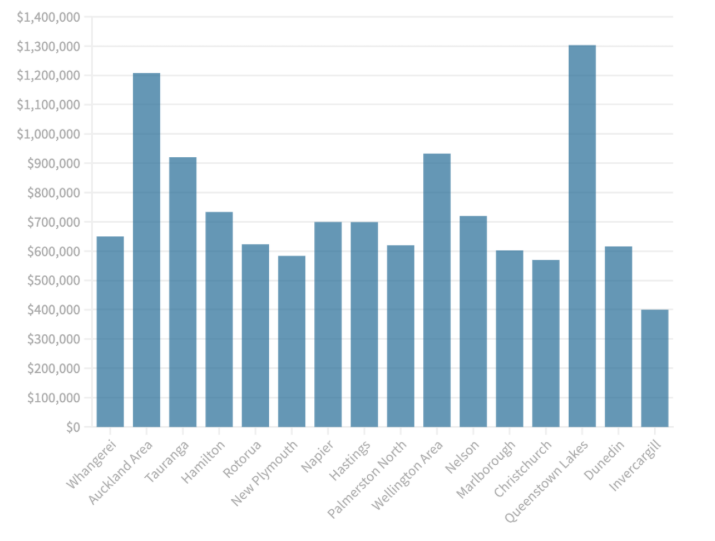
- The Auckland region’s average house price reached NZ$1,207,860.
{ad}
QV general manager David Nagel says house prices in New Zealand’s main urban centres have continued to grow strongly over the past three months.
“Price growth has been relatively rapid in the larger urban centres, mainly because first-home buyers and investors are competing to enter the market, with very limited stocks of lower-priced, entry-level homes. However, as confidence in the domestic economy’s post-lockdown recovery improves, market attention has now also spread to higher-end residential areas in the main centres.”
“Continued rapid house price growth has put further pressure on affordability. Many first-home buyers struggle to secure even a modest foothold in the major cities despite committing everything they have. This appears to have become the main barrier to their entry into the market,” he says.
Nagel believes continued rapid house price growth has become the main barrier facing first-home buyers, and that reinstating LVR restrictions after March could gradually cool the property market in the second half of the year, particularly in entry-level areas suited to first-home buyers. However, he says: “The long-term outlook for housing demand in New Zealand remains positive, and the market is unlikely to undergo a major downturn in the near term.”
North Shore property becomes Auckland’s biggest hotspot
In January 2021, house prices in the Auckland region rose 2.1%, taking growth over the past three months to 5.56%. The average house price across Auckland reached NZ$1,207,860.
The North Shore recorded the strongest growth over the past three months, at 6.15%, setting a new average price record of NZ$1,380,811. It was followed by central Auckland (5.99%), Manukau (5.63%), Rodney (5.47%) and Franklin (5.45%).
Only Franklin (NZ$774,789), Papakura (NZ$817,699) and Waitakere (NZ$961,841) currently have average prices below NZ$1,000,000. Auckland City has the country’s highest average residential property price, at NZ$1,423,833, followed by the North Shore (NZ$1,380,811), Rodney (NZ$1,096,822) and Manukau (NZ$1,061,285).
“Values are rising across the entire market. With demand currently outstripping supply, conditions are extremely favourable for sellers,” says QV senior consultant Rupert Yortt.
“Investor activity in Auckland is also strong, although LVR restrictions may have an impact in 2021. The market is relatively more stable in rural and semi-rural areas such as Huapai and Kumeu, where many listed homes are sold by negotiation, rather than at auction as is predominantly the case in central urban areas.”
Meanwhile, Auckland properties with development potential continue to be snapped up, with Te Atatu Peninsula currently a hotspot for residential development.
Prices rise nationwide, with Tauranga leading
Tauranga
Nationally, Tauranga led the market with a sharp 10.46% increase over three months, setting a new average price record of NZ$920,427.
QV property consultant Derek Turnwald says first-home buyers remain numerous in the market. Low stock levels and rapidly rising prices mean these buyers must compromise on location, property condition and other factors to have a chance of entering the market.
“Fear of missing out is widespread, creating very strong demand for all homes on the market, regardless of price or location,” Turnwald says. “Buyers are turning out enthusiastically at auctions and open homes, with auction bids and offers far exceeding sellers’ expectations.”
Turnwald says development sites in areas such as Papamoa and Pyes Pa are rising rapidly in price, with some buyers willing to pay handsomely for their development potential. “Demand far exceeds supply, and builders are struggling to complete housing developments quickly enough to meet it.” He therefore believes Tauranga’s construction industry may continue to “boom”.
Tauranga’s buoyant property and construction markets are far from an isolated case. According to QV’s report, Invercargill may in fact be the only regional centre nationwide to have recorded little growth over the past three months, at just 0.71%. Yet its average price of NZ$399,935 remains 9.35% above the same time last year. QV property consultant Andrew Ronald says local demand for all property types was strong throughout 2020.
“Buyers were mainly locals and first-home buyers, although investor activity increased in the second half of 2020 because local property offered higher investment returns than other parts of the country. Demand was strongest for affordable homes priced between NZ$250,000 and NZ$450,000.”
Another notable increase was in Queenstown Lakes. After an exceptionally difficult year, Queenstown’s property market appears to have regained momentum. The local average house price rose 6.51% over the past three months to NZ$1,303,218.
QV property consultant Greg Simpson says: “With sales volumes increasing, the local property market has generally rebounded rapidly from lockdown, surprising many experts. Property management companies report that the residential rental market has now stabilised, and rents also appear to have found a relatively steady balance.”
Government and Reserve Bank: policies will favour first-home buyers
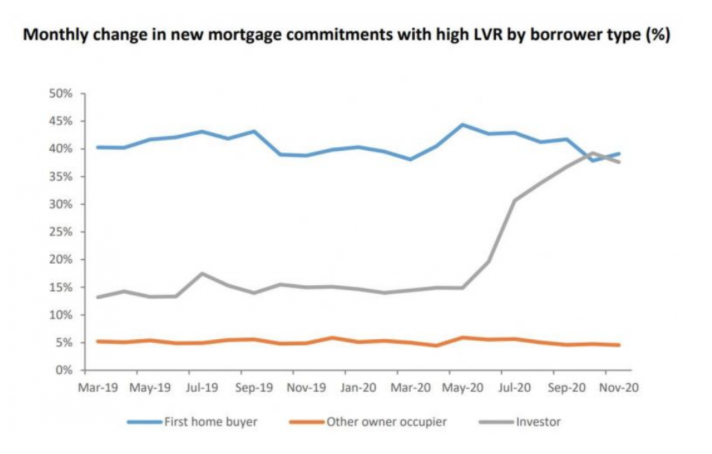
As property market data for January 2021 continues to emerge, the Finance Minister and the Reserve Bank of New Zealand (RBNZ) have both said they will advance measures to cool the overheated market.
In today’s Budget Policy Statement, Finance Minister Grant Robertson said a package to address the housing crisis would be announced by the end of February, including building more affordable homes and using regulation to curb property speculation.
The RBNZ also released its timetable today for reintroducing loan-to-value ratio (LVR) restrictions:
From 1 March 2021:
- LVR restrictions for owner-occupiers will return to 20%.
- LVR restrictions for investors will return to 30%.
From 1 May 2021:
- LVR restrictions for owner-occupiers will remain at 20%.
- LVR restrictions for investors will be increased further to 40%.
The reinstatement of LVR restrictions also includes restoring existing exemptions for owner-occupier and investor mortgages, such as:
- The new-build exemption, where borrowers commit to purchasing early in construction or buy from a developer within six months of completion;
- Kāinga Ora’s First Home Loan scheme, formerly Welcome Home Loan, for borrowers buying their first home with a low deposit;
- Loans for repairs to bring homes up to new building codes or rental property standards, such as installing insulation.
However, the Reserve Bank is cautious about whether restoring LVR restrictions will significantly affect house prices, considering a decline of 1–2 percentage points a reasonable estimate. Given the current irrational state of the property market, its greater hope is that the measure will help prevent price growth from accelerating further.
Economist: no doubt LVR cannot curb price rises — finance
Although the government and Reserve Bank have both expressed an urgent desire to control house prices, independent economist Tony Alexander says he does not believe the property market frenzy will ease substantially after the Reserve Bank fully reinstates LVR restrictions in March. The following factors, which cannot be changed for now, remain enduring drivers of market heat:
- Faced with low deposit interest rates and foreseeable inflation, many investors simply want to buy assets that will preserve or increase their value;
- New Zealand’s unemployment rate fell from 3% in the third quarter of 2020 to 4.9% at year-end, only half the level expected before the first lockdown. High job security is sustaining strong housing demand;
- Demand from overseas New Zealanders eager to return, buying property from abroad, will continue through 2021;
- Although housebuilding is accelerating, shortages of skilled construction workers and land will limit growth over the next few years.
Alexander therefore believes: “House prices will continue rising throughout this year.” Even if reintroducing LVR restrictions slows the property market for a month or two, it will not bring substantive change. “Beyond that, any further meaningful restraint on house prices may have to come from higher interest rates, which are highly likely at some point in 2022.”