Easy to hire, hard to dismiss: why do New Zealand’s small and medium-sized business owners keep falling foul of employment law?
Do you find New Zealand employment law almost excessively strict? Are you worried about how to interpret its complicated provisions? Are you unsure how to put the legal requirements into practice correctly?…
New Zealand employment law is widely known for being strict. It gives employers and employees their respective rights and obligations. Although employment law should cut both ways, many small and medium-sized business owners do not understand the relevant legislation well enough to use it to protect their interests. Instead, they can easily be caught out by procedural requirements, left suffering consequences they find hard to explain. Chinese business owners are no exception. Let us look at two examples:
The first dispute concerns a dismissal in 2017, which New Zealand’s Employment Relations Authority (ERA) recently found to be unjustified, ordering the employer to pay NZ$14,700. Ms Li, who worked at a speciality goods shop in Auckland’s CBD, was dismissed within half an hour after being suspected of stealing a tube of hand cream, triggering an employment dispute. The ERA ultimately ordered the business to pay her NZ$5700 in lost wages and a further NZ$9000 in compensation for unjustified dismissal.
Another case arose from the pandemic. Although it did not involve a Chinese business owner, it also deserves attention. Solly’s Freight Limited began a restructuring process after business declined during the pandemic, making some long-serving employees redundant. The business undoubtedly had its own difficulties. However, because Solly’s Freight had signed up for the government’s wage subsidy during the pandemic, whose declaration required employers to make their best efforts to retain staff, among other reasons, it was ordered to pay two former employees a total of NZ$58,039.
{ad}
The employers in these cases were not without reasonable considerations, yet they still faced penalties of amounts that could be described as shocking. Ultimately, they suffered because they lacked legal awareness and knowledge. What, then, was the basis for the ERA’s decisions? And how can employers prevent and avoid similar outcomes?
According to the Ministry of Business, Innovation and Employment (MBIE), small businesses — those employing fewer than 20 people — account for as much as 97% of New Zealand businesses. Many Chinese-owned businesses fall into this category. A defining feature is that their size and operating costs require small, lean teams, with staff often taking on several roles and no specialist human resources (HR) personnel. Employers consequently often lack familiarity with the many detailed provisions of employment law. Cultural differences and misunderstandings of English legal texts can also lead them to overlook procedural details or fail to comply strictly with legal requirements.
Employment law is hardly the only challenge. Contracts, tax and financial matters are all persistent problems that small and medium-sized business owners must manage themselves, and every one can affect a business’s survival.
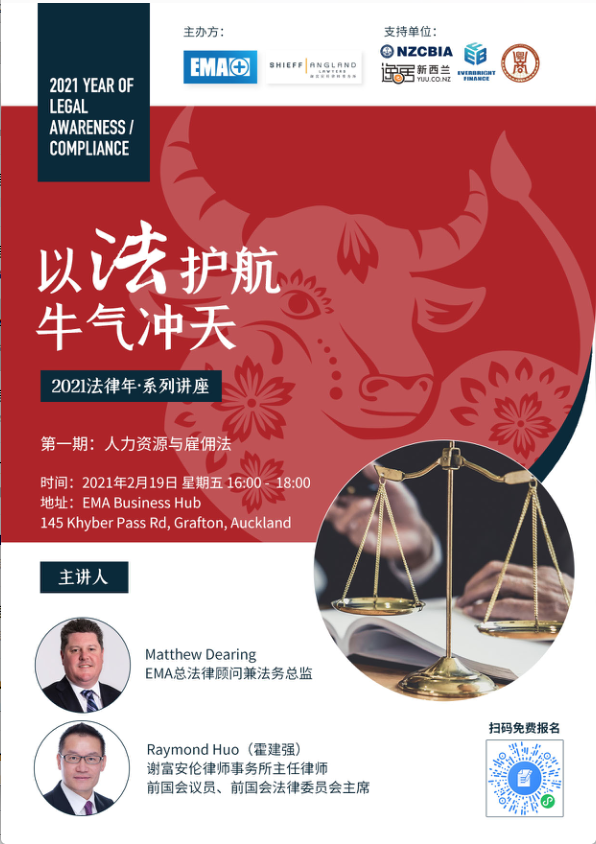
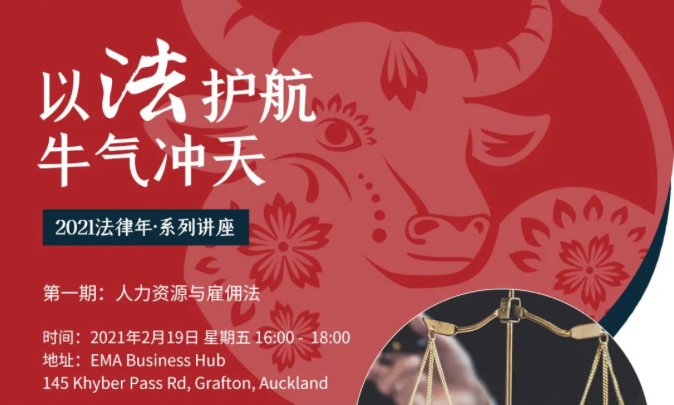
To address the legal difficulties facing Chinese-owned small and medium-sized businesses, the Employers and Manufacturers Association’s Chinese Business Centre (EMA CBC) is partnering with SHIEFF ANGLAND LAWYERS to launch a free “Year of Law” seminar series for New Zealand’s small and medium-sized businesses this month. The five seminars will cover areas closely connected with business development, including human resources, tax, commercial contracts — construction contracts and others — and trusts, including business holding, trading and family trusts. Through explanations of legislation and analysis of real cases, the series aims to improve business owners’ legal awareness and provide stronger legal support and protection for their businesses.
The first seminar, on “Human Resources and Employment Law”, will take place on 19 February. Keynote speaker Matthew Dearing, EMA’s general counsel and legal services director, will explain New Zealand employment law in accessible detail, covering:
- The basic framework of New Zealand employment law
- The latest personal grievance data
- The latest detailed rules on work visas, immigration and related matters
- The latest public holiday and sick leave provisions
…
As a standing member of the Auckland District Law Society’s Employment Law Committee, Matthew has worked with businesses of varying sizes over many years across areas including dispute resolution, restructuring, employee performance, reviewing and drafting employment agreements and internal policies, and advising on a broad range of employment issues. Lawyer Raymond Huo, a former MP and former chair of Parliament’s Justice Committee, will also attend to answer questions from Chinese business owners. The seminar will be co-hosted throughout by Chinese National Party parliamentary candidate Nancy Lu and EMA CBC head Anna Li.
Registration is now open and attracting strong interest. Scan the code to register for free.