
The last Level 3 before vaccination? What you need to know about building, buying and renting
Although vaccines are already being produced on a large scale, and New Zealand has announced its first vaccinations could begin as early as this coming Saturday, outbreaks around the world continue to reach new peaks. Victoria, home to Melbourne, entered another statewide lockdown on Lunar New Year's Day. A renewed outbreak in New Zealand felt like the other shoe waiting to drop: we hoped it would not happen, while knowing it eventually would.

At 7h last night, Prime Minister Jacinda Ardern announced at a press conference that Auckland would return to Level 3 from midnight that day (11:59pm), while the rest of New Zealand would move to Level 2. This followed 3 community cases of unknown origin in Auckland, whose movements included several locations in Auckland and New Plymouth, including a high school. After two lockdowns, the government's response seems increasingly decisive and efficient, while New Zealand industries, having weathered previous disruptions, are also taking developments in their stride. After a busy night, let us look at the emergency responses across Auckland's property construction, sales and rental sectors.
{ad}
House construction
Hundreds of Auckland construction sites in an industry with annual output of NZ$16,000,000,000 opened as usual this morning. With its open working environments and relatively manageable physical distancing, construction is among the limited industries able to continue operating as usual at Level 3. However, businesses and industry associations spent a busy night preparing for today's work, passing on information and reiterating construction site contingency plans for Level 3.
Culum Manson, head of New Zealand's largest private developer, Mansons TCLM, said the company's health and safety team had notified all staff last night of the move to Level 3. “Builders already have contingency plans for alert level changes and have implemented COVID protocols. These cover arrangements for on-site workers, cleaning stations and physical distancing between work groups.” Manson said that although time was tight, fortunately everyone was already familiar with these contingency plans.
Frank Xu, president of the New Zealand Chinese Building Industry Association, said that after last night's press conference, the association and its member businesses immediately activated the emergency response mechanism developed last year, coordinating throughout the night. Owners, main contractors and subcontractors each implemented health and safety responsibilities according to their roles and their relationships with others in the chain, ensuring site safety at Level 3.
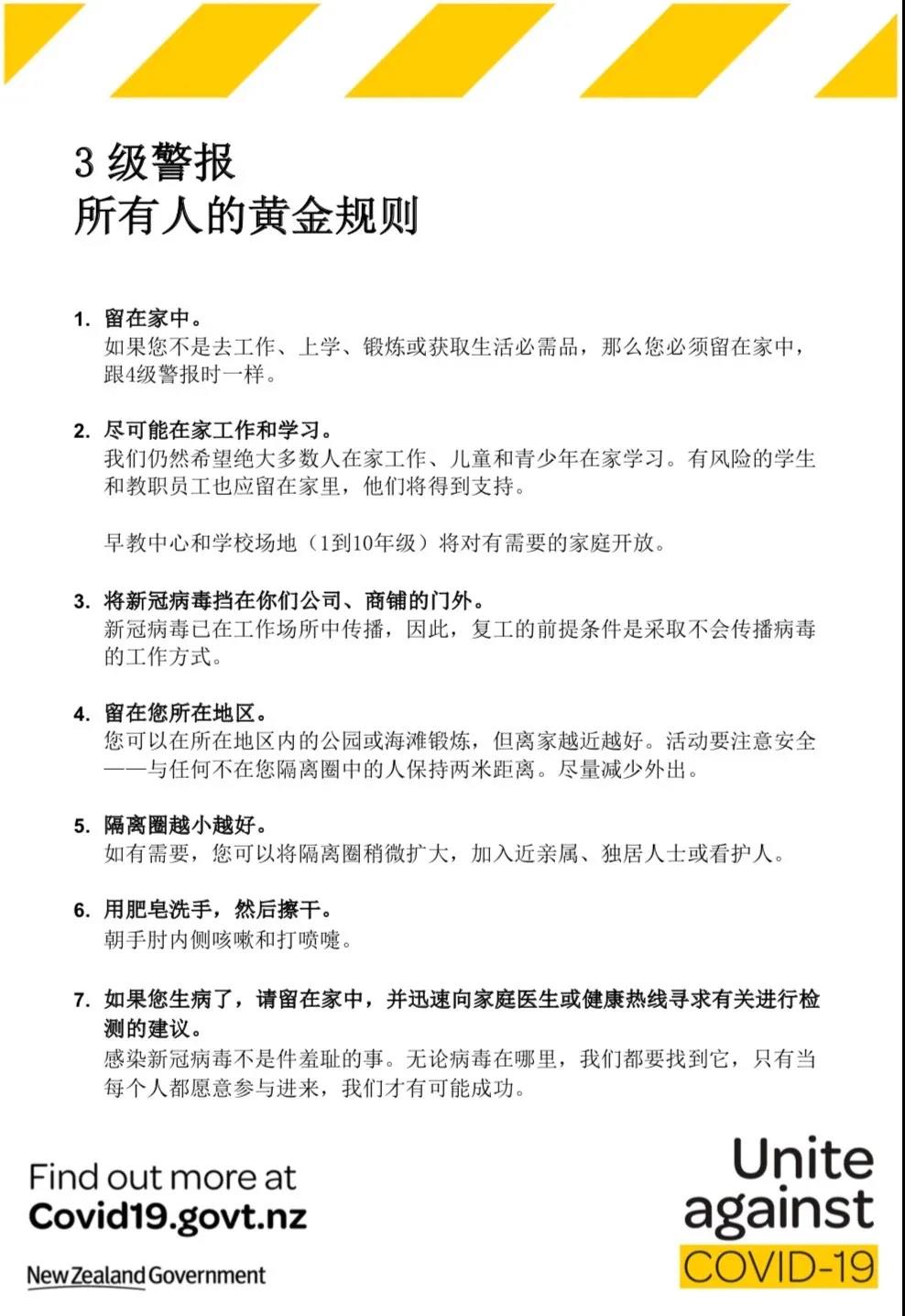
In an interview, Frank asked YIJU to reiterate the Level 3 safety rules in Chinese for Chinese-speaking construction workers:
- Work remotely wherever possible. Businesses are encouraged to adopt and use technology to enable flexible working.
- Where remote working is not possible, on-site work may be permitted, provided appropriate health and safety measures are in place for workers and others affected, such as occupants of buildings under construction, and physical distancing of at least 1 metre is maintained.
- Display a business contact-tracing code at the construction site and maintain contact-tracing records.
- For detailed health and safety requirements and procedures, consult the relevant guidance on the CHASNA or WorkSafe websites. A Chinese version of the New Zealand COVID-19 Construction Site Safety Induction (CSSI) for residential and commercial sites is also available to download free. Please insert the download link here. (I remember it was in the previous magazine issue; please click it first to confirm it still works.)
- Businesses whose staff need to enter or leave Auckland for work must designate someone to apply to the Ministry of Business, Innovation and Employment (MBIE). For application criteria and procedures, see the relevant government webpage: https://www.business.govt.nz/covid-19/business-travel-across-alert-level-boundaries
House sales
Around 30,000 residential properties are currently for sale across New Zealand. Real Estate Institute chief executive Bindi Norwell said the higher alert levels would undoubtedly bring changes to house sales, potentially having a significant but temporary impact on the multibillion-dollar market, particularly the 9000 properties in Auckland.
Norwell said that under Level 3 restrictions, “Any Auckland property can have a maximum of two private viewings a day, by prior appointment. Property auctions in Auckland can still take place, but only by telephone or online.”
For the rest of New Zealand at Level 2, “Open homes and on-site auctions are permitted, provided physical distancing is maintained between all attendees.”
However, she said the previous two lockdowns had changed people's transaction habits. “Buyers and sellers are also more accustomed to using digital tools as part of the process. Given people's adaptability and flexibility, the increase in alert levels is unlikely to significantly slow the property market.”
Moving house following a sale or purchase would not be greatly affected at Level 2. If buyers or sellers needed to enter or leave the Level 3 area, Auckland, to return to their main home or move house, Norwell said: “People travelling for these reasons do not need an exemption from the Ministry of Health, but should carry documents proving the reason for their travel.”
Norwell stressed that the real estate industry had very clear guidance on what was and was not permitted at different alert levels. Real estate agents and property managers were already thoroughly familiar with it from last year's experience.
Rental housing
Barfoot & Thompson director Kiri Barfoot said the government's Tenancy Services guidance set out detailed rules for rental housing at Level 3, including:
- Tenants may move into a new home, and moving companies may assist them. Physical distancing must be maintained during the move, and records should be kept for contact tracing.
- Landlords and property managers cannot carry out routine inspections during this period, except in an emergency, such as when a landlord needs to establish whether urgent repairs are required. Tenants are encouraged to carry out self-inspections instead.
- Repairs and maintenance may only be carried out in emergencies or with the tenant's approval. This may involve plumbers, electricians and others working inside or outside the property.
- Professionals may be engaged to clean or maintain vacant rental properties.
- Open homes are not permitted. Private viewings may be arranged subject to restrictions, with no more than two viewings per rental property each day.
- If the rental property is occupied, the landlord or property management company must obtain the tenant's consent, and viewings may only take place while the tenant is away from the property.
- During viewings, maintain physical distancing and minimise contact with all surfaces in the property. Anything touched should be cleaned with disinfectant.