
Bottoming out or rebounding? A leading international organisation's latest New Zealand housing forecast: mortgage rates will stay low for a long time!
Last week, the United States announced that 30-year mortgage rates had risen five basis points to 3.02%. This was also the first time since July 2020 that the US benchmark mortgage rate had exceeded 3.02%.

Market indicators show that US mortgage rates are rising rapidly, and many people are beginning to worry about the impact of exchange-rate movements on the US property market. Against a backdrop of massive global monetary stimulus, where will New Zealand interest rates head in 2021? This is also among the issues people are most concerned about.
“Interest rates are driven primarily by inflation. Wherever inflation goes, interest rates follow.” The globally renowned financial website Marketwatch.com recently published an article forecasting New Zealand interest-rate trends for 2021. It said that, against a backdrop of massive global monetary stimulus, New Zealand's low interest rates would remain low for a long time. Its view was:
{ad}
1. If the central bank artificially pushes interest rates up, the economy will slow, causing a recession. That will not happen.
2. If the central bank artificially pushes interest rates down, the economy will overheat, causing an inflationary bubble. That will not happen.
3. Instead, it “dances” in the middle, adjusting interest rates up and down within a very narrow range.
Former US Federal Reserve chair Ben Bernanke has likewise said that low interest rates are a long-term trend rather than a short-term anomaly.
New Zealand interest rates are far above those in most developed countries, and on a par with Canada, the Czech Republic and the United States
According to the global interest-rate data published by the organisation, Switzerland's central bank rate is -0.75%, Japan's is -0.1%, and rates in Sweden, Norway and the eurozone are all 0%. The eurozone includes Austria, Belgium, Cyprus, Estonia, Finland, France, Germany, Greece, Ireland, Italy, Latvia, Lithuania, Luxembourg, Malta, the Netherlands, Portugal, Slovakia, Slovenia and Spain. Denmark's rate is close to 0. Interest rates in these countries are already far higher than in most countries worldwide.
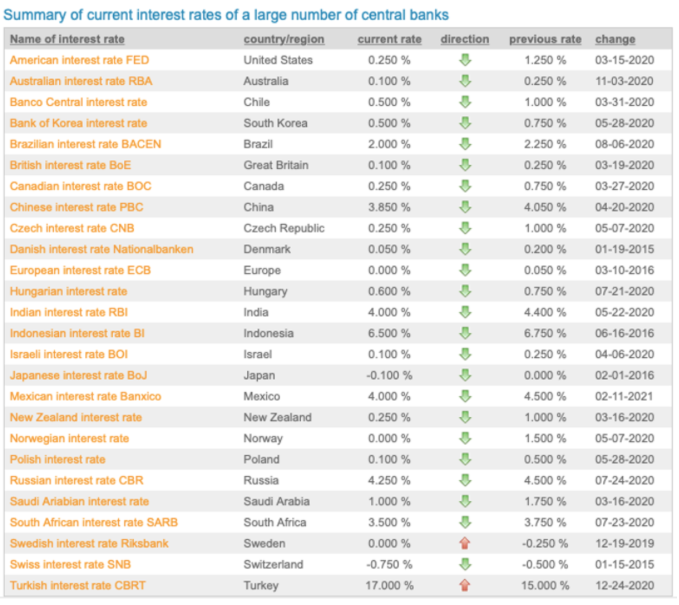
“Against the global economic backdrop, our forecast for New Zealand interest rates is that they will remain low for a considerable time,” the article said.
The article noted: “Wherever interest rates go, mortgage rates follow.” Fixed rates at the major banks are currently all below 3%. Inflation, the main driver of interest rates, has remained stubbornly below target since the global financial crisis in 2008, and is expected to stay low for a considerable time.
Forecast: short-term mortgage rates to remain low over the next few years, with medium- and long-term rates strengthening towards year-end
Given the uncertainty surrounding the current economic situation, many people are concerned about property investment in New Zealand. Some believe mortgage rates could rise in 2021 or 2022. Some even believe they could rise to very high levels.
The article stated: “This is understandable given our memories of high mortgage rates in the 80s. In fact, 10-year bond yields peaked at 19.2% in May 1985, but that was 35 years ago. We are unlikely to see mortgage rates like that again any time soon. (Not that we would be distraught if they did reach those levels… Mortgage rates would only be very high if inflation were high, in which case capital gains would rise substantially.)” People therefore need not worry about a sharp rise in mortgage rates in the short term.
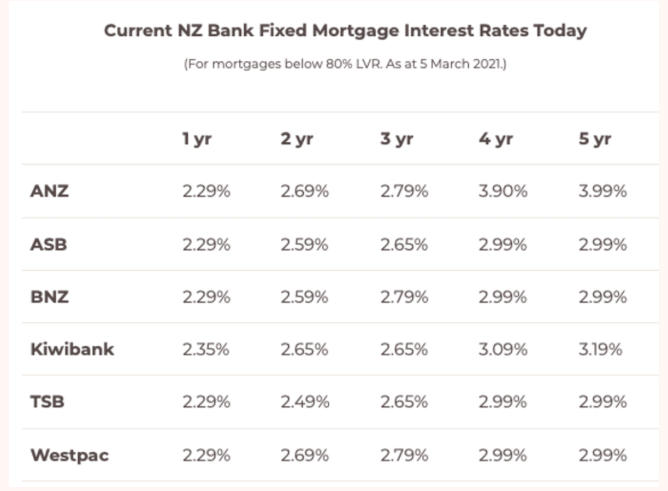
The article said its best forecast was that we were at the bottom of the cycle, short-term mortgage rates would remain low for several years, and medium- and long-term mortgage rates would begin to stabilise later in 2021.
The risk is upwards rather than downwards. Put simply, interest rates are unlikely to fall further. If the Reserve Bank does lower them, the change will be small.
The Reserve Bank of New Zealand faces political pressure to avoid further stimulating house prices: mortgage-rate cuts are highly unlikely!
A series of New Zealand economic figures released in February 2021 was far more positive than economists had predicted. Unemployment fell from 5.3% to 4.9%, surprising even the most optimistic economists. They had expected unemployment to rise after the Covid-19 wage subsidy ended, but that did not happen.
Statistics New Zealand figures showed that, even as house prices were rising at a frantic pace in early 2021, New Zealand's annual inflation rate for December 2020 was just 2%. This was very close to the midpoint of the Reserve Bank's 1%–3% target range. This means there is no inflationary pressure to either raise or lower interest rates. In addition, the Reserve Bank faces political pressure to avoid further stimulating house prices, so we believe further mortgage-rate cuts are out of the question.
Economic forecasters predict: OCR will move early next year; short-term mortgage-rate increases will lag OCR increases
ANZ's business confidence survey released on 4 February 2021 found that businesses were concerned about rising freight and staffing costs amid skills shortages. Around half of respondents lacked confidence in their ability to maintain current profitability and planned to offset costs by raising prices.
This has heightened expectations of upward pressure on inflation, despite New Zealand and Australia being held back by lost tourism revenue. That, in turn, will put upward pressure on the Official Cash Rate (OCR). We believe the OCR could start moving as early as February 2022 (or possibly even November 2021). Last month, the Reserve Bank of New Zealand announced that the OCR would remain unchanged at 0.25%. However, it said it could still lower the benchmark rate at a later stage if necessary.
Economist's advice: lock in long-term rates and forgo the “sweetener” of short-term rates
What about mortgage rates? We expect medium- and long-term rates to start rising in 2021, ahead of the OCR, while short-term rate increases will lag OCR increases.
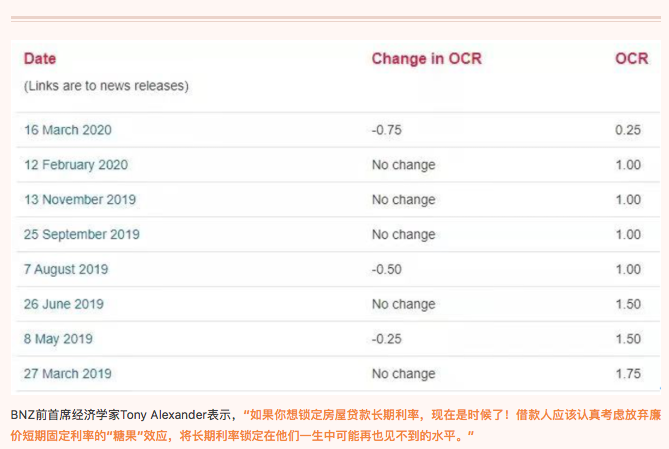
Former BNZ chief economist Tony Alexander said: “If you want to lock in long-term mortgage rates, now is the time! Borrowers should seriously consider forgoing the sweetener of cheap short-term fixed rates and locking in long-term rates at levels they may never see again in their lifetimes.”
ASB forecast: term deposit rates to remain low over the next few years
ASB reportedly said in its term deposit report dated 5 February 2021 that 2021 was expected to be another year of low interest rates. ASB economist Chris Tennent-Brown said term deposit rates were “very low”, with no sign of that changing soon. He said that, at current New Zealand term deposit rates, savers investing more than NZ$10,000 for between 1 and 5 years would receive annual interest of between 0.8% and 1.75%. ASB's term deposit rates are currently higher than those of several other major New Zealand commercial banks. Media reports said ASB raised its term deposit rate to 1.75% last month, with other banks expected to follow.
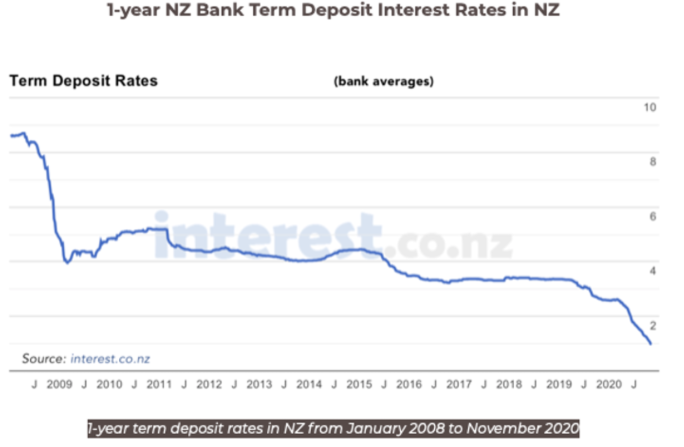
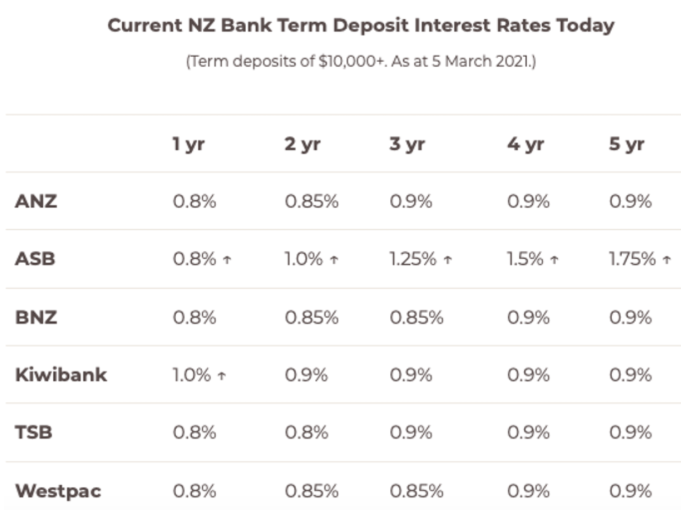
Low interest rates have helped borrowers and frustrated savers in recent years. Over the past year, term deposit rates have steadily fallen, dropping well below their average over the past 10–15 years. Rates are expected to remain low for the next few years, and we may still see further falls from today's levels.