
1,690,000 above the opening price! Commercial property sees another wave of rising sales volumes and prices!
New Zealand’s housing market has faced a fresh regulatory offensive in 2021. From the return of LVR restrictions to last week’s announcement extending the bright-line test to 10 years and removing interest deductibility, alongside the government’s consideration of DTI restrictions, the new measures show its determination to rein in the housing market this year. With residential investment increasingly difficult to enter, where will investors turn?
The following housing market measures have been introduced since the start of 2021:
1. 1 March: LVR restrictions officially return, raising the deposit requirement for investment properties to 30%.
2. 27 March: the bright-line period is extended from 5 years to 10 years.
3. 1 May: LVR lending restrictions will raise the deposit requirement for investment properties to 40%.
4. 1 October: the interest deductibility “loophole” is removed.
Major regulatory measures the government is expected to announce this year:
1. Introduce DTI (debt-to-income) restrictions.
2. Eliminate interest-only mortgages.
Each of these measures will deal a significant blow to property investors.
In 2018, the New Zealand government targeted overseas buyers in an effort to curb continuing house price growth, formally legislating a ban on overseas buyers on 22 August 2018. At the time, the industry believed the legislation would disrupt the housing market, ultimately drive large numbers of buyers out of it and severely dampen overseas buyers’ interest in New Zealand property.
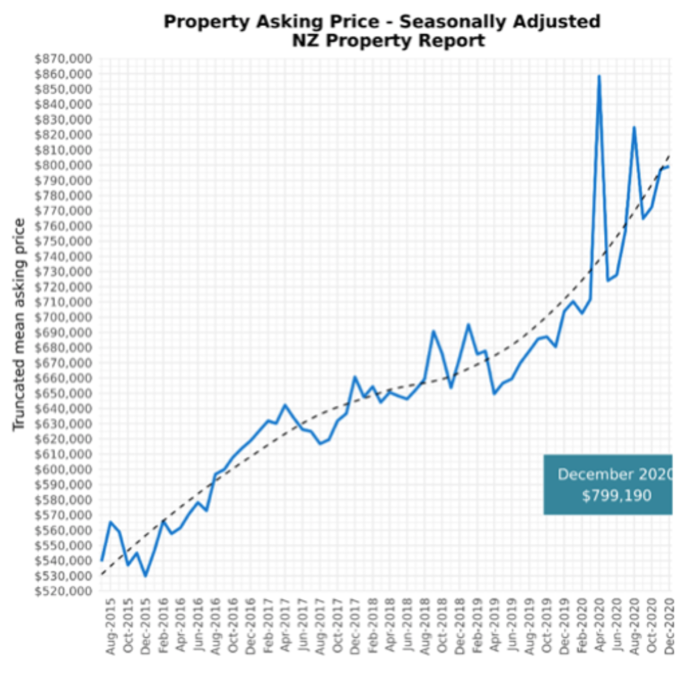
Figures from Realestate.co.nz show that New Zealand house prices continued to rise between 2018 and 2020. In less than three years, the average house price rose by NZ$300,000, reaching a 6-year peak last year.
An industry insider offered this assessment: “This time, the government wants to drive investors out of residential investment to revitalise other parts of the economy.”
A senior Westpac economist said the housing measures announced by the government last week could create substantial downside risks for the entire residential market. Removing interest deductibility, in particular, would significantly dampen investors’ enthusiasm for housing.
Some economists have even suggested that house prices could fall by around 10%. With the housing market’s outlook uncertain, many investors have gradually turned to commercial property after the government’s succession of policy blows.
Small Auckland commercial property fetches a hefty 6,180,000 at auction, exceeding the opening price by 1,690,000!
A report from interest.co.nz shows that the government’s heavy crackdown on residential investment has prompted many investors to seek small commercial properties as an alternative.
interest.co.nz reports that commercial property sales volumes in New Zealand are steadily recovering. Small commercial property auctions are seeing another wave of rising volumes and prices, particularly in areas with strong development potential.
Figures show that competition was fiercest for properties in Albany on the North Shore at Bayleys’ latest commercial property auction in Auckland last week. A 650-square-metre warehouse attracted numerous investment bidders and fetched 3,690,000, selling for 1,690,000 above the opening price. At the same auction, a vacant 734-square-metre commercial development site in Newmarket sold for 6,180,000, exceeding its opening price by 680,000.
Commercial sales boom around Auckland as traditional investors join the bidding
Commercial property sales volumes have also risen in Waikato, Taupo, Gisborne, Whanganui, Hawke’s Bay, Wellington and Timaru. Buyers competed for several motels in the Taupo area, with yields of 5.67% and 7.65% respectively.
According to Bayleys’ report, the continuing economic recovery, and renewed investor interest in tourism in particular, have brought substantial commercial sales across the country since the start of the year. Hotels, motels and bed and breakfasts have become a renewed investment focus in surrounding towns and cities. Retail properties around Auckland have attracted many traditional investors to auctions, driving brisk sales.
Build-to-rent among the fastest-growing investments as commercial property draws New Zealanders’ attention
According to a Data Insight report, the pandemic caused the value of commercial and industrial property sales across New Zealand in 2020 to fall by 15.8% compared with 2019. This year, as the economy recovers and vaccines are rolled out worldwide, commercial property is becoming a focus for New Zealanders.
Ryan Johnson, director of the national commercial and industrial division, said build-to-rent (BTR) was attracting widespread attention in commercial property. It is currently among the fastest-growing investment asset classes worldwide and is drawing increasing interest in New Zealand.
Reserve Bank figures show that NZ$21,700,000,000 has flowed out of New Zealand bank term deposits since August 2019. These funds are urgently seeking viable investment returns, and interest in commercial and industrial property has increased substantially in Auckland and elsewhere.
Logistics, offices and cold storage become investors’ preferred alternative assets
The latest Asia-Pacific Investor Intentions Survey released by Confidence in commercial real estate (CBRE) shows that confidence in commercial property across the Asia-Pacific region continues to rise. Investment in 2021 is expected to grow by 5% to 10%.
The report says the pandemic has made logistics properties, offices and cold storage facilities investors’ preferred alternative asset classes.
CBRE New Zealand executive chairman Brent McGregor said: “Compared with North America and Europe, Asia has controlled influenza relatively well, so more investors have identified Asian investment markets as their first choice this year.”
He said: “Current travel restrictions have not dampened Asia-Pacific investors’ strong interest in cross-border investment. More than 70% of respondents intend to purchase overseas assets in 2021.”
He therefore said: “New Zealand is very likely to remain an attractive destination for overseas investment.”
{ad}
Zoltan Moricz, senior director of research at CBRE New Zealand, said: “Thanks to our successful response to the pandemic, New Zealand’s economic and social environment has shown remarkable resilience over the past year. Commercial purchasing activity here recovered earlier than elsewhere in the world, which may change some investors’ views. We expect investment in New Zealand’s commercial property market to grow by more than 10% in 2021.” Although the New Zealand government is intensifying its crackdown on residential investment, the global vaccine rollout and continuing economic recovery mean commercial property is set to become a new alternative asset class for investors. Recently, New Zealand Prime Minister Jacinda Ardern and the Reserve Bank also said that “they did not want New Zealanders to put all their money into “buying houses alone”, instead encouraging them to seek more investment options. Commercial property is a barometer of the real economy, and its recovery will inevitably stimulate a wide range of economic activity. This is what the country and its government hope to see.