Major boost! ASB announces an ultra-low mortgage rate! These borrowers stand to benefit most!
As a wave of interest rate rises sweeps the world, New Zealand mortgage rates have become a nationwide focus. Many economists predict that New Zealand is moving ever closer to rate rises. Unexpectedly, however, ASB announced early this morning that it would cut mortgage rates again, lowering its floating rate for new homes to 1.79% and causing a stir across the industry.

Analysing the reasons behind the rate cut: Government and banks support new home construction
It is important to note that this rate cut applies to new homes. Mortgage rates for purchases of existing homes remain unchanged.
This year, the government announced a series of measures intended to cool the hot property market. New data show residential sales volumes fell 13% in April. Stricter loan-to-value ratio (LVR) lending restrictions are being implemented, while the removal of investors’ interest deductibility is having a significant effect on the housing market.
These measures show that the government has eased restrictions on new homes and the commercial market. The bright-line test period for new homes remains five years, and this year the government will commit NZ$3,800,000,000 to a housing construction fund to address the worsening housing shortage.
Increasing new home construction is central to the government’s current response to housing problems. ASB’s ultra-low rate announced today appears intended to support the government in encouraging people to build and buy new homes.
{ad}
Bank encourages people to contribute to New Zealand’s housing market
ASB’s current standard floating rate is 4.45%, in line with those of New Zealand’s other major commercial banks. Only Kiwibank offers a standard floating rate of 3.40%.
We understand that ASB’s new floating-rate offer for new homes runs for three years. During that period, customers can make a lump-sum repayment or switch to a fixed rate at any time, offering considerable flexibility.
ASB said the programme uses funding obtained from the Reserve Bank of New Zealand for a “special” purpose.
ASB executive general manager Craig Sims said he hoped the programme would help address New Zealand’s long-standing “housing supply problem” and build a more sustainable housing market.
“Housing supply is a major problem for New Zealand’s economy. We have therefore specifically chosen to offer this programme to homeowners and investors to encourage them to play a greater role in the current housing market,” Craig Sims said.
Cash incentives: Homes meeting energy-efficiency standards can earn rewards of up to NZ$2000
ASB also announced today that it would offer cashback incentives to borrowers with energy-efficient homes.
ASB said the programme would operate in partnership with the New Zealand Green Building Council. Customers whose homes achieve a Homestar rating of 6 stars or higher (Homestar refers to an energy-efficiency standard) will receive a cash reward of NZ$2,000, encouraging the construction of new energy-efficient homes.
April home sales fall markedly, but prices keep rising
With the government and banks encouraging more new home construction on one hand, and the government continuing to restrain the existing housing market on the other, what is actually happening in New Zealand’s property market?
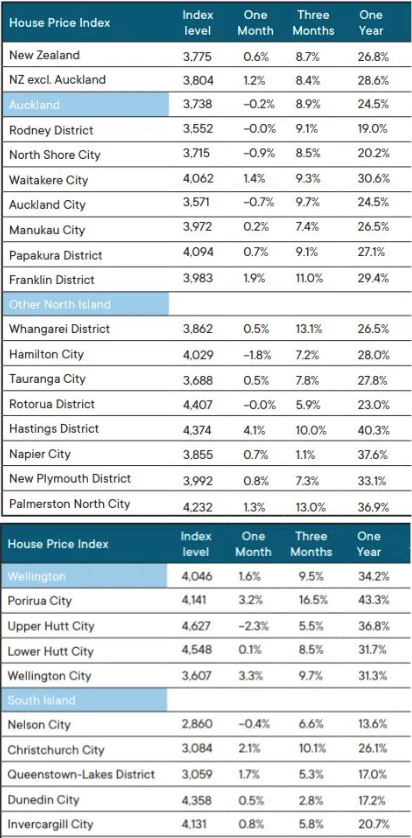
According to the latest REINZ data, the housing market showed initial signs of cooling last month, April, following a series of policy restrictions. However, house prices across New Zealand continued to rise.
Data show that New Zealand’s total home sales fell 13% in April. Auckland recorded the largest fall, at 21%, while Otago and Waikato both fell 18%. REINZ reported house price inflation of 1.7% in April, with annual growth of 26.8%.
North Shore and central Auckland lead the decline But prices in these other areas keep rising
REINZ’s House Price Index report shows that New Zealand house prices rose just 0.6% overall in April, below the 2.7% rise in March. Auckland prices fell 0.2% overall in April.
The North Shore and central Auckland led the decline. Data show North Shore prices fell 0.9% in April, compared with a rise of 3.8% in March. Central Auckland prices fell 0.7% in April, after rising 0.7% in March. Declines in these two areas drove down the index for Auckland’s housing market as a whole.
Notably, however, house prices in Waitakere, Manukau, Papakura a and Franklin continued to rise in April.
Only four areas nationwide recorded stronger house price growth than in March
Data show that only four areas in New Zealand recorded strong house price growth in April that exceeded March. They were Hastings, up 4.1% in April (3.6% in March); Wellington, up 3.3% (0.1% in March); Queenstown, up 1.7% (0.7% in March); and Dunedin, up 0.5% (-0.4% in March).
Housing market could face a winter chill Regulatory measures are affecting the current market
REINZ’s April House Price Index for New Zealand shows that the reintroduction of LVR restrictions and the government’s crackdown on investors are affecting the current housing market.
Kiwibank said: “Recent housing policy changes and New Zealand’s continued border closure are reducing demand for housing investment. The Reserve Bank of New Zealand is expected to begin tightening monetary policy at the end of next year.”
Despite concerns that the Reserve Bank of New Zealand could introduce stricter lending rules, such as tighter LVR restrictions or debt-to-income limits (DTI), Kiwibank does not expect changes any time soon.
The table below shows REINZ’s House Price Index for April 2021: