
Latest survey: housing market remains resilient! Many expect house prices to keep rising next year!
A new ASB housing confidence survey released last week showed that most New Zealanders still strongly expect house prices to keep rising, despite a slowdown in the market following the Government's measures to curb it this year.

Most respondents expect house prices to keep rising
In ASB's housing confidence survey, a net 64% of respondents expected house prices to continue climbing next year. Aucklanders were less optimistic about current house prices, with a net 58% expecting Auckland house prices to rise further next year.
The survey showed that respondents in areas outside the North Island, including Canterbury and the South Island, had above-average expectations of future house price growth. Respectively, 67% and 68% expected prices to keep rising.
ASB senior economist Mike Jones said, “Although a raft of measures is affecting the property market, including loan-to-value ratio restrictions on investor mortgages, the end of mortgage repayment deferrals and the removal of interest deductibility, expectations for New Zealand's housing market remain elevated, with people still strongly expecting prices to keep rising.”
{AD}
Reflecting the impact of current policies, 21% of respondents said it was a bad time to buy a house, compared with just 8% in ASB's previous survey. The survey also showed that views on mortgage interest rates are changing, with 20% of respondents now expecting mortgage rates to rise in the near future.
Real Estate Institute data put annual house price inflation in April at 27%, confirming the record-breaking scale of the current housing boom. Mike Jones said, “We think house price inflation will slow from here, but given the dramatic shifts in supply and demand during the boom, that will take time.”
Whether investor numbers are falling or the market is supposedly cooling, the actual data show that the property market remains extraordinarily resilient.
Reserve Bank: mortgage lending slows but remains at historically high levels
The current property market can still be described as red-hot.
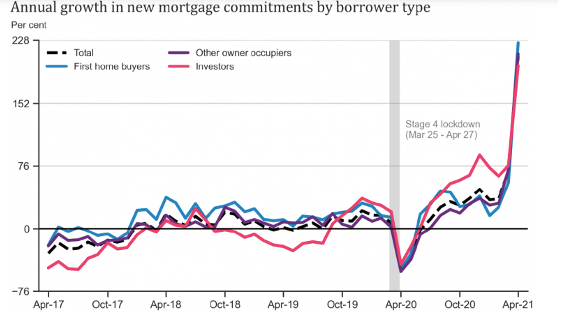
The latest Reserve Bank of New Zealand data show that mortgage lending across the country slowed in April but remained at historically high levels, with signs of more first-home buyers and fewer investors.
Total mortgage lending in April was NZ$8,486,000,000, below the record NZ$10,487,000,000 reached in March. Lending in April was approximately NZ$2,000,000,000 lower than in March.
It is worth noting that although lending in month 4 totalled (8,486,000,000 NZ dollars), a decline from March, it remained above the level seen from mid-2016 until the pandemic began last year, when monthly mortgage lending totalled 7,300,000,000 NZ dollars.
The market: more first-home buyers, fewer investors
First-home buyer numbers continued to increase in April after the Reserve Bank introduced loan-to-value ratio restrictions on investors.
Data show that first-home buyers borrowed NZ$1,574,000,000 that month. This accounted for 18.5% of total lending, the highest share in recent times and well above the 16.9% recorded in March.
As investors' share of borrowing rose rapidly in the second half of last year, first-home buyers' share had been declining after peaking at 20.4% in July last year. The latest figure marks the highest level since then.
Reserve Bank figures show that investors borrowed NZ$1,668,000,000 in April, down from NZ$2,325,000,000 in March. Their share fell from 22.2% in March to 19.7% in April, also signalling cooling investor activity.

“Stronger in the face of setbacks”4: the month saw nationwide house prices continue to climb
Although many in the market have voiced concerns about the Government's newly announced housing policies, the latest data tell us that in month 4, house prices nationwide continued to rise and the market remained buoyant.
The April property report from realestate.co.nz showed that the national average asking price rose from NZ$835,844 in March to NZ$839,035 in April. Auckland still had the highest average asking price at NZ$1,099,154, followed by Central Otago at NZ$1,029,304 and Coromandel at NZ$920,722.
In April, house prices in Taranaki and Manawatu–Whanganui also reached their highest levels in records stretching back 14 years, with average asking prices of NZ$553,071 and NZ$604,196 respectively. Wellington also set a new record, with an average asking price of NZ$887,837, up 4.3% from NZ$850,912 in March. Northland recorded an all-time high for the fourth consecutive month, with its average asking price now NZ$751,670.
It is worth noting that the West Coast had the lowest average asking price, at 359,263 NZ dollars.
Realestate.co.nz spokesperson Vanessa Taylor said, “Over the past year, New Zealand house prices have risen steadily month by month. Since the market went into lockdown last April because of the pandemic, the rebound has remained remarkably fast and strong.”
Vanessa Taylor said, “Demand for property remains high across New Zealand, but the number of properties available cannot meet current market demand.”
Data show that New Zealand currently has a housing shortfall of approximately 130,000 to 150,000 homes. The shortage of stock poses a real challenge for buyers and is a major reason for the housing market's continued resilience.
The Reserve Bank has made it clear that it expects to begin raising the Official Cash Rate in the second half of next year, while higher mortgage rates are also under consideration. Finally, I would once again remind readers: it is time to lock in your mortgage interest rate.