Apartment disputes: how can you defend your housing rights when faced with an unreliable property manager?
In recent years, land shortages and the Government's strong push for medium- and high-density housing development have led to a substantial increase in owners buying unit title properties. These units collectively form a body corporate, often shortened to body corp. Many Chinese owners who buy properties within a body corporate encounter management disputes and do not know how to protect their rights. Dealing with a highly unreliable management company makes the experience even more exhausting and time-consuming.


In recent years, land shortages and the Government's strong push for medium- and high-density housing development have led to a substantial increase in owners buying unit title properties. These units collectively form a body corporate, often shortened to body corp. Many Chinese owners who buy properties within a body corporate encounter management disputes and do not know how to protect their rights. Dealing with a highly unreliable management company makes the experience even more exhausting and time-consuming.
Although unit title apartments are popular in the market, owners also commonly face disagreements over property management. This is an important reason for continuing to advance reform of the Unit Titles Act.
{ad}
Who protects owners' lawful rights when they encounter an unreliable property manager?
Most apartment bodies corporate in New Zealand currently engage professional property management companies, whose quality plays a crucial role. Whether you are investing or buying a home to live in, a good management company can give you peace of mind while helping the property's value grow over time. An unreliable company, or one that simply fails to act, is among the biggest headaches for almost any body corporate.
Mr Li and Mrs Wang were dissatisfied with the company managing their unit title apartments. Responses to issues raised by owners often took several weeks, and the manager sometimes deliberately delayed matters or ignored them altogether. The company's insurance quote for the building was also very expensive. With limited English, Mr Li and Mrs Wang struggled to communicate with the company. They frequently worried that its inaction would affect sale prices throughout the building, and it made living there very unpleasant.
Unsure how to defend their rights, Mr Li and Mrs Wang contacted a Chinese real estate agent working for a well-known New Zealand agency through a friend's introduction. The agent advised them:
If owners are dissatisfied with their management company's performance, they can check the duties agreed in the Body Corporate Management Agreement. This legally binding contract is between the body corporate and its manager. The law also requires the company to provide at least three insurance quotes when arranging insurance for a unit title development. Having learned this, Mr Li and Mrs Wang had friends help translate the information into English and emailed it to the body corporate secretary. The secretary notified the manager in writing that it had failed to meet its statutory obligations and perform the duties listed in the contract. However, the manager's conduct still did not improve.
With no other option, the body corporate applied to the tribunal for an order removing the manager. After reviewing the evidence, the tribunal ultimately ordered the termination of the body corporate management contract.

Scan the code to view the source of the case
Why owners need to understand the Unit Titles Act
This case shows that Chinese owners facing apartment disputes or unfair treatment by property managers must use legal means to protect their rights. New Zealand is governed by the rule of law, and all conduct should be subject to legal constraints.
Today, we have invited Adriana Radich, a department head at New Zealand's largest locally owned real estate agency, Barfoot & Thompson, to explain the importance of the Unit Titles Act for bodies corporate and the loopholes that currently exist in the legislation. As the manager responsible for all body corporate matters, Adriana Radich brings highly specialised knowledge and distinctive insights to this area.

Adriana Radich
In simple terms, can you explain what the Unit Titles Act means for a body corporate?
The Unit Titles Act is the legislation governing all unit titles. It was first introduced in 1972 and amended in 2010. The Government is now considering further amendments to address many confusing issues, as well as matters that are not currently covered. Many aspects of body corporate activity are unregulated under the current legislation. As a company, Barfoot & Thompson fully supports amendments to the Unit Titles Act that would establish more comprehensive industry standards to protect owners' interests.
Can you give an example of a problem with the current Unit Titles Act?
Our industry is currently concerned about information disclosure. Under the Unit Titles Act 2010, owners must disclose any problems they know about. Yet much information is not disclosed in sale and purchase agreements involving bodies corporate, and some is even concealed. For example, committee meeting minutes are often not proactively disclosed to buyers. Building issues under investigation at the time of purchase are also usually not disclosed unless the investigation has reached a conclusion. As a result, some owners who do not live in their apartments face the risk of court proceedings when selling because they genuinely knew nothing about the problems. These owners are actually innocent: the management company failed to disclose information and concealed the truth.
What other problems are there with the current Act?
Put simply, this is essentially an unregulated industry, with no professional standards or formal oversight. For example, most management companies pool body corporate funds in a single account. In our view, this is clearly problematic because funds could be misappropriated or even stolen. Bodies corporate also receive no interest income from that account. Instead, the management companies earn interest on the pooled funds, depriving bodies corporate of that income. In my view, trust accounts should be abolished altogether, and accounts for any type of complex should be private, individual accounts only.
What distinguishes us from other management companies is that we place each client's funds in a separate bank account. This safeguards the money and makes its use transparent.
How should the proposed amendments to the Act strengthen governance?
We have made recommendations to strengthen the legislation, covering fund management, professional qualifications and the consequences of failing to meet industry standards. It would be excellent if, before long, those working in body corporate management had to be licensed professionals.
There are also many unresolved questions in the Act, with no specific guidance. We advocate updating these areas where gaps exist.
What examples illustrate how a lack of standards can affect a body corporate?
We recently took on a new client who wanted to transfer its body corporate funds from the previous management company to us, but the transfer involved a wait of 2–3 months. We later learned that the previous company had pooled those funds with money belonging to other bodies corporate. This meant a lengthy transfer process when the body corporate wanted to change managers. Financially, owners would have no money to pay for repairs or obtain timely payments from suppliers and cover other expenses. No law currently prohibits this conduct, creating a serious lack of financial transparency.
What does Barfoot & Thompson think of the newly proposed amendments?
Our company is 100% behind establishing rules for the industry, promoting professional standards and protecting owners. Barfoot & Thompson is also an owner within a body corporate. From our own experience, better industry standards are needed when these companies hold large sums of money.
Why should owners pay attention to the Unit Titles Act?
Because large sums of money are at risk. Having a company with an excellent professional team manage your property will increase its value. A professional management team reassures prospective buyers that they will not encounter problems. A sound audit trail is also crucial, as it demonstrates to buyers that their investment will be safe and secure.
Advice for buyers and developers of body corporate properties
What are the benefits of engaging a professional property services company?
Professional management services can maintain a property proactively and resolve problems and disputes promptly. Professional care also helps a property remain attractive in the sales market and appeal to buyers. Every body corporate member faces a demanding process of learning about property management and the relevant legislation. Engaging the right professionals helps ease that burden and streamline procedures, saving owners time and giving them greater peace of mind at home.
What should a body corporate understand about property levies?
The more luxurious the building, the higher the levies. When preparing to buy this type of property, you need to consider your budget. Alongside everyday expenses, such as mortgage payments and normal property taxes, you must allow for additional levies. For example, levies may rise if the property needs major repairs or owners vote for substantial improvements. Most importantly, choose a property type that suits your financial circumstances.
What lifestyles are body corporate properties best suited to?
As land available for development becomes scarce, body corporate properties have become an alternative to standalone houses. They offer a viable lifestyle for owners who do not want to spend time gardening. Some compromises are necessary, however, such as sharing spaces with others and having slightly less privacy. The convenience these properties offer also makes them more attractive in the market.
What advice would you give investors and developers on this subject?
I see many investors considering developments under the Unitary Plan, and many recognise the benefits. If they decide to take that route, I recommend choosing the right professional property management team. This can help reduce oversight costs while achieving better results with less effort.
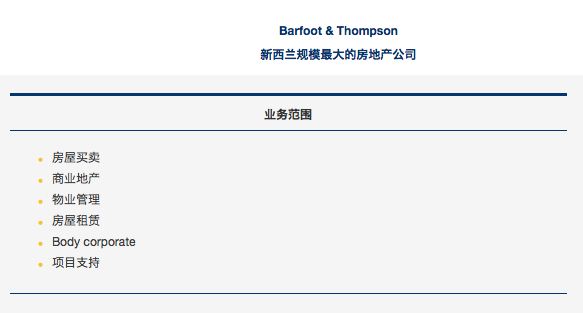
What body corporate services does Barfoot & Thompson currently offer?
We currently offer day-to-day management and annual operational services, and can also tailor services to your needs.
Day-to-day management generally includes arranging, maintaining and managing owners' common property. Annual operational services focus on accounts and budgets, coordinating audits of financial statements and valuations, and providing information statements or preparing agreements for properties being sold.
We are available 7 days a week, 24 hours a day, giving unit owners peace of mind. You will find that having the right professional team manage your property offers the best protection for the body corporate as a whole.
Visit the official website for service details
www.barfoot.co.nz/bodycorporate/our-services