
GDP records its first rise this year! Banks look poised to raise mortgage rates!
The latest data released by Statistics New Zealand last week showed that New Zealand's GDP grew 1.6% in the first quarter ended March this year. This was the first rebound since a 1% decline in the fourth quarter ended December 2020. With GDP rising, banks now appear poised to increase mortgage rates.

Stats NZ senior manager Paul Pascoe said: “Despite the borders remaining closed, first-quarter GDP growth reflects a broad-based economic recovery across the country.”
As of today, New Zealand has recorded no community infections for more than 3 consecutive months. Successful control of the pandemic within New Zealand has encouraged people to get out and about more, helping services and retail grow 1.1% in the first-quarter GDP figures. These sectors account for two-thirds of New Zealand's economy.
The report noted that New Zealanders had opened their wallets, with household spending on accommodation, dining out, furniture, audio equipment and cars rising 5.5%. This was also a major driver of first-quarter growth in the services sector.
“This benefited retail, food services and accommodation, and wholesale trade,” Paul Pascoe said.
The main industries with strong GDP growth included:
- Services: food services, accommodation and retail;
- Construction;
- Production industries:
- Business services;
- Wholesale trade;
- Media and telecommunications;
- Healthcare;
{AD}
Notably, construction rose 6.6% in the quarter ended March this year, following an 8.4% decline in the fourth quarter ended December 2020. Residential building, construction services and civil engineering were major contributors to this growth.
Stats NZ said: “Construction has returned to near-record levels of activity. Residential building work, in particular, reached a record high, contributing to the overall rise in construction activity.”
ASB senior economist Jane Turner said: “The GDP growth result released for the first quarter ended March 2021 was a very big surprise, and also showed domestic demand was stronger than expected.”
In 2020, as the pandemic battered the global economy, the central bank introduced a series of macroeconomic measures to maintain New Zealand's economic stability, including large-scale bond issuance and lower home loan interest rates, but with this year's GDP growth, the central bank is increasingly likely to raise the Official Cash Rate (OCR), pushing interest rates higher.
Last week, as GDP figures were released, one-year swap rates rose 8 basis points to their highest level since April 2020. Two-year swap rates rose 16 basis points to their highest level since March 2020. These signs already indicate that the central bank will adjust interest rates in response to the strong economic recovery.
Economists said, “Rising interest rates have already begun to push longer-term fixed mortgage rates higher”
Many people are now concerned about whether these increases will have the same effect on 1-year and 2-year home loan rates. For this group, 34% of fixed mortgage terms will expire within the next 6 months, while another 37% will expire in 6 to 12 months.
According to the Reserve Bank of New Zealand's forecast, the OCR will reach 2% within 4 years (see chart below). Achieving this would require gradual increases of 0.25% from the current level, starting in early 2022. Although bank economists differ on when OCR increases will begin, they generally consider the first quarter of 2022 the most likely starting point.
Similarly, as the OCR continues to rise, mortgage rate increases will follow.
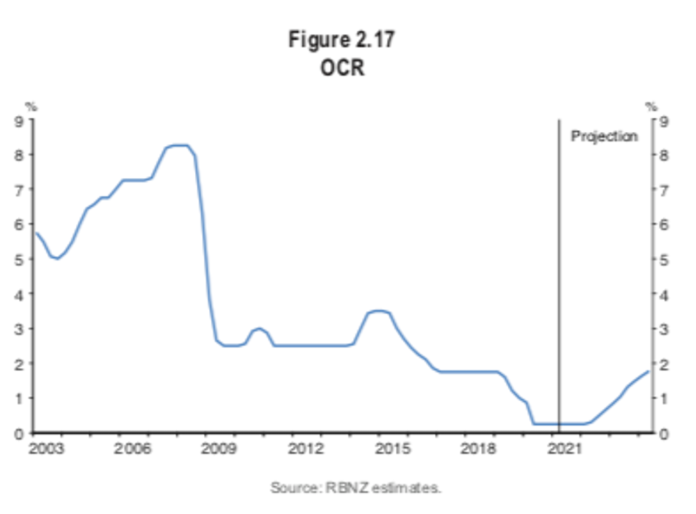
Short-term interest rates could rise sharply within 12 months
Experts at Interest.co.nz said: “Short-term interest rates could rise sharply over the next 12 months. The wisest approach would be for borrowers to act before their existing mortgage rate agreements expire and lock in a fixed rate now for 3, 4 or 5 years. Otherwise, they could face higher financial costs in future.”
Currently, major banks' 2-year fixed rates range from 2.55% to 2.59%,5-year fixed rates are around 3.69%. Ultra-low interest rates have persisted for quite some time, and policymakers at the central bank are looking for the “right” opportunity to change this.
Many also point out that, with the world still facing a pandemic-driven financial crisis, banks are very unlikely to return to the “old normal” by lifting 2-year rates to 5% and 5-year rates to 6.5%. Others, however, note that risks to the economic outlook are tilted upwards, and markets and regulators often overshoot.
To manage the risks of future uncertainty, Interest.co.nz said,
“Borrowers can choose a relatively low, certain interest rate and fix it for 5 years to protect against the risk of impending rate rises.”
Although the OCR target of 2% is still several years away, continued increases in the OCR could push short-term interest rates up by at least 1.75%. On this calculation, the one-year rate of 2.19% would approach 4%, while rates for other terms would approach 5%,longer-term rates are affected by both central bank policy settings and international conditions, making them harder to predict.
If the market collectively pushes short-term lending rates higher, the opportunity to secure today's low rates may not last long. The author recommends seeking advice from a qualified professional, who can help borrowers make the right decision for their financial circumstances.
Conclusion
Ultra-low interest rates are a product of an “exceptional” period in the market and a macroeconomic tool used by the central bank. Once that period passes, policymakers will reconsider and reassess. As the pandemic's global impact diminishes and New Zealand's GDP continues to rise, banks raising mortgage rates is only a matter of time. Current economic developments also point in that direction. For borrowers, a keen understanding of the market is ultimately the key to making a decision.