
The Reserve Bank holds the OCR: relief or another blow for property investors?
Against the backdrop of the Government’s nationwide Alert Level 4 lockdown to combat the outbreak, the Reserve Bank of New Zealand’s Monetary Policy Committee agreed today to maintain the current level of monetary stimulus. In other words, the Official Cash Rate (OCR) will remain unchanged at 0.25%.

Against the backdrop of the Government’s nationwide Alert Level 4 lockdown to combat the outbreak, the Reserve Bank of New Zealand’s Monetary Policy Committee agreed today to maintain the current level of monetary stimulus. In other words, the Official Cash Rate (OCR) will remain unchanged at 0.25%.
In fact, the major banks had been busy in the month before the Reserve Bank announced this seemingly simple decision. Let us review their series of eye-catching moves over the past month or so:
First, after ASB led the way on 14 July by raising its one-year and two-year fixed mortgage rates, the other major banks all raised their one-year and two-year fixed mortgage rates on 16 July. New Zealand’s mainstream media and financial experts immediately exclaimed: “New Zealand’s mortgage market is heading for a sea change!” and “The cycle of increases in the Reserve Bank of New Zealand’s OCR and the major banks’ mortgage rates has begun!”
To explore this, we spoke to several mortgage advisers we knew in late August about where the major New Zealand banks’ mortgage rates might go next. Their answer was that it was “very difficult to predict”, but the unemployment rate due to be released by Stats NZ on 4 August would be an important indicator.
On 4 August, Stats NZ released the latest unemployment figures. Over the three months to 30 June, the unemployment rate fell from its end-of-March level of 4.6% to 4%.
The total number of unemployed people fell by 17,000 to 117,000, a decline of 12.4%. This was the largest fall since Stats NZ began its Household Labour Force Survey in 1986, and the actual unemployment rate was far lower than most economists had forecast before the release!
Many economists then began predicting a substantial OCR increase, warning that a mortgage nightmare could be looming for New Zealand investors!
Yesterday, just before the answer was due, ANZ made another bold move, raising its one-year fixed rate from 3.15% to 3.29%. Rates for terms from 18 months to 5 years also rose, by between 0.10% and 0.30%. For a moment, I thought an OCR increase was certain!
A day later, to the astonishment of all the economists and the major banks, the OCR remained unchanged! Amid this uncertainty, we again contacted Bernard Leung, a well-known, seasoned New Zealand property investor with more than twenty years’ experience and his own distinctive insights into the sector. Perhaps his experience can help us avoid the greatest risks wherever possible.
Mr Leung, how do you interpret the Reserve Bank of New Zealand’s just-announced move today to leave the OCR (Official Cash Rate) unchanged—a decision of this kind?
The Reserve Bank of New Zealand’s Official Cash Rate has remained at the low of 0.25 for 17 months. As everyone had predicted, an announcement raising the OCR was indeed very possible and could have caused considerable trouble for investors. It would be a major shock for 80% or more of mortgage borrowers, who have previously experienced only low or falling interest rates.
Mortgage rate increases resulting from a higher OCR could compound the difficulties of investors already struggling with repayments. But the question is whether the OCR would rise by 25 basis points, 50 basis points or even more.
New homeowners need not worry about a rise of 25 basis points, because the market has already absorbed the impact of those 25 basis points through the major banks’ round of rate increases in July.
Concerns about the sudden outbreak’s impact on New Zealand’s economy meant the OCR was not raised today. But this is only temporary: nobody can guarantee there will not be a substantial increase next time to meet market expectations.

Indeed, if the Reserve Bank of New Zealand next raises the OCR in a single move by 50 basis points or more, would that really mark the beginning of a mortgage nightmare for New Zealand investors?
There is really no need to panic. Lenders generally stress-test buyers at interest rates far higher than those they actually pay. In theory, most homeowners should be able to withstand mortgage rates of at least 6%. For someone with a NZ$500,000 mortgage, every increase of 100 basis points means an extra NZ$416 in interest each month. These homeowners may need to consider how to reduce living expenses, increase income and trim spending.
The Reserve Bank of New Zealand’s aim is not to leave New Zealanders unable to repay their mortgages and create more bad debts for banks. It simply wants to help the Government cool the overheated housing market. There is no need to deal a sweeping blow to all homeowners’ interests.
As an experienced investor, how would you address the potential interest rate risks arising from this collective rate increase by the major banks?
Recently, I have seen many economists suggest that mortgage rates will keep rising, with the OCR potentially exceeding 1% by the end of this year.
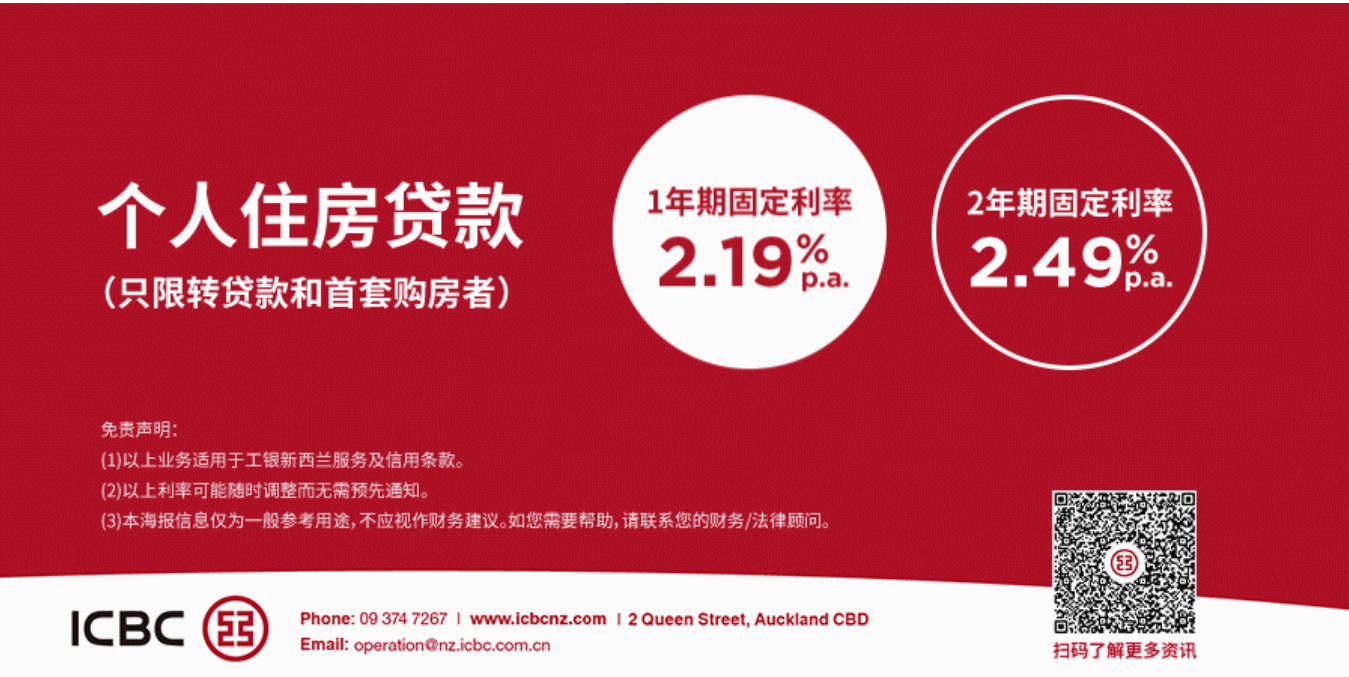
In my view, with interest rates trending upwards, investors need to seize each key opportunity before an increase to lock in the best rate. We can also look beyond New Zealand’s major banks at other banks’ promotional rates—there may be a pleasant surprise! For example, I recently visited the New Zealand International Building Expo & Summit (NZIBES) and discovered that ICBC NZ(Industrial and Commercial Bank of China New Zealand) had recently introduced a one-year fixed mortgage rate of 2.19% per annum and a two-year fixed mortgage rate of 2.49% per annum(available only to first-home buyers or customers refinancing). These were a breath of fresh air while so many banks were raising their one-year and two-year fixed rates. The stand looked very busy, with many Chinese visitors enthusiastically signing up as new customers.

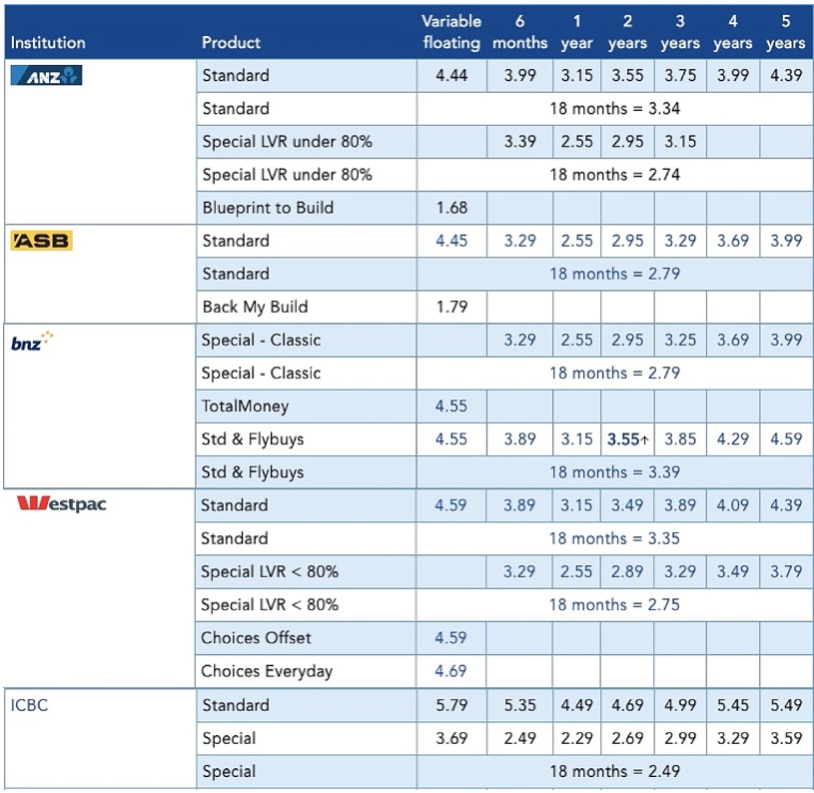
(Source: www.interest.co.nz)
With the market outlook uncertain, many prospective buyers/investors choose to hold on to their cash and wait. How do you view this?
The old saying still applies: investing involves risk, so proceed with care! The Government is currently rolling out a combination of measures to cool the housing market. With the outlook uncertain, I would again urge everyone to invest cautiously. Of course, increases in the OCR and the associated rise in interest rates put pressure on mortgage borrowers but also bring good news for term deposit returns. ASB has raised its annual interest rate on six-month term deposits by 0.2% from 0.8 to 1%, while ICBC NZ offers a 6-month special term deposit at an impressive annual rate of 1.3%(subject to certain conditions), higher than many banks’ one-year term deposit rates.
If I had money on hand and did not know how to invest it in the short term, I would consider products such as high-interest term deposits. If I had cash I intended to invest but was unsure when I would need it, I would also consider smart savings products, such as ICBC NZ’s Smart Saver“Value Savings” which can offer 0.6% per annum.
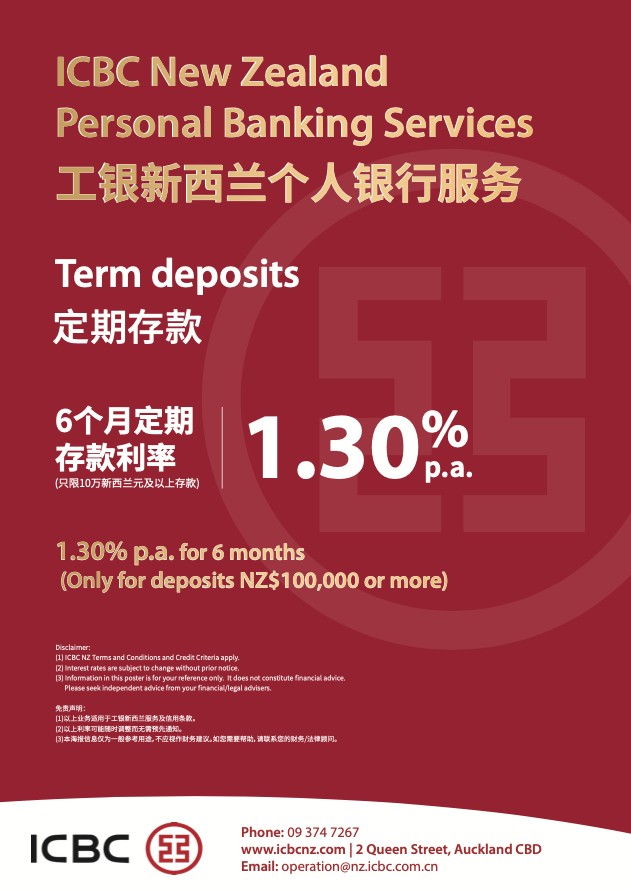
YIJU New Zealand reminds readers that special conditions may apply to this financial product. If interested, please contact ICBC New Zealand:
Phone: 09 3747266
Email: operation@nz.icbc.com.cn
Disclaimer:
(1) The above services are subject to ICBC New Zealand’s service and credit terms.
(2) The above interest rates may change at any time without prior notice.
(3) This information is for general reference only and should not be regarded as financial advice. If you need help, please contact your financial/legal adviser.
The views expressed above are personal opinions provided for reference only. Neither YIJU New Zealand nor ICBC New Zealand accepts any liability.