
Million-dollar townhouses sell out in 48 hours! Your questions about finance for the hottest townhouse market ever, answered in one article!
Last weekend, contracts were signed within 48 hours for all 10 townhouses marketed by Ray White Kemeys Brothers in Days Bay, Wellington. The 10 townhouses are due for completion in 2022. The 3 two-bedroom properties sold for more than $975,000, while the other 7 three-bedroom townhouses sold for $1,200,000 or more.
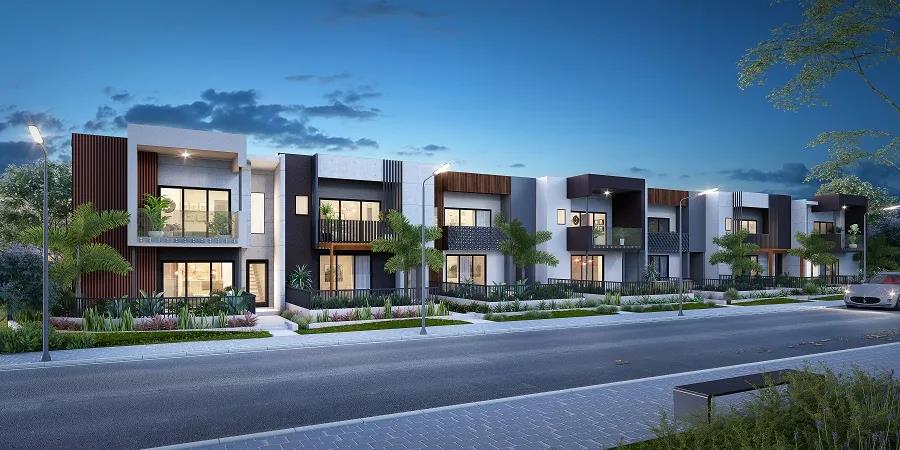
Nationwide lockdown restrictions have not dampened demand in New Zealand's property market. As the market heats up and prices rise, townhouses have clearly become a particularly popular choice.
According to the latest Trade Me Property Price Index, released on 19 August, New Zealand property prices recorded unprecedented growth in July: asking prices for urban properties nationwide, including apartments, townhouses and units, reached a record $697,700. The average asking price for townhouses rose 26% year on year to a record $817,500.
For many young people who cannot afford an existing standalone house on a large section, townhouses have finally offered an opportunity to buy their first home. Many investors choose townhouses because they see them as good value with strong investment returns. Forward-thinking developers recognised their overall advantages and market potential long ago. Data shows that townhouses have accounted for a quarter of all building consents issued in the Auckland region over recent years.
Together, these groups have made investment in townhouse construction a dominant trend in recent years. However, while medium-density housing offers strong returns and promising prospects, it also presents more challenges during construction. Funding is one of the most important elements, with lending especially critical.
YIJU interviewed York Zhang (Zhang Yong), a senior expert at Plaxo Mortgages, to break down and explain the lending issues involved in townhouse development.
{ad}
YIJU: How do banks define small, medium and large townhouse developments?
York:This is a question I often encounter when advising on townhouse construction loans. Generally, bank lending teams use 2 criteria to classify the scale of a townhouse development: the number of dwellings or the monetary value of the project.
When assessing loan applications, banks allocate them to departments with different functions according to the scale of the project, such as residential, business or property finance. Each department has different responsibilities and authority. The higher the level of the department handling an application, the harder it becomes to secure approval, and the more extensive and specialised the documentation required.
Each bank has a different structure and different department names, but departments at equivalent levels across banks perform similar functions. Taking BNZ as an example:
- A development of fewer than 4 townhouses is considered small, and its loan application is handled by the business department;
- Developments of more than 4 townhouses must be handled by the property finance department, with the following classifications:
1) A development of 4–10 dwellings, or valued below ten million dollars, is considered medium-sized;
2) A development of more than 10 dwellings, valued above ten million dollars, or comprising more than 3 blocks, is considered large.
YIJU: What proportion can be borrowed through a townhouse construction loan?
York:Townhouse construction lending is generally calculated in two ways: as a percentage of project cost, known as LTC (land value plus total construction costs), or as a percentage of the project's valuation.
Banks generally lend up to 70% of project cost, or 65% of the project's valuation, excluding GST.
Finance companies generally assess factors such as the development's location and the experience of the construction and management companies involved. A project considered strong may qualify for lending of around 75% of project cost, potentially more for an exceptionally good project. An ordinary project may qualify for around 65% of project cost, while some may qualify for 65% of the project's valuation, excluding GST.
YIJU: How much of my own money do I need to develop a townhouse project?
York:Based on the bank lending proportions discussed in the second question, having your own funds equivalent to 35%–40% of project cost, including the land value and borrowing against it, provides a reasonable margin of security. Construction projects face many uncertainties, so sufficient funding is extremely important. For stronger projects, 30% may also be enough.
YIJU: What difference does it make if the land for a townhouse development is mortgaged or mortgage-free?
York:All construction loans include the cost of the land when calculating project cost. This means that if the land is mortgage-free, the developer has already contributed more of their own funds than if the land were mortgaged.
For example: land value of $800,000 + total construction costs of $1,800,000 = total project cost of $2,600,000.
If the land is mortgage-free, you have already contributed $800,000, meaning 30% of project cost has been paid. As discussed in the second question, banks generally lend up to 70% of project cost, which means the entire construction cost of $1,800,000 could be covered by borrowing. In addition, because the land is mortgage-free, you can draw down a 40% top-up to help prepare for subsequent construction or materials purchases.
If the land is already mortgaged, the amount available to borrow = total project cost × 70% − the outstanding land loan. In this example, assuming a land loan of $300,000, the total available would be $2,600,000 × 70% − $300,000, or $1,520,000. If the land has increased in value, you may also be able to use that increase for a top-up loan. Consult a mortgage adviser to calculate the specific amount available for your circumstances.
YIJU: If I have funds available, can I build part of the project myself first and apply for a loan once my money runs out?
York:It is best to avoid this approach, as the risk of being unable to obtain a loan later is extremely high.
Generally, all development projects must apply for lending before construction begins. Once the loan is approved, you can allocate your own funds appropriately in line with the bank's requirements.
Banks generally will not approve loans for projects that have already started construction and subsequently need more money. This is one way banks manage risk. For example, a project that is only a third or halfway built has a very low chance of securing a loan. If most costs have already been paid and there is only a shortfall for completion, lending may still be possible.
It is best to avoid this approach, as the risk of being unable to obtain a loan later is extremely high.
Generally, all development projects must apply for lending before construction begins. Once the loan is approved, you can allocate your own funds appropriately in line with the bank's requirements.
Banks generally will not approve loans for projects that have already started construction and subsequently need more money. This is one way banks manage risk. For example, a project that is only a third or halfway built has a very low chance of securing a loan. If most costs have already been paid and there is only a shortfall for completion, lending may still be possible.
YIJU: Townhouse construction loans must meet the bank's pre-sale requirements for the project. What exactly are those requirements?
York:There are generally two possibilities: a required pre-sale value or a required number of pre-sold dwellings.
Value requirement: banks generally require pre-sales equal to the loan amount. In other words, borrowing $10,000,000 requires pre-sales worth $10,000,000, excluding GST. Depending on the project's quality and risk assessment, the bank may require pre-sales worth 120%–200% of the loan amount. This means borrowing $10,000,000 may require pre-sales of $12,000,000–$20,000,000 before the bank releases funds.
Dwelling-count requirement: more than 50% of the total dwellings must be pre-sold. For example, a development of 10 townhouses would need more than 5 pre-sales. This requirement is generally intended to assess the proportion of borrowing relative to development cost.
The following points also need attention in banks' pre-sale conditions:
1) To manage risk strictly, banks impose requirements on the project's lawyer in relation to pre-sale terms. Developers must use a bank-approved lawyer with experience in pre-sale terms. Otherwise, the bank will require the client to change lawyers.
2) Banks also impose strict requirements on sunset dates to manage risk. They require lawyers to allow as much time as reasonably possible before the sunset date. For example, a developer may be certain that a large townhouse project can be completed in a year and a half, but the bank, drawing on risk controls and years of experience, may consider that it needs at least 2 and a half years. The developer must then extend the contractual sunset date to 2 and a half years. Extensions for the effects of the pandemic or other force majeure events will also be required, and provisions allowing the sunset date to be extended for these unforeseen events will be included in the contract.
3) Banks also impose strict requirements on pre-sale counts. Only 2 purchases per buyer are recognised. In other words, if a seller is building 100 townhouses, purchases attributable to each seller are counted up to a maximum of 2: buying 3 still counts as 2, and buying 5 still counts as 2. This is a bank risk-control measure to guard against fabricated pre-sale numbers.
YIJU: If I do not want to pre-sell, is a finance company my only option? Can a finance company release the loan in a single payment?
York:Yes. Bank construction loans for townhouses intended for commercial purposes require pre-sales. If you do not want to pre-sell, you can choose a finance company. All construction loans are released in stages; neither banks nor finance companies release the entire loan at once.
A substantial lump-sum advance may only be possible if the applicant has other mortgage-free properties, such as their own home or investment properties, that can be offered as additional security.
YIJU: My development involves several townhouse blocks being built together. For example, I might develop 3 blocks simultaneously, with 4 townhouses at the front, 6 behind them and another 8 at the rear. Is it easier to obtain a loan to build them all together, or to finance each row separately?
York:First, let us clarify the premise: a single project on a single site, comprising 3 or more blocks.
Whether you can borrow separately depends on whether the project shares a consent and whether the titles will ultimately be issued together.
If the consent covers the whole project, you cannot borrow separately. If titles for the front block cannot be issued until the rear blocks are completed, you cannot borrow separately either.
This is a very complex issue. A professional lending manager needs to examine the consents, contracts, project plans and other documentation individually. Otherwise, there is a real risk that titles cannot be obtained later, causing funding to run out.
About the expert
York Zhang (Zhang Yong)
Chairman of Plaxo Mortgages
In 2006, York Zhang (Zhang Yong) founded Plaxo Mortgages to provide the Chinese community with lending for homes, construction, businesses, land development, vehicles and heavy equipment. Combining his professional mortgage-advisory knowledge with his personal experience of living in New Zealand, York Zhang hopes to use Plaxo Mortgages to introduce more products suited to the Chinese community's needs and circumstances, train more outstanding mortgage advisers, and release more equity from their assets for reinvestment.